HARARE: Zimbabwe’s ruling party expressed confidence Monday that longtime President Robert Mugabe could be impeached within two days, while the world’s oldest head of state ignored the party’s midday deadline to resign.
As ruling party lawmakers began meeting on impeachment plans, deputy secretary for legal affairs Paul Mangwana said they would move a motion for impeachment on Tuesday and set up a parliamentary committee, and on Wednesday the committee would report back to all lawmakers and “we vote him out.”
The main charge against the 93-year-old Mugabe is “allowing his wife to usurp government powers” and that “he is too old and cannot even walk without help,” Mangwana told reporters.
He said the ruling ZANU-PF party needs the backing of the MDC opposition group to have enough votes in Parliament but “we have talked to them and they are supporting us.”
Zimbabweans were stunned by Mugabe’s defiance during a national address Sunday night in which the increasingly isolated president, put under military house arrest last week, had been expected to step down. Mugabe did acknowledge “a whole range of concerns” about the chaotic state of the government and the economy, which has collapsed since he took power after independence from white minority rule in 1980.
The military appears to favor a voluntary resignation for Mugabe, one of Africa’s last remaining liberation leaders, to maintain a veneer of legality in the political transition and avoid accusations of a coup. Mugabe, in turn, is likely using whatever leverage he has left to try to preserve his legacy or even protect himself and his family from possible prosecution.
Amid the political confusion, the government on Monday urged Cabinet ministers to pursue business as usual. Meanwhile, opposition activists and the influential liberation war veterans association announced more demonstrations to pressure Mugabe to go.
“Your time is up,” veterans association leader Chris Mutsvangwa said at a press conference. He suggested that the military was still beholden to Mugabe and compelled to protect him because he is officially their “commander in chief.”
The war veterans’ association will go to court to argue that Mugabe is “derelict of his executive duty,” Mutsvangwa said.
Mugabe was stripped of his party leadership on Sunday by the ruling party’s Central Committee but said in his speech he would preside over a party congress next month.
That congress is expected to ratify his firing as party chief, the expulsion of the unpopular first lady and the naming of Mugabe’s recently fired deputy, Emmerson Mnangagwa, to succeed him.
The firing of Mnangagwa and the positioning of first lady Grace Mugabe to succeed her husband as president led the military to step in last week. Mugabe has discussed his possible exit on two occasions with military commanders.
Some people in the capital, Harare, have become more cautious about talking to reporters. That contrasted with the jubilation and open condemnation of Mugabe over the weekend, when the bulk of Harare’s population of roughly 1.6 million appeared to be in the streets, dancing and taking selfies with soldiers in an event backed by the military.
At the University of Zimbabwe, students protested and refused to sit for exams, demanding that Mugabe step down. The spokesman for the Zimbabwe National Students Union, Zivai Mhetu, said they want all universities shut down until he does.
The once-formidable Mugabe is now virtually powerless, largely confined to his private home by the military.
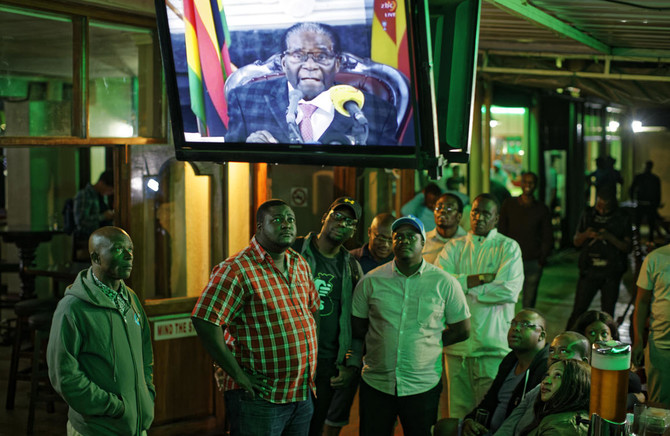
Yet he sought to project authority in his speech Sunday night, which he delivered after shaking hands with security force commanders. The army commander himself leaned over a couple of times to help the president find his place on the page he was reading.
“I, as the president of Zimbabwe, as their commander in chief, do acknowledge the issues they have drawn my attention to, and do believe that these were raised in the spirit of honesty and out of deep and patriotic concern for the stability of our nation and for the welfare of our people,” Mugabe said.


![]()
Zimbabwe’s Mugabe could be impeached in 2 days, ruling party says
Zimbabwe’s Mugabe could be impeached in 2 days, ruling party says

Latest updates


© 2026 SAUDI RESEARCH & PUBLISHING COMPANY, All Rights Reserved And subject to Terms of Use Agreement.