LONDON: A driverless, electric car is only a swipe away in the cities of the future, where pollution clampdowns and rapid advances in technology will transform the way we travel, despite lagging infrastructure.
As more and more countries announce a phasing-out of pure petrol and diesel cars, early versions of tomorrow’s models are already on the streets: Hybrid cars, fully electric motors and vehicles that can partially drive themselves.
Attitudes to vehicle ownership in cities are changing as smartphone apps make a ride available in minutes.
David Metz, of the Center for Transport Studies at University College London, believes developed cities have reached “peak car,” with ownership no longer associated with increasing prosperity.
Metz said city planning was changing to temper the vehicle access once thought vital.
“We now see high-density urban areas are more successful with less traffic,” he said, citing London’s car-free Leicester Square entertainment district and the Canary Wharf financial hub.
Cars could be phased out of city centers altogether, as urban planners ditch the 20th-century, car-focused grid-plan model for city streets.
Private cars, sitting idle for 23 hours a day, might be eclipsed by car-pool clubs, journey-sharing apps or one-trip rental cars as seen in cities around the world from Berlin to Istanbul to Vancouver.
Driverless technology also looks set to revolutionize urban road travel, according to industry figures.
Graeme Smith, chief executive of Oxbotica, a British company developing autonomous vehicle software, said new cities being planned in China envision all vehicles being electric, autonomous and publicly-owned.
“In those cities, your life would be fundamentally different,” he told AFP.
“50 years into the future, maybe these things will be driving everywhere by themselves — but there’s a progression to go through.”
Driverless technology faces the challenge, over time, of bringing down the cost of sensors while improving their performance — and there is currently no standard operating methodology.
Some cars with levels two and three autonomy are already on the roads.
Britain’s Transport Secretary Chris Grayling said he expected the first level four self-driving cars to reach the UK market by 2021, bringing the world closer to level five, or total autonomy.
Fully driverless cars could help ease gridlock by driving closer together in convoy and avoid traffic by exchanging real-time information.
The switch to electric vehicles (EVs), meanwhile, is already well underway.
Volvo will no longer sell solely diesel or petrol cars from 2019, while Volkswagen’s Audi brand is gearing up to offer an electric version of every one of its models.
Britain and France intend to ban the sale of fully petrol or diesel cars from 2040, while smog-plagued India wants to sell only electric cars by 2030.
— AFP


Driverless cars just round the corner
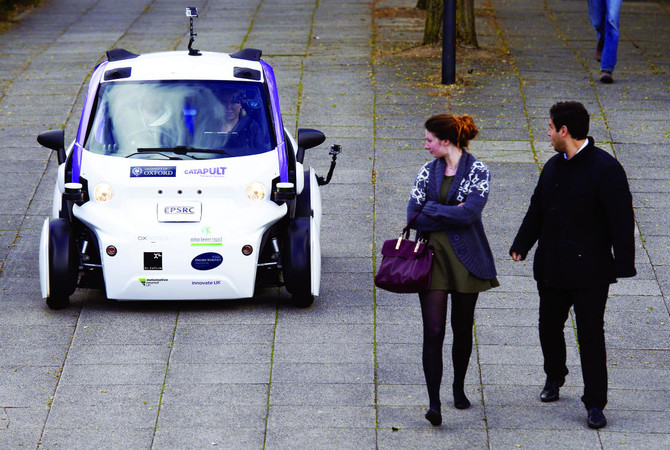
Driverless cars just round the corner

Major airlines suspend, reroute flights amid US-Israel strikes on Iran
- Saudia says decision taken in line with aviation safety and security standards
- Emirates said it temporarily suspended it's operations out of Dubai
RIYADH: Major international airlines across the Middle East and South Asia have suspended, canceled or rerouted flights following ongoing US-Israel attacks on Iran and the resulting airspace closures, according to official statements issued via X.
Saudia said in an official statement that it had canceled a number of flights due to developments in the region and the closure of airspace.
The airline said the decision was taken in line with aviation safety and security standards, noting that its Emergency Coordination Center is closely monitoring developments with relevant authorities.
Saudia urged passengers to verify the status of their flights before heading to the airport and said guests would be notified of updates through the contact details associated with their bookings.
The carrier added that further information would be announced in a subsequent statement if available.
بيان رسمي من #الخطوط_السعودية pic.twitter.com/CHfjKj9yLX
— Saudia Group | مجموعة السعودية (@SaudiaGroup) February 28, 2026
Air Arabia said its flights were experiencing cancellations, delays or rerouting as a result of the evolving situation and airspace closures.
The airline advised passengers to check the status of their flights before traveling to the airport by visiting its website or contacting its call center.
Customers booked on affected flights will be notified directly, the airline said, adding that further updates would be provided as the situation develops.
Air India announced a broader suspension, stating that “in view of the developing situation in parts of the Middle East, all Air India flights to all destinations in the Middle East have been suspended.”
The airline said it remains committed to maintaining the highest standards of safety for passengers and crew and will continue to assess the safety and security environment for flight operations, adjusting services proactively as required.
Air India said its teams would extend necessary support to passengers and advised customers to check flight status online or contact its 24/7 call center for assistance.
#TravelAdvisory
— Air India (@airindia) February 28, 2026
In view of the developing situation in parts of the Middle East, all Air India flights to all destinations in the Middle East have been suspended. We remain committed to maintaining the highest standards of safety for our passengers and crew. We will continue to…
All flight operations at Dubai International and Dubai World Central – Al Maktoum International are suspended until further notice, according to a post by Dubai Media Office on X.
Dubai-based Emirates reported that regional airspace closures had caused disruption to several of its flights and that the airline had temporarily suspended its operations from its hub Dubai.
The airline said it is actively monitoring the situation, engaging with relevant authorities and adjusting operations in line with the latest developments.
The carrier apologized to affected customers and said it is assisting them with rebooking, refunds or alternative travel arrangements, reiterating that the safety and security of passengers and crew remain its highest priority.
Due to multiple regional airspace closures, Emirates has temporarily suspended operations to and from Dubai.
— Emirates Support (@EmiratesSupport) February 28, 2026
Emirates urges customers to check https://t.co/Ucm3UswfVh and https://t.co/yehFUeWZQq for the latest updates before proceeding to the airport.
We are actively monitoring… pic.twitter.com/SLDC7iNaUN
Qatar Airways confirmed a temporary suspension of flights to and from Doha due to the closure of Qatari airspace.
The airline said it is working closely with government stakeholders and relevant authorities to support impacted passengers and will resume operations once the airspace reopens.
It warned that delays are anticipated when usual operations resume and said additional ground staff have been deployed at Hamad International Airport and other key airports to assist passengers.
Temporary Suspension of Qatar Airways Flights due to Qatari Airspace Closure
— Qatar Airways (@qatarairways) February 28, 2026
Qatar Airways Group confirms the temporary suspension of its flights to, and from, Doha due to the closure of Qatari airspace.
The airline is working closely with government stakeholders and the…
Meanwhile, Al Jazeera reported that British Airways had canceled flights to Tel Aviv and Bahrain, adding to the list of carriers adjusting operations.
Across their statements, airlines consistently cited airspace closures and safety considerations as the primary reasons for suspensions and disruptions, while urging passengers to monitor official channels for updates as the situation continues to evolve.


