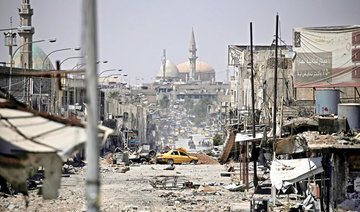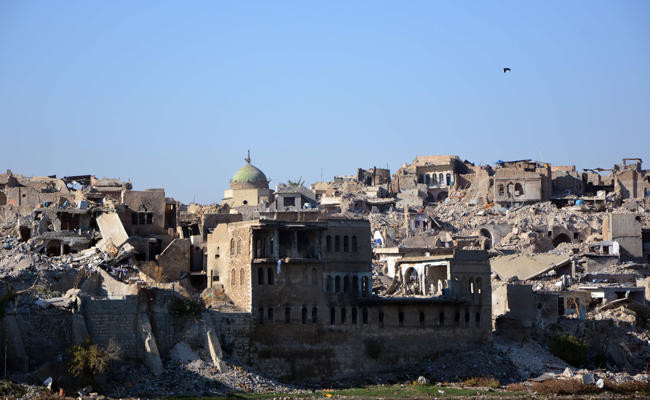
BAGHDAD: The war does not seem to end in this part of the world. The smell of death emanates from every corner and the almost complete destruction dominates the area. It used to be the heart of the capital of Daesh in northern Iraq for almost three years.
Constant movement takes place in the nearby districts to renovate the houses and shops, which indicates that people are getting rid of their trauma and trying to restore a small part of their normal lives.
The alleys of the Old City still show all the war details: Broken furniture, torn clothing, smashed cars and the bodies of militants under the rubble of homes and buildings. They all tell the story of the 142 terrifying days experienced by residents before the Iraqi security forces and their backers terminated the Daesh fighters who fiercely resisted until death.
“I saw seven corpses just yesterday (Saturday) in Sha’arien Market in the Old City,” says Hilal Mahmoud, 27, who has documented the work of the civil defense teams evacuating the bodies of civilians buried under rubble.
“I was with two of my friends. One of them was taking selfies with the corpses, the second one felt disgusted and was coughing strongly, but for me it was a very normal view,” Hilal said. “I cannot feel sorry when I remember their iron grip and tyranny, and how they used to kill us."
Mosul is the capital of Nineveh Province, the second largest Iraqi city in terms of population. The Tigris River divides the city into two sides, western and eastern. The western side consists of around 100 districts. Most of the houses in these districts are old, fenced and converged, separated by narrow alleys that do not allow passage of wheels, so it is called the Old City.
The Old City used to host the largest population group controlled by Daesh. Weapon warehouses, the headquarters of Daesh's command and control and the hideouts of its senior leaders were all in this part of the city, residents and local officials told Arab News.
The military operations to liberate the western side of Mosul lasted for 142 days before the Iraqi Security Forces announced that the area was free of Daesh on July 10.
Thousands of civilian bodies have been retrieved since July. More than 11,500 houses, shops and buildings were destroyed by the aerial bombardment carried out by the US-led coalition forces and the suicide bombings carried out by Daesh fighters. A further 25,000 houses were partially damaged, Mosul local government records obtained by Arab News show.
Although four months have passed since the liberation of the area, it is still closed and people who have no security permission cannot get in. The corpses of Daesh fighters can be easily identified as most are still wearing their armor and their waists are encircled by military belts used to carry ammunition.
Hundreds of bodies are still trapped under the rubble in the Old City — the civil defense teams cannot pull them out because of the bobby traps, improvised explosive devices and car bombs that have been left behind by the militants. Many members of the civil defense teams were killed while trying to evacuate victims' bodies, local officials told Arab News.
Mosul’s local authorities do not have the required machines or financial resources to carry out operations to rescue victims' bodies without causing casualties, officials said.
“The problem is still mainly in the Old City because of the bobby traps. We have been receiving information from people about their relatives (who are still under the rubble),” Abdulsattar Al-Habu, the head of Mosul’s Municipality, told Arab News.
“At present, we do not care for (the bodies of) Dawa’ash (Daesh fighters). We cannot evacuate the corpse of a dirty Daeshi and lose an Iraqi citizen,” Habu said. “When the machinery and financial allocations are available, we will get them out.”
Iraqi military commands said that more than 25,000 militants, including 450 suicide bombers, were killed during the military operations to liberate Mosul, but neither the civil, federal and local authorities nor the military one revealed the exact numbers of casualties among civilians. A local senior official, on condition of anonymity, told Arab News that the civil teams had evacuated more than 3,800 civilian bodies until two months ago, before the local authorities received orders not to disclose any details on the number of victims.
Civil defense officers working in Mosul reached by Arab News said they had received almost daily reports from the relatives of families still under the rubble, but refused to give any numbers relating to the bodies they had evacuated during the past three months. They said that the removal of bodies left in the streets was the task of the teams of the Ministry of Health and the municipality of Mosul as their mission was restricted to retrieving the bodies of civilians from the rubble.
“We still carry out a mission or two on a daily basis, based on the reports presented by people. They (the relatives) guide us to determine the locations (of their relatives' bodies),” Col. Hossam Khalil, commander of a civil defense team operating in Mosul, told Arab News.
“(Evacuating) the corpses out of the rubble is not a part of our duty. People do not inform us about these (Daesh fighters') bodies,” Khalil said.