

Pakistan says it backs Gaza peace plan, hopes next phase leads to Palestinian state

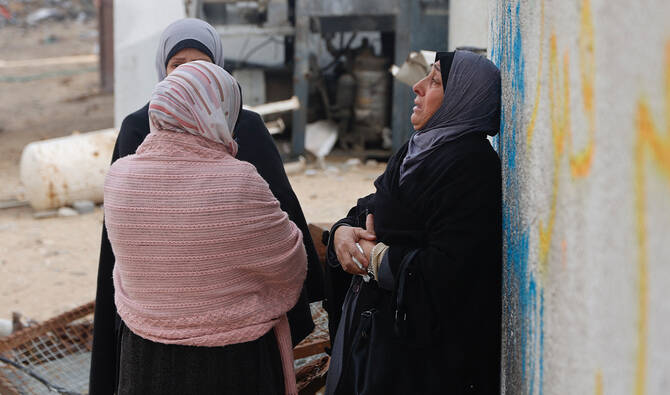
Palestinian women mourn during the funeral of three displaced members of the Hamoda family who died after parts of a war-damaged building where they had taken shelter collapsed on a windy winter day in Gaza City on January 13, 2026. (AFP/File)
Short Url
Updated 15 January 2026
Follow

Pakistan says it backs Gaza peace plan, hopes next phase leads to Palestinian state

  • Foreign Office says it is not concerned about who joins or stays out of the Abraham Accords
  • Pakistan reaffirms rejection of Israel’s recognition of Somaliland, warns of regional instability

ISLAMABAD: Pakistan’s Foreign Office said on Thursday it supported the Gaza peace plan endorsed by the United Nations Security Council, expressing hope its next phase would stabilize the situation in the war-ravaged territory, scale up humanitarian assistance and lead to an independent Palestinian state.

The United States said on Wednesday it was moving into the next phase of a Gaza ceasefire plan. President Donald Trump’s Middle East envoy Steve Witkoff said in a post on X that the second phase will establish “a transitional technocratic Palestinian administration in Gaza” and mark the beginning of “the full demilitarization and reconstruction of Gaza, primarily the disarmament of all unauthorized personnel.”

Commenting on the development, Foreign Office Spokesperson Tahir Andrabi said Pakistan had taken note of the announcement.

“We have seen this social media post about the next phase of the ceasefire agreement in Gaza, and we express the hope that these steps will lead to further stabilization of the situation, and upscaling the humanitarian assistance and end of the sacrifices of the people,” he said while addressing his weekly news conference.

Andrabi said Pakistan had been engaged in the Gaza peace effort as part of a group of Arab and Islamic countries since the initiative was presented by the US president and supported both the plan and the UN Security Council resolution endorsing it.

“We also hope that these efforts will lead to a credible time bound, political process consistent with international legitimacy and relevant UN resolutions to establish an independent, sovereign, contiguous state of Palestine, based on pre-1967 borders with East Jerusalem as its capital,” he added.

Asked about Pakistan’s position on the Abraham Accords, a series of US-brokered agreements normalizing relations between Israel and several Arab states, Andrabi said Islamabad’s stance remained unchanged.

“Our position with respect to it is that there are certain benchmarks that have to be achieved ... And [these relate do] a viable, contiguous state of Palestine, with East Jerusalem as its capital.”

He said Pakistan did not judge other countries’ choices on the accords.

“We are not concerned about who does or who does not join the Abraham Accords,” he said.

SOMALILAND ISSUE

Earlier in his opening remarks, Andrabi reiterated Pakistan’s rejection of Israel’s recognition of Somaliland, a self-declared breakaway region of Somalia, calling the move illegal and warning it could destabilize the Horn of Africa and Red Sea region.

Somaliland declared independence from Somalia in 1991 but is not recognized by the United Nations or the African Union.

Israel’s recent steps to recognize the territory have drawn criticism from Somalia and several Muslim-majority countries.

Pakistan’s Deputy Prime Minister and Foreign Minister Ishaq Dar raised the issue during the 22nd Extraordinary Session of the Organization of Islamic Cooperation Council of Foreign Ministers held in Jeddah on Jan. 10.

“In his address, the DPM-FM strongly condemned the illegal and unlawful recognition by Israel of the Somaliland region, as well as subsequent unwarranted and highly provocative visits of Israeli officials to the territory,” the Foreign Office spokesman said.

“He termed such acts as political aggression and a direct assault on Somalia’s internationally recognized borders, setting a perilous precedent and threatening peace and security in the Horn of Africa, the Red Sea region, and beyond.”

Andrabi said Dar also addressed the Palestinian issue during the session, rejecting proposals for the displacement of Palestinians and reaffirming Pakistan’s long-standing support for a two-state solution.


Curfew extended in Gilgit-Baltistan, probe ordered after deadly Khamenei protests

Updated 6 sec ago
Follow

Curfew extended in Gilgit-Baltistan, probe ordered after deadly Khamenei protests

  • At least 15 people were killed in clashes with law enforcement agencies over the weekend in Gilgit-Baltistan
  • Government also announces a de-weaponization campaign, crackdown on hate speech and cybercrime in region

ISLAMABAD: The government in Pakistan’s Gilgit-Baltistan (GB) region on Tuesday extended a curfew in Gilgit district and ordered a judicial probe into violent protests over the killing of Iranian Supreme Leader Ali Khamenei in US-Israeli strikes last week, an official said.

At least 15 people were killed in clashes with law enforcement agencies over the weekend in GB, where protesters torched and vandalized several buildings, including United Nations regional offices, an army-run school, software technology park and a local charity building.

The violence prompted regional authorities to impose curfew in Gilgit and Skardu districts on March 2-4 as officials urged people to stay indoors and cooperate with law enforcers, amid widespread anger in Pakistan, particularly among members of the Shiite minority, over Khamenei’s killing.

On Tuesday, the GB government convened to review the situation and announced the extension of curfew in Gilgit among a number of security measures as well as ordered the establishment of a judicial commission to investigate the weekend violence in the region.

“The government has made it clear that the law will strictly take its course against elements involved in vandalism at government institutions, private properties and incidents of vandalism in Gilgit and Skardu and no kind of mischief will be tolerated,” Shabbir Mir, a GB government spokesperson, said in a statement.

“In view of the security situation, curfew will remain in force in Gilgit, while the decision to extend the curfew in Skardu will be taken keeping the ground realities and the changing situation in view.”

The statement did not specify how long the curfew will remain in place in Gilgit.

Besides the formation of the judicial commission to investigate the violent clashes, the government also decided to launch a large-scale de-weaponization campaign in the entire Gilgit district, for which relevant institutions have been directed to immediately complete all necessary arrangements, according to Mir.

In addition, a crackdown has been ordered on hate speech, spread of fake news and cybercrime.

“The aim of these decisions is to ensure the rule of law, protect the lives and property of citizens and crack down on miscreants,” he said. “Approval has also been given to immediately survey the affected infrastructure and start their restoration work on priority basis.”

Demonstrators in Pakistan’s southern port city of Karachi also stormed the US Consulate on Sunday, smashing windows and attempting to burn the building. Police responded with batons, tear gas, and gunfire, leaving 10 people dead and more than 50 injured.

Pakistani authorities have since beefed up security at US diplomatic missions across the country, including around the US consulate building in Peshawar, to avoid any further violence.