FIFA officials took bribes for Qatar 2022 votes, court hears

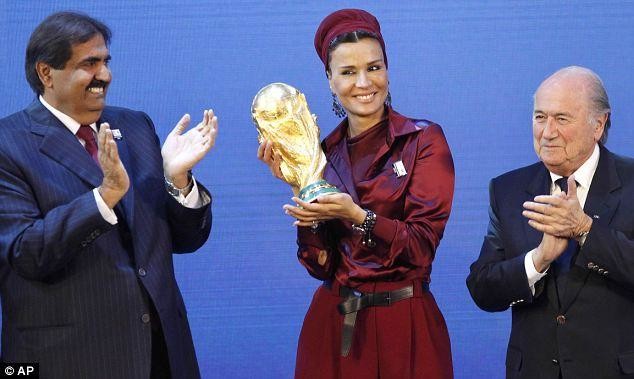
Qatar’s Sheika Mozah bint Nasser Al-Misned holds the World Cup trophy as the emir Sheikh Hamad bin Khalifa Al-Thani (left) applauds following the controversial announcement in 2010. (AP)
Updated 16 November 2017
Follow

FIFA officials took bribes for Qatar 2022 votes, court hears

DUBAI: The investigation into corruption at FIFA has heard how a senior official took bribes of at least $1 million in return for voting for Qatar to host the 2022 World Cup, UK national daily The Guardian reported.
It is claimed that Senior Vice President at FIFA and head of the Argentinian football association until he died in 2014, Julio Grondona, told witness, Argentinian sports marketing executive, Alejandro Burzaco, he was owed the money by way of payment for his vote, which helped Qatar secure the 2022 tournament.
The claims are some of the strongest evidence supporting allegations that the 2022 vote was corrupt, since Qatar won the vote, the hearing in a New York City court heard on Tuesday.
Former CEO of the Argentinian sports marketing executive Torneos y Competencias, Burzaco, has admitted paying millions of dollars in bribes to senior South American football officials for the broadcast rights of major regional tournaments.
On Tuesday he gave testimony claiming a sustained program of bribes – often in excess of $1 million – both annual and one-off, over a 10-year period.
He said he accepted a bribe for his World Cup vote. He said he also secured $15 million in bribes for various parties to secure the Copa America, the hearing heard.
Burzaco said that as voting was under way for the 2022 tournament, Nicolás Leoz, the then Conmebol president, who had taken bribes, had voted for Japan and South Korea.
He said it was during a break that senior FIFA executive, Ricardo Teixeira and he took Leoz to one side “to shake him up” and ask “What the hell are you doing? Are you the one not voting for Qatar?”
On their return, Leoz complied with the conspiracy to vote for Qatar.
The officials deny their part in the claimed corruption which it is alleged carried on for 24 years and involved approximately $150 million in bribes, the hearing has heard.
The trial also heard that several major broadcasters were implicated in bribery claims for broadcasting rights.
The trial continues.


Most women’s national team players earn less than $20,000, FIFPRO study shows

Updated 9 sec ago
Follow

Most women’s national team players earn less than $20,000, FIFPRO study shows

  • Some 66 percent of players earn below $20,000 annually from football
  • Nearly one-third of respondents reported earning between $0 and $4,999 from football

MANCHESTER: Two-thirds of women’s national team players earn less than $20,000 annually, according to a new FIFPRO survey that highlights persistent financial insecurity and structural gaps in the women’s game.
The global players union and affiliated national players unions surveyed 407 footballers from 41 nations who participated in the UEFA Women’s Euros, Copa America Femenina, the Women’s Africa Cup of Nations and the OFC Women’s Nations Cup.
Some 66 percent of players earn below $20,000 annually from football and nearly one-third of respondents reported earning between $0 and $4,999 from football, while only a small minority reached higher income brackets.
Professional clubs remain the main source of income, followed by national team payments, yet one in four players still rely on jobs outside football to make ends meet.
“Financial stability is a cornerstone of any career,” said FIFPRO’s Director of Women’s Football Alex Culvin. “The data is very clear: most players are earning insufficient income to ensure secure careers within the game.
“It is a risk to the sustainability of the sport because players will be inclined to leave football early to make ends meet.”
The survey, conducted between August and October, also revealed short-term contracts remain common: 33 percent of players were signed for one year or less, and 22 percent had no contract at all.
International competition schedules continue to strain players, with 58 percent saying pre-match rest was inadequate and 57 percent reporting insufficient recovery after games.
Travel conditions are also an issue, with three-quarters of players flying economy class during tournaments, with only 11 percent in premium economy or business.
While FIFPRO noted improvements since their 2022 survey – including increased prize money and a player-dedicated share at the Women’s Euros – similar reforms have not been replicated across other confederations.
Culvin said stakeholders must “continue to raise standards to support the increased professionalization of the women’s game.”