

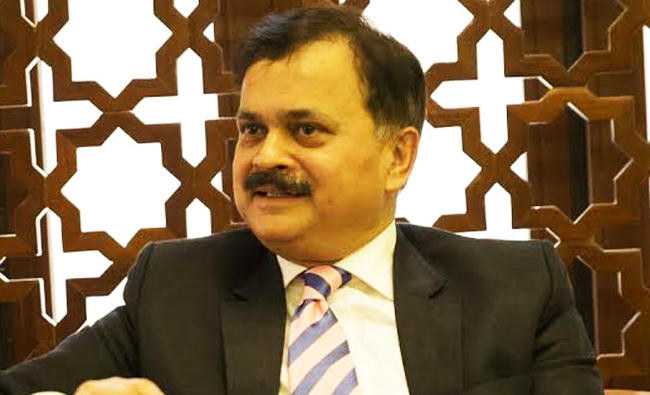
Indian expats in Saudi Arabia not affected by fees imposed on dependents, ambassador says

Indian Ambassador Ahmed Javed said that Jubail and Jeddah have the largest proportion of Indian workers in Saudi Arabia.
Updated 12 November 2017
Follow

Indian expats in Saudi Arabia not affected by fees imposed on dependents, ambassador says

JUBAIL: Indian Ambassador Ahmed Javed said that the Indian community in Saudi Arabia has not been affected by the family fees imposed on dependents of expatriates.

Javed told the Sabq news website that a large proportion of Indian expatriates came to the Kingdom without their families; therefore, the effect of the newly imposed family fees on them was minimal.

He also said Jubail and Jeddah have the largest proportion of Indian workers in Saudi Arabia, whose total number comes to about 3.2 million, and who work in different areas across the Kingdom.

Javed said the Indian Embassy always responds to the needs of Indian expatriates, and it recently opened a visa and passport office in Jubail in order to serve Indian expatriates in the area.

This came on the sidelines of the celebration which was held on Friday in Jubail to mark the arrival of the Indian Coast Guard ship Samarth to Jubail Commercial Port on a three-day visit which aims to enhance cooperation between the Indian Coast Guard and Saudi maritime authorities and hold joint exercises.

In this context, Javed said that he was “pleased with the cooperation between India and Saudi Arabia in the military and maritime fields. The target of the visit is the exchange of expertise between the two countries and conducting joint exercises.”
This is the first visit of the Samarth to the Kingdom, and a number of reporters attended the press conference held on board the ship.

The Samarth is participating in joint programs with the Saudi marine and equipment services during the three-day visit, including responding to marine pollution, search and rescue, and law enforcement.

The ship is accompanied by 25 officers and 115 employees, and it is currently based in Goa on the west coast of India.


‘Cake not hate’ campaign becomes ‘Dates not hate’ in Madinah

“The Joshie-Man” and his father Dan Harris in the courtyard of the Prophet’s Mosque in Madinah. (Supplied)
Updated 02 February 2026
Follow

‘Cake not hate’ campaign becomes ‘Dates not hate’ in Madinah

  • Dan said he was very impressed by Saudi hospitality and that his family was warmly welcomed
  • He said being in Madinah exposed him to the true diversity of Islam

LONDON: A British autistic and non-verbal boy who has been visiting UK mosques and distributing cakes to promote solidarity amid an increase in far-right support in the country has taken his message of love to Madinah.

Joshua Harris, or “The Joshie-Man” as the 12-year-old is known to his social media fans, has handed out hundreds of his baked goods to worshipers at mosques in major British cities over the last few months.

The “Cake not hate” campaign came about after an Islamophobic attack on a mosque in his home city of Peterborough in October 2025.

Harris and his father visited Masjid Darassalaam, the mosque that was targeted, with cakes that the boy had baked and distributed them to the congregation soon after the attack. Since then, Harris has visited dozens of mosques in the UK.

On a recent trip to the Middle East, he and his father visited Madinah. In a local twist that pays tribute to the holy city’s famous date varieties including ajwa and ambar, Harris handed out dates to people in the courtyard of the Prophet’s Mosque. The “Cake not hate” campaign became “Dates not hate” for Saudi Arabia.

“He was greeted really, really warmly. There were some really touching moments where people were kissing his hands and his head. It was really lovely,” his father, Dan Harris, said.

Dan, the founder of global charity Neurodiversity in Business, said being in Madinah exposed him to the true diversity of Islam.

“We met people from all around the world. It was amazing. It’s like the United Nations there, you get people from different countries and it just goes to show you that the Muslim community, or the Ummah more generally, is not a homogeneous group,” he said.

“We saw people from Tajikistan and Uzbekistan and it was really interesting for us.”

Dan said his visit to Madinah, considered the second holiest city in Islam after Makkah for Muslims, was “profound and life-changing.”

He added: “I would say it’s my favourite city in the world due to the peace and tranquillity I felt there.”

Dan added that he was very impressed by Saudi hospitality: “Everywhere we went, people were taking down my number and insisting that we come for dinner, insisting they pick us up from the location. They were extremely attentive to Joshie as well, making sure his needs were met. We felt a great sense of welcome, something Saudi Arabia is known for.”