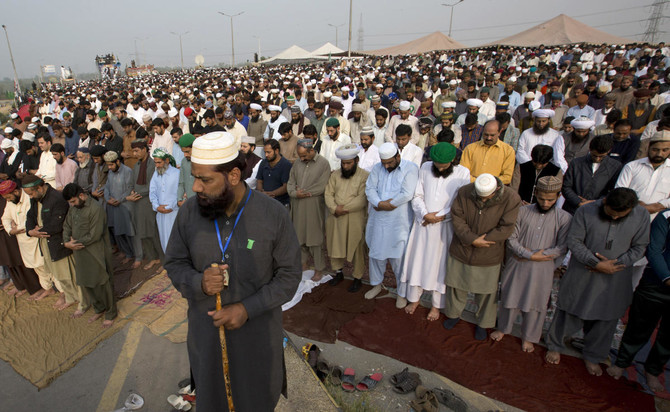
RAWALPINDI: Pakistan on Friday blocked off roads into Islamabad, the capital, as an Islamist party that backs strict blasphemy laws staged a sit-in on a key highway, demanding the resignation of a minister it blames for changes to an electoral oath.
Dozens of Pakistanis are on death row, convicted of having insulted Islam’s prophet, a charge that carries a mandatory death sentence, although no executions have been carried out.
More than 500 supporters of the Tehrik-e-Labaik Pakistan party, or Movement of the Prophet’s Followers, chanted slogans as speakers addressed them from atop a cargo truck, pledging their lives to protect Pakistan’s blasphemy laws.
The protesters demanded the resignation of Law Minister Zahid Hamid, whom they hold responsible for the law change, and denounced him as a blasphemer.
“Immediately appear before us and beg for forgiveness,” said one speaker.
Two high court lawyers who joined the sit-in said they would work to advance Labaik’s agenda in the courts.
“He (Hamid) has insulted the blasphemy laws, the punishment for which is death,” said one of the lawyers.
Pakistan’s interior ministry did not immediately answer telephone calls from Reuters to seek comment.
The ruling Pakistani Muslim League-Nawaz (PML-N) unexpectedly set off a firestorm last month after voting through the alteration of the oath, among seemingly small changes to the nation’s electoral law.
The changes prompted accusations of blasphemy from religious parties and the government retreated, apologizing in parliament for what it called a “clerical” mistake.
But the apology did not satisfy Tehreek-e-Labaik, triggering the sit-in, as the culmination of a march of nearly 400 km (249 miles) from the eastern city of Lahore.
The party rose to prominence in September, after placing third in a by-election in Lahore, edging out a major opposition party to pick up 6 percent of the vote.
Last month, it gained nearly 8 percent in a by-election in the northwestern city of Peshawar.
While Tehrik-e-Labaik is unlikely to break out of single digits in coming votes, its rapid rise could present a challenge for the PML-N.
On a bridge overlooking the highway demonstration site, drivers of trucks halted by blockades erected by city authorities complained about cargo delivery delays.
One commuter unable to take public transport to work told Reuters his business had suffered.
“I run a tailoring shop and can’t go to work today,” said Mohammad Altaf. “I have lost a day’s earnings.”

Pakistan blocks off roads into capital as blasphemy law supporters stage sit-in
Japanese court set to sentence man who admitted killing former leader Abe
- Shinzo Abe was serving as a regular lawmaker after leaving the prime minister’s job when he was killed in 2022
TOKYO: A Japanese court on Wednesday will sentence a man who’s admitted assassinating former Japanese Prime Minister Shinzo Abe, a case that revealed decades of cozy ties between Japan’s governing party and a controversial South Korean church.
Abe, one of Japan’s most influential politicians, was serving as a regular lawmaker after leaving the prime minister’s job when he was killed in 2022 while campaigning in the western city of Nara. It shocked a nation with strict gun control.
Tetsuya Yamagami, 45, pleaded guilty to murder in the trial that started in October, and Wednesday’s ruling will determine how long he’ll spend in prison.
Shooter said he was motivated by hatred of a controversial church
Yamagami said he killed Abe after seeing a video message the former leader sent to a group affiliated with the Unification Church. He added that his goal was to hurt the church, which he hated, and expose its ties with Abe.
Prosecutors have demanded life imprisonment for Yamagami, while his lawyers have sought a sentence of no more than 20 years, speaking of his troubles as the child of a church adherent.
The revelation of close ties between the ruling Liberal Democratic Party and the church caused the party to pull back from the church. It also prompted investigations that ended with the church’s Japanese branch being stripped of its tax-exempt religious status and ordered dissolved.
The killing has also led to officials working to increase police protection of dignitaries.
Shooting at a crowded election campaign venue
Abe was shot on July 8, 2022, while giving a speech outside a train station in Nara. In footage captured by television cameras, two gunshots ring out as the politician raises his fist. He collapses holding his chest, his shirt smeared with blood. Officials say Abe died almost instantly.
Yamagami was captured on the spot. He said he initially planned to kill the leader of the Unification Church, but switched targets to Abe because of the difficulty of getting close to the leader.
Yamagami won sympathy from people skeptical of church
Yamagami’s case has also brought attention to the children of Unification Church adherents in Japan, and influenced a law meant to restrict malicious donation solicitations by religious and other groups.
Thousands of people have signed a petition requesting leniency for Yamagami, and others have sent care packages to his relatives and the detention center where he’s being housed.
Abe, one of Japan’s most influential politicians, was serving as a regular lawmaker after leaving the prime minister’s job when he was killed in 2022 while campaigning in the western city of Nara. It shocked a nation with strict gun control.
Tetsuya Yamagami, 45, pleaded guilty to murder in the trial that started in October, and Wednesday’s ruling will determine how long he’ll spend in prison.
Shooter said he was motivated by hatred of a controversial church
Yamagami said he killed Abe after seeing a video message the former leader sent to a group affiliated with the Unification Church. He added that his goal was to hurt the church, which he hated, and expose its ties with Abe.
Prosecutors have demanded life imprisonment for Yamagami, while his lawyers have sought a sentence of no more than 20 years, speaking of his troubles as the child of a church adherent.
The revelation of close ties between the ruling Liberal Democratic Party and the church caused the party to pull back from the church. It also prompted investigations that ended with the church’s Japanese branch being stripped of its tax-exempt religious status and ordered dissolved.
The killing has also led to officials working to increase police protection of dignitaries.
Shooting at a crowded election campaign venue
Abe was shot on July 8, 2022, while giving a speech outside a train station in Nara. In footage captured by television cameras, two gunshots ring out as the politician raises his fist. He collapses holding his chest, his shirt smeared with blood. Officials say Abe died almost instantly.
Yamagami was captured on the spot. He said he initially planned to kill the leader of the Unification Church, but switched targets to Abe because of the difficulty of getting close to the leader.
Yamagami won sympathy from people skeptical of church
Yamagami’s case has also brought attention to the children of Unification Church adherents in Japan, and influenced a law meant to restrict malicious donation solicitations by religious and other groups.
Thousands of people have signed a petition requesting leniency for Yamagami, and others have sent care packages to his relatives and the detention center where he’s being housed.
© 2026 SAUDI RESEARCH & PUBLISHING COMPANY, All Rights Reserved And subject to Terms of Use Agreement.