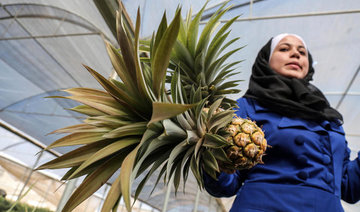
KHAN YUNIS, Palestinian Territories: Pineapples are being harvested in the Gaza Strip for the first time as part of efforts to help the impoverished Palestinian territory work toward food self-sufficiency.
The fruit, for domestic sale, is grown in a 1,000-square-meter greenhouse in the southern Gaza Strip town of Khan Yunis as part of a project sponsored by the Dutch government.
Mussa Al-Jadba, an agricultural engineer who supervised the project, said they had cultivated pineapples “for the first time in the temperate Gaza Strip after we have created the environment and climate for their growth.”
Two hundred and fifty plants have so far reached maturity with up to 4,000 expected to bear fruit throughout this harvest.
The goal is to develop new crops to help Gazan farmers achieve self sufficiency, Jadba added.
“The Gaza Strip suffers fundamentally from salty water, which has encouraged the union to grow pineapples as they don’t need much water,” he added, referring to the agricultural union.
Gaza suffers from severe water pollution, with more than 95 percent of its groundwater unclean, leading to increased risk of serious diseases.
The UN has warned the strip will be uninhabitable by 2020.
Israel has imposed a crippling blockade on Gaza for a decade, citing security reasons.


First pineapple farm opens in Gaza

First pineapple farm opens in Gaza



Saudi Arabia’s FMF concludes with over $26.6bn in agreements
RIYADH: Saudi Arabia said it secured more than SR100 billion ($26.6 billion) in agreements and memorandums of understanding at the fifth edition of the Future Minerals Forum, underscoring the Kingdom’s push to position mining as a key pillar of its economic diversification strategy.
The forum, held in Riyadh under the patronage of King Salman bin Abdulaziz Al Saud, drew representatives from around 100 countries and attracted about 21,500 participants, according to the Ministry of Industry and Mineral Resources.
The government has identified mining as a priority sector as it seeks to reduce reliance on oil and strengthen global supply chains for critical minerals.
The agreements signed during the forum span the full mining value chain, including exploration, extraction, and mineral processing, as well as manufacturing, research and development, innovation, and sustainability.
The ministry said the breadth of the deals highlights efforts to accelerate sector development while attracting long-term domestic and foreign investment.
Participants included ministers, senior government officials, executives from major global mining companies, and investors, as well as academics and technical experts. More than 450 speakers took part in ministerial roundtables, panel discussions and technical sessions.
An international exhibition formed a key part of the event, featuring 274 exhibitors from 13 countries, including Australia, the US, and the UK, as well as France, Germany, and several emerging mining markets.
The exhibition was organized across four main zones covering exploration and mining, processing and manufacturing, advanced technologies and innovation, and investment and partnerships.
Forum discussions focused on strengthening cross-border cooperation across mineral supply chains, accelerating exploration activity, and improving access to financing, as well as promoting sustainable and responsible mining practices.
Sessions also examined the growing role of digital tools, automation and artificial intelligence in enhancing operational efficiency and decision-making in the sector.
The ministry said the scale of agreements announced at the forum provides a foundation for sustained growth and supports the Kingdom’s long-term objective of becoming a global hub for mining and mineral processing, at a time of rising international demand for critical and strategic minerals.
The ministry also highlighted the rapid evolution of the Future Minerals Forum over its five editions, describing it as a platform that has transitioned from a regional gathering into a global convening point for policymakers and industry leaders.


