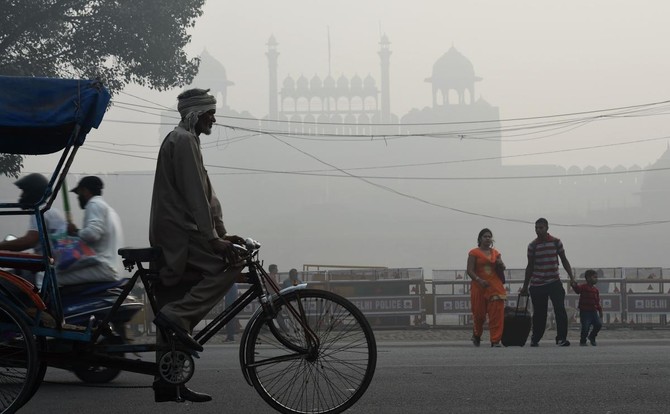
NEW DELHI: India plans to spray water over its capital, New Delhi, to try to combat toxic smog that has triggered a pollution emergency, officials said on Friday, with conditions expected to get worse over the weekend.
Illegal crop burning in farm states surrounding New Delhi, vehicle exhaust in a city with limited public transport and swirling construction dust have caused the crisis, as they do year after year.
“Sprinkling water is the only way to bring down the dangerous pollution levels,” said Shruti Bhardwaj, the environment ministry’s senior most official in charge of monitoring air quality.
The government was finalizing the plans to spray the water from a height of 100 meters, which would be unprecedented, she said, without saying how much of the city of 22 million people would be covered.
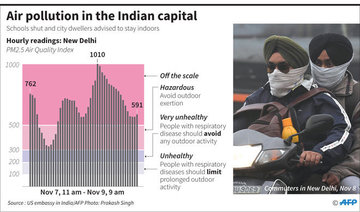
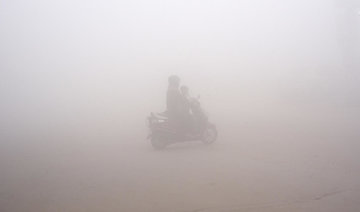
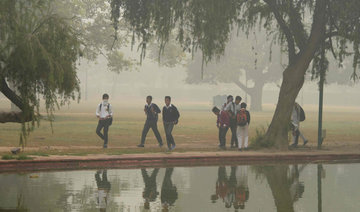
The thick blanket of grey air and pollutants has enveloped Delhi for the past four days. A US embassy measure of tiny particulate matter, called PM 2.5, showed a reading of 523 at 9am on Friday — the outer limit of “good” air is 50.
PM 2.5 is about 30 times finer than a human hair. The particles can be inhaled deep into the lungs, causing heart attacks, strokes, lung cancer and respiratory diseases.
The air has remained consistently in the “hazardous” category or beyond those levels, despite a litany of government measures: ordering a halt to all construction activities, restricting vehicular movement and raising parking charges four times to push residents to use public transport.
Commercial trucks are now banned from the city unless they are transporting essential commodities and the Delhi transport department said it re-introduced an “odd-even” scheme under which cars with license plates ending in an odd number are allowed one day and even-numbered cars the next day.
The scheme was introduced in the Chinese capital a decade ago to fight traffic and pollution with mixed success.
The Delhi high court issued an order on Thursday suggesting the city’s government consider “cloud seeding” to induce rainfall artificially, a practice also used in Beijing.
Anumita Roychowdhury, executive director of the Center for Science and Environment in New Delhi, said sprinkling water will help, but it won’t solve everything.
“Each and every dust control measure has to be put in place to ensure that air quality improves as soon as possible,” she said.
Satyendra Kumar Jain, New Delhi’s health minister, said laborers living in urban slums or beneath road fly-overs were suffering the most. Government hospitals in the city, Jain said, were treating thousands of patients with respiratory ailments.
“The only solution left is that we start spraying water right at the street level, especially along heavy traffic roads,” Jain said.
Chief Minister Arvind Kejriwal, the leader of Delhi, called the capital a “gas chamber” earlier this week as his government sought urgent meetings with the federal government and neighboring states to find solutions.
Affluent residents and large private companies have been placing bulk orders for air purifiers and filtration masks.
“I have installed six air purifiers in my home, closed all the windows, but my eyes are still watering,” said Ranveer Singhal, a commodity trader living in leafy neighborhood of the city.
According to a 2016 World Bank report, nearly 1.4 million people died in India due to air pollution in 2013, causing an economic loss worth 7.7 percent of the nation’s GDP.
Organizers of music festivals and open air parties are now canceling events after the Central Pollution Control Board said air quality could deteriorate further during the weekend.
Pronab Sarkar, president of the Indian Association of Tour Operators, said air pollution had also hit tourism.
“Many tourists are canceling their bookings for Christmas holiday,” he said.