OIC pledges to cooperate with UNESCO for protection of cultural heritage

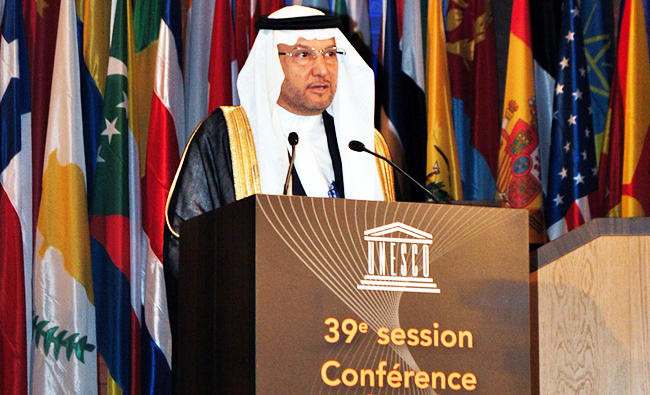
OIC Secretary-General Yousef Al-Othaimeen addresses the 39th session of the UNESCO’s General Conference in Paris on Monday. (SPA)
Updated 07 November 2017
Follow

OIC pledges to cooperate with UNESCO for protection of cultural heritage

JEDDAH: The Organization of Islamic Cooperation (OIC) on Monday pledged to cooperate with UNESCO in fighting intentional destruction and illegal trafficking of the cultural heritage in conflict zones.
Addressing the 39th session of UNESCO’s general conference in Paris, OIC Secretary-General Yousef Al-Othaimeen applauded the UN body’s call to include protection of cultural heritage in the tasks of peacekeeping missions and other global programs.
Al-Othaimeen said combating terrorism and extremist ideology is at the top of his organization’s agenda. In this regard, he said, the OIC has launched “Voice of Wisdom” project, which seeks to spread the concepts of tolerance and moderation.
The OIC, Al-Othaimeen added, seeks to raise awareness among the youth about the perils of joining the ranks of terrorist outfits.
The OIC chief also condemned Israeli occupation of Palestinian lands and its persistent attempts to alter the demographics of the occupied East Jerusalem.
He urged the UNESCO to take necessary measures to ensure preservation of the historical and cultural heritage of the Palestinian state.
The OIC chief also met the newly elected director-general of UNESCO, Audrey Azoulay, on the sidelines of the conference.
Heads of both the organizations reiterated their commitments to further strengthen cooperation to ensure protection of cultural heritage, access to quality education and technology for sustainable development.
Speaking at the UNESCO event, the director-general of the Islamic Educational, Scientific and Cultural Organization (ISESCO), Abdul Aziz bin Othman Al-Twaijri, said proper education is crucial to lasting peace.
Therefore, he said, UNESCO has huge responsibility over its shoulders, especially in the current global scenario marked by political tensions, economic crises and armed conflicts.
“As a result, millions of children are deprived of their right to pursue a decent education in a normal atmosphere of security and stability,” Al-Twajiri said.
The ISESCO chief said education is a must for economic and political development.
He deplored the state of education in the developing word. “Today, the number of refugees in the world exceeds 50 million, 25 percent of whom are children…
“While ISESCO is monitoring this situation and making constant efforts to ensure access to education for refugee children … international cooperation in this important area is still a very pressing need,” Al-Twaijri said.
He expressed hope that UNESCO will play its due role in this regard.
The ISESCO director-general said the world should take necessary steps to save the present and future generations from the dangers of ignorance, extremism and terrorism.
“A real mobilization is required to ensure security and peace and equal education opportunities for all …” he said.


Experimental farm in Al-Lith looks into future of Saudi Arabian agriculture

Updated 02 February 2026
Follow

Experimental farm in Al-Lith looks into future of Saudi Arabian agriculture

  • Research initiative reflects strategic transformation

JEDDAH: An experimental farm in Saudi Arabia’s Al-Lith Governorate is one of the research initiatives reflecting the strategic transformation taking place in the Kingdom’s agricultural sector.

The farm uses highly efficient, sustainable production models that combine scientific research with commercial application, contributing to strengthening the country’s food security system and the sustainability of water resources.

Located in the Ghumaiqa Center on an area of about 10 hectares, the cutting-edge farm is a testing platform for modern agricultural technologies that tackle the challenge of water scarcity.

The farm includes developed open fields and modern greenhouses, supported by smart irrigation encompassing drip and sprinkler irrigation alongside surface and subsurface technologies.

All the systems operate via smart controls that enable the monitoring of water consumption and ensure improved efficiency, thereby achieving a balance between agricultural production and water conservation.

The farm also uses treated and diluted low-salinity seawater.

It aims to diversify agricultural water sources, reduce reliance on freshwater, and open new horizons for agriculture in coastal and semi-arid environments.

A view of the experimental farm in Al-Lith. (SPA)

The project represents a promising investment opportunity in the field of smart agriculture, enabling the development of commercially scalable production models, particularly for high-value vegetables and fruits, while reducing operational costs associated with water and energy, enhancing the economic feasibility of future agricultural projects.

In addition, the project contributes to transferring and localizing agricultural expertise, supporting local food supply chains, and creating an attractive environment for agricultural investment.

This aligns with Sustainable Development Goals and enhances the efficiency of the private sector in adopting innovative agricultural solutions.

Yahya bin Abdulrahman Al-Mahabi, the director of the Ministry of Environment, Water and Agriculture office in Al-Lith Governorate, told the Saudi Press Agency that the project represented the future of agriculture in the Kingdom.

He explained that the vision was based on investing in technology, enhancing the return on water per unit, and integrating scientific research with investment opportunities.

Al-Mahabi spoke of the experimental farm as a modern, scalable and replicable model applicable in several regions of the Kingdom, particularly in coastal environments.

Al-Mahabi highlighted the Ministry of Environment, Water and Agriculture’s commitment to supporting distinctive projects that contributed to achieving food security while developing rural areas and enhancing agricultural production efficiency, in line with the objectives of the Kingdom’s Vision 2030.