SUTHERLAND SPRINGS, Texas: The gunman who opened fire in a small Texas church, killing 26 people during worship services, sent threatening text messages to his mother-in-law before the attack, which appeared to stem from a domestic situation, authorities said Monday.
Investigators have concluded that the deadliest mass shooting in state history was not racially or religiously motivated, Texas Department of Public Safety Regional Director Freeman Martin said.
Based on evidence at the scene, they believe that Devin Patrick Kelley died of a self-inflicted gunshot wound after he was chased by armed bystanders and crashed his car.
The 26-year-old shooter also used his cellphone to tell his father that he had been shot and did not think he would survive, authorities said.
The gunman’s family relationships were uncertain. The sheriff said the shooter’s former in-laws sometimes attended services at the church but were not there on Sunday. Martin said the text messages were sent to the gunman’s mother-in-law, who attended the church. It was unclear if they were referring to the same people.
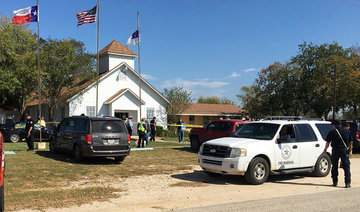
Once the shooting started at the First Baptist Church in Sutherland Springs, there was probably “no way” for congregants to escape, Wilson County Sheriff Joe D. Tackitt Jr. said.
The gunman, dressed in black tactical gear, fired an assault rifle as he walked down the center aisle during worship services. He turned around and continued shooting on his way out of the building, Tackitt said.
The attack claimed multiple members of some families and tore apart the close-knit town of 400 people.
“It’s unbelievable to see children, men and women, laying there. Defenseless people,” Tackitt said.
The dead ranged in age from 18 months to 77 years old. About 20 other people were wounded, 10 of whom were still hospitalized Monday in critical condition.
Authorities said Kelley lived in New Braunfels, about 35 miles north of the church.
A US official told The Associated Press that Kelley did not appear to be linked to organized terrorist groups. The official spoke on the condition of anonymity because the person was not authorized to discuss the investigation.
Investigators were looking at social media posts Kelley made in the days before the attack, including one that appeared to show an AR-15 semi-automatic weapon.
Kelley, who had a license to serve as an unarmed private security guard, did not have a license to carry a concealed handgun. Martin said.
After serving in the Air Force, Kelley received a bad conduct discharge for assaulting his spouse and child and was sentenced to 12 months of confinement after a 2012 court-martial. He served in Logistics Readiness at Holloman Air Force Base in New Mexico from 2010 until his 2014 discharge, Air Force spokeswoman Ann Stefanek said.
The attacker pulled into a gas station across from the church, about 30 miles (48.28 kilometers) southeast of San Antonio, around 11:20 a.m. Sunday. He crossed the street and started firing the rifle at the church, then continued firing after entering the white wood-frame building, Martin said.
Killed by an armed resident
As he left, the shooter was confronted by an armed resident who “grabbed his rifle and engaged that suspect,” Martin said. A short time later, the suspect was found dead in his vehicle at the county line.
Twenty-three of the dead were found in the church. Two were found outside and one died after being taken to a hospital, Martin said.
The man who confronted Kelley had help from another local resident, Johnnie Langendorff, who told KSAT-TV that he was driving past the church as the shooting happened. He did not identify the armed resident but said the man exchanged gunfire with the gunman, then asked to get in Langendorff’s truck and the pair followed as the gunman drove away.
Langendorff said the gunman eventually lost control of his vehicle and crashed. He said the other man walked up to the vehicle with his gun drawn and the suspect did not move. He stayed there for at least five minutes, until police arrived.
“I was strictly just acting on what’s the right thing to do,” Langendorff said.
Among those killed was the church pastor’s 14-year-old daughter, Annabelle Pomeroy. Pastor Frank Pomeroy and his wife, Sherri, were both out of town when the attack occurred, Sherri Pomeroy wrote in a text message.
“We lost our 14-year-old daughter today and many friends,” she wrote. “Neither of us has made it back into town yet to personally see the devastation.”
Church member Nick Uhlig, 34, who was not at Sunday’s service, told the AP that his cousin, who was eight months’ pregnant, and her in-laws were among those killed. He later told the Houston Chronicle that three of his cousin’s children also were slain.
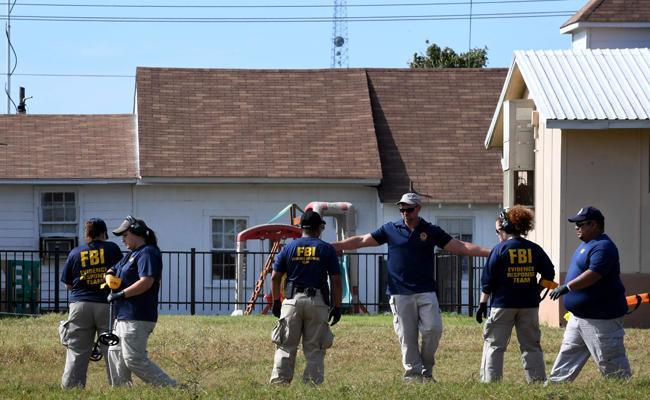
Three guns were recovered. A Ruger AR-556 rifle was found at the church, and two handguns were recovered from the suspect’s vehicle, according to the Bureau of Alcohol, Tobacco, Firearms and Explosives.
The church has posted videos of its Sunday services on a YouTube channel, raising the possibility that the shooting was captured on video.
In a video of its Oct. 8 service, a congregant who spoke and read scripture pointed to the Oct. 1 Las Vegas shooting a week earlier as evidence of the “wicked nature” of man. That shooting left 58 dead and more than 500 injured.
Sunday’s attack came on the eighth anniversary of a shooting at Fort Hood, between Austin and Waco, where 13 people were killed and 31 others wounded by a former Army major.
The previous deadliest mass shooting in Texas had been a 1991 attack in Killeen, when a mentally disturbed man crashed his pickup truck through a restaurant window at lunchtime and started shooting people, killing 23 and injuring more than 20 others.
The University of Texas was the site of one of the most infamous mass shootings in American history, when Marine sniper Charles Whitman climbed a clock tower at the Austin campus in 1966 and began firing on stunned people below, killing 13 and wounding nearly three dozen others. He had killed his wife and mother before heading to the tower. One victim died a week later, and medical examiners eventually attributed a 17th death to Whitman in 2001.