SUTHERLAND SPRINGS, United States: The United States was in mourning Monday after a gunman wearing a bulletproof vest opened fire with an assault rifle on the congregation of a small-town Texas church, killing 26 people and wounding 20 more in the nation’s latest shooting massacre.
President Donald Trump said the nation was living through “dark times” but guns were not to blame for Sunday’s carnage, which came just five weeks after the worst mass shooting in modern US history.
“I think that mental health is your problem here,” said the US president, speaking in Tokyo as part of his Asia tour. “This was a very — based on preliminary reports — a very deranged individual.”
“This isn’t a guns situation,” Trump insisted, calling it “a mental health problem at the highest level.”
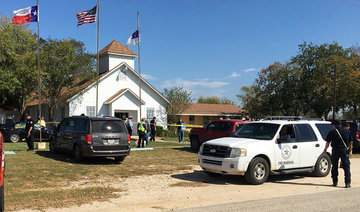
The victims, who ranged in age from five to 72, were gunned down at First Baptist Church in Sutherland Springs, a rural community of some 400 people 30 miles (50 kilometers) southeast of San Antonio.
The gunman, widely identified as Devin Kelley, 26, was described by authorities as a young white male who was found dead in his vehicle after being confronted by a local resident.
The Air Force said Kelley served at a base in New Mexico starting in 2010 before being court-martialed in 2012 for allegedly assaulting his wife and child.
He was sentenced to 12 months in confinement and received a “bad conduct” discharge, Air Force spokeswoman Ann Stefanek told AFP. He was discharged in 2014.
Dressed all in black, Kelley fired outside the church before entering the building and continuing to spray bullets, said Freeman Martin, regional director of the Texas Department of Public Safety.
“As he exited the church, a local resident grabbed his rifle and engaged that suspect. The suspect dropped his rifle, which was a Ruger AR assault-type rifle, and fled from the church. Our local citizen pursued the suspect at that time,” Martin said.
Law enforcement later found Kelley dead in his car, which had crashed on the Wilson-Guadalupe county line. It was not clear if he had killed himself or was shot by the resident who had confronted him.
Multiple weapons were found in the car, which was processed by bomb technicians.
“We have multiple, multiple crime scenes. We have the church, outside the church. We have where the suspect’s vehicle was located,” said Martin.
“We have been following up on the suspect and where he’s from. We have Texas Rangers at all the hospitals locating those and interviewing those who were injured.”
“There’s so many families who have lost family members. Fathers, mothers, sons, and daughters,” Governor Greg Abbott said, warning the toll could rise.
“The tragedy, of course, is worsened by the fact that it occurred in a church, a place of worship, where these people were innocently gunned down. We mourn their loss, but we support their family members.”
The wounded had been transported to various hospitals with “injuries that vary from minor to very severe,” Martin said.
The dead included the 14-year-old daughter of pastor Frank Pomeroy, the church leader told ABC News.
Annabelle Renee Pomeroy “was one very beautiful, special child,” her father said.
Frank Pomeroy had been in the neighboring state of Oklahoma at the time of the shooting, and was driving back to Texas after the tragedy.
Other victims, some of whom were evacuated by helicopter, included a six-year-old boy named Rylan who was in surgery after being shot four times, his uncle told CBS News. A two-year-old was also shot and wounded, The Dallas Morning News reported.
A spokeswoman for Connally Memorial Medical Center in nearby Floresville said the hospital received eight patients with gunshot wounds. Four were transferred to San Antonio.
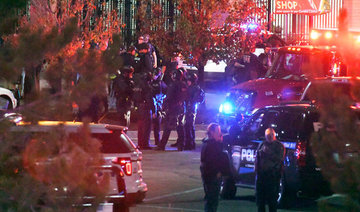
Police formed a perimeter around the area while tearful relatives and neighbors stood outside, nervously awaiting news from inside the traditional white-frame church.
Agents from the FBI and the Bureau of Alcohol, Tobacco, Firearms and Explosives were headed to Sutherland Springs, the agencies said.
Trump called the “horrific shooting” an “act of evil,” ordering flags be flown half-staff at the White House and federal buildings.
“Our hearts are broken but in dark times — and these are dark times — such as these, Americans do what they do best: we pull together,” he said.
Though he said “it’s a little bit soon to go into it” regarding renewed calls for gun control, the president promised his administration’s “full support” for the investigation.
As with many other previous shootings, Democrats pointed to the latest tragedy to highlight the need for gun control, a hot-button issue in a country that holds the right to bear arms as almost sacred.
In denouncing the “act of hatred,” Trump’s predecessor Barack Obama said: “May God also grant all of us the wisdom to ask what concrete steps we can take to reduce the violence and weaponry in our midst.”
The shooting comes just over a month after a gunman in Las Vegas fired down from a hotel room on to an outdoor concert, killing 58 people and wounding hundreds. It was the deadliest mass shooting in modern US history.
A little more than two years ago, white supremacist Dylann Roof entered a historically black church in Charleston, South Carolina, and shot nine people to death.