Saudi-led Coalition closes land, sea and air ports in Yemen to stop Iranian arms smuggling

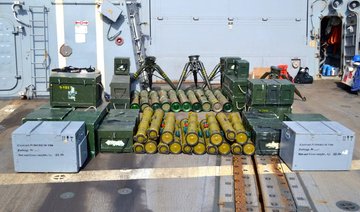
Weapons and equipment, believed to be from Iran, are displayed aboard the deck of USS Forrest Sherman after they were seized from a smuggling boat on Sept. 27, 2015 off the coast of Yemen. The Saudi-led Coalition on Sunday said Iran has stepped up its smuggling of weapons, including ballistic missiles, for Yemen's Houthi insurgents. (Combined Maritime Forces photo via AP, file)
Updated 06 November 2017
Follow

Saudi-led Coalition closes land, sea and air ports in Yemen to stop Iranian arms smuggling

JEDDAH: The Saudi-led coalition supporting Yemen’s UN-recognized government on Sunday said it was temporarily closing all land, sea and air ports in Yemen to stop Iranian weapons from reaching Shiite Houthi insurgents.
A press statement by the coalition’s command said the decision was made after experts ascertained that the ballistic missiles being fired by Houthis from Yemen toward Saudi Arabia, including the one intercepted over Riyadh on Saturday night, were manufactured in Iran.
“A thorough examination of the debris of these missiles, including the missile launched on July 22, 2017, has confirmed the role of Iran’s regime in manufacturing these missiles and smuggling them to the Houthi militias in Yemen for the purpose of attacking the Kingdom, its people, and vital interests,” said the statement carried by the Saudi Press Agency (SPA).
Saudi air defense forces shot down the ballistic missile before it could hit the airport in the national capital on Saturday night.
“The coalition’s command considers the Iranian regime’s action in supplying the Houthi militias that it commands with these missiles to be a blatant violation of the United Nations Security Council (UNSC) resolutions that prohibit nations from arming these militias, specifically UNSC Resolution 2216,” the statement said.
It also said it considers “Iran’s role and its direct command of its Houthi proxy” a “blatant act of military aggression by the Iranian regime, and could be considered as an act of war against the Kingdom of Saudi Arabia.”
While closing all points of entry to Yemen, the coalition command said it will “take into consideration the continuation of the entry and exit of humanitarian supplies and crews in accordance with the coalition’s updated procedures.”
It urged Yemeni civilian and humanitarian crews and diplomatic missions to avoid areas of combat operations; areas populated by armed militias; and Houthi smuggling routes and missile launch sites. 
Western analysts have said the smuggling of Iranian weapons to Houthi insurgents have continued despite efforts to stop them since the coalition sent forces to Yemen to restore the government of President Abed Rabbo Mansour Hadi in March 2015.
A Reuters report on March 23, 2017, had said that from September 2015 until March 2016, “the French and Australian navies frequently intercepted weapons which officials said were most likely bound for the Houthis.”
It also quoted a US defense official as saying Iranian weapons smuggling to the Houthis had continued since March 2016, and that the equipment included “long-range ballistic missiles capable of reaching deep into Saudi Arabia.”
Nic Jenzen-Jones, a military arms specialist and director of Armament Research Services, which has tracked Iranian equipment ending up in Yemen, also said quantities had increased, the same report said.
Conflict Armament Research (CAR) also said in a study that it had evidence showing that the Qasef-1 UAV drone that Houthis claimed to have made were actually traced to Iran.

Flights canceled
Yemen’s national airline said Monday it has canceled all flights to the country’s only two functioning airports after the Saudi-led coalition battling Houthi rebels announced the closure of all land, air and sea ports, reported The Associated Press (AP).
Yemenia airlines said that the coalition, which controls Yemen’s airspace, had denied permission to fly out of Aden and Sayoun, both in areas of southern Yemen controlled by coalition allies.

Threat to Kingdom’s security is ‘red line’ that will be ‘addressed and neutralized,’ Saudi envoy says

Updated 56 min 29 sec ago
Follow

Threat to Kingdom’s security is ‘red line’ that will be ‘addressed and neutralized,’ Saudi envoy says

  • Abdulaziz Alwasil tells UN Security Council the situation in southern Yemen is ‘a just cause with social and historic dimensions’ that can only be resolved through dialogue
  • Recent military activity in the south was unilateral, resulting in an escalation that harms the interests of Yemeni people and undermines efforts to address issues in the south, he said

NEW YORK CITY: Any attempt to threaten Saudi Arabia’s national security is a “red line” and will be met with decisive action, the Kingdom’s ambassador to the UN told the Security Council on Wednesday.

Speaking during a meeting of the council to discuss Yemen, Abdulaziz Alwasil said the situation in the south of the country is “a just cause with social and historic dimensions” that can only be resolved through dialogue.

“We stress that any attempt to threaten our national security is a red line, and we will not hesitate to take the necessary actions and steps to address it and neutralize it,” he added.

Alwasil reaffirmed Saudi Arabia’s support for Yemeni President Rashad Al-Alimi, the Presidential Leadership Council, and the Yemeni government in their efforts to achieve security, stability, development and peace while preserving national unity.

He said military activity by Southern Transitional Council forces in Hadramout and Al-Mahra on Dec. 2, 2025, was unilateral, did not have the approval of the Presidential Leadership Council, and was not carried out in coordination with the Coalition to Restore Legitimacy in Yemen.

It had resulted in an unjustified escalation that harmed the interests of the Yemeni people, undermined efforts to address the issues in the south, and ran counter to the coalition’s objectives, Alwasil added.

The Kingdom, working with its coalition partners, the Presidential Leadership Council and the Yemeni government, had moved to contain the situation by dispatching a military force to coordinate arrangements with the Southern Transitional Council in Aden, he said.

The aim was to ensure the return of the southern council’s forces to their previous positions outside of Hadramout and Al-Mahra, and the handover of camps to legitimate government forces and local authorities in line with agreed procedures, Alwasil added.

He expressed regret over the military operations that took place in Hadramout and Al-Mahra, close to Saudi Arabia’s southern border, which he said posed a direct threat to the Kingdom’s national security, as well as the security of Yemen and regional stability. Such steps were extremely dangerous, he added, and contradicted the principles on which the Coalition to Restore Legitimacy in Yemen had been founded.

Alwasil welcomed a prisoner and detainee exchange agreement signed in Muscat on Dec. 23, which he described as an important humanitarian measure to alleviate suffering and build confidence.

He praised Oman for hosting and sponsoring the consultations and supporting negotiations, and commended the efforts of UN’s special envoy for Yemen, Hans Grundberg, the International Committee of the Red Cross and all others that has played a part.

Regarding the political efforts to resolve the crisis, Alwasil said Saudi Arabia welcomed President Al-Alimi’s call for an inclusive conference in Riyadh to bring together all stakeholders to discuss just solutions to the situation in southern Yemen.

Preparations for the conference have begun, he added, in cooperation with the Yemeni government and southern representatives, reflecting the close ties between the two countries and their shared interests in stabilizing Yemen.

He urged all southern stakeholders to participate actively and constructively in the talks, to help find comprehensive and just solutions that meet the legitimate aspirations of the people of southern Yemen.

Alwasil called on all Yemeni forces and stakeholders to cooperate and intensify their efforts to reach a lasting political settlement that would ensure security and stability.

He described the southern issue as “a just cause with social and historic dimensions,” adding that “the only way to address it is through dialogue that leads to a comprehensive political solution” based on nationally and internationally agreed terms of reference.