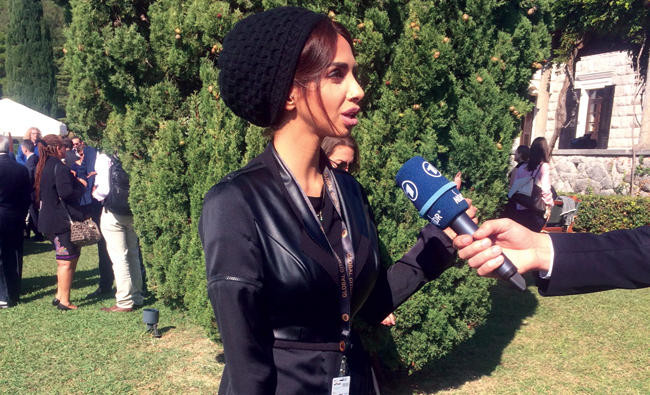
SVETI STEFAN, Montenegro: More local women are likely to become entrepreneurs after the ban on them driving is lifted in Saudi Arabia, according to a prominent Emirati fashion designer and businesswoman.
Sara Al-Madani, an entrepreneur and board member of the Sharjah Chamber of Commerce & Industry (SCCI), said: “I’m so happy about this, the women in Saudi (Arabia) are a huge wealth and it needs to be properly invested into the economy.
“Imagine the effect it will have when millions of women can move and get to work. It will transform the country and it’s undeniable that force will have a big impact.”
Al-Madani, founder of Sara Al-Madani Fashion Design and the new British restaurant Shabarbush in Dubai, added that not being able to drive has never stopped women from setting up their own business ventures, but “this freedom opens up more opportunities for them so we will see more women on board.”
The entrepreneur, speaking to Arab News on the sidelines of the recent Global Citizen Forum, said that the word “innovation” is now trending globally.
“I tell everyone, before you innovate in business or at your work, you need to innovate in yourself, you need to believe in yourself and break the stereotype.
“You need to stand up for your rights and believe in your dreams and accomplish them and, once you’ve done that, you can innovate externally … Women are strong, we just need inspiration.”
Al-Madani ventured into the business world at a time when very few Emirati women were doing so. Defying cultural norms, she started her fashion label Rouge Couture, now known as Sara Al-Madani Fashion Design, at the age of 15.
In 2014 Al-Madani, now 30, was selected by Sultan bin Muhammad Al-Qasimi, ruler of the UAE emirate of Sharjah, as a board member of the SCCI.
Al-Madani also runs the creative consultancy Social Fish, and is a brand ambassador for Nivea and Natura Bissé in the Middle East.
She said: “This is just the beginning (of freedoms) for Saudi women. I wish the Saudi women all the best — they are graceful, smart and educated.”

Boom in entrepreneurs expected after ban on Saudi women driving lifted
Lebanese social entrepreneur Omar Itani recognized by Schwab Foundation
- FabricAID co-founder among 21 global recipients recognized for social innovation
DAVOS: Lebanon’s Omar Itani is one of 21 recipients of the Social Entrepreneurs and Innovators of the Year Award by the Schwab Foundation for Social Entrepreneurship.
Itani is the co-founder of social enterprise FabricAID, which aims to “eradicate symptoms of poverty” by collecting and sanitizing secondhand clothing before placing items in stores in “extremely marginalized areas,” he told Arab News on the sidelines of the World Economic Forum in Davos, Switzerland.
With prices ranging from $0.25 to $4, the goal is for people to have a “dignified shopping experience” at affordable prices, he added.
FabricAID operates a network of clothing collection bins across key locations in Lebanon and Jordan, allowing people to donate pre-loved items. The garments are cleaned and sorted before being sold through the organization’s stores, while items that cannot be resold due to damage or heavy wear are repurposed for other uses, including corporate merchandise.
Since its launch, FabricAID has sold more than 1 million items, reached 200,000 beneficiaries and is preparing to expand into the Egyptian market.
Amid uncertainty in the Middle East, Itani advised young entrepreneurs to reframe challenges as opportunities.
“In Lebanon and the Arab world, we complain a lot,” he said. Understandably so, as “there are a lot of issues” in the region, resulting in people feeling frustrated and wanting to move away. But, he added, “a good portion of the challenges” facing the Middle East are “great economic and commercial opportunities.”
Over the past year, social innovators raised a combined $970 million in funding and secured a further $89 million in non-cash contributions, according to the Schwab Foundation’s recent report, “Built to Last: Social Innovation in Transition.”
This is particularly significant in an environment of geopolitical uncertainty and at a time when 82 percent report being affected by shrinking resources, triggering delays in program rollout (70 percent) and disruptions to scaling plans (72 percent).
Francois Bonnici, director of the Schwab Foundation for Social Entrepreneurship and a member of the World Economic Forum’s Executive Committee, said: “The next decade must move the models of social innovation decisively from the margins to the mainstream, transforming not only markets but mindsets.”
Award recipients take part in a structured three-year engagement with the Schwab Foundation, after which they join its global network as lifelong members. The program connects social entrepreneurs with international peers, collaborative initiatives, and capacity-building support aimed at strengthening and scaling their work.