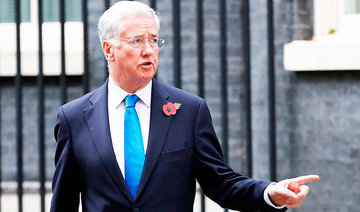
LONDON: Prime Minister Theresa May on Thursday named Gavin Williamson as Britain’s new defense secretary after his predecessor Michael Fallon was forced to step down over a sexual harassment scandal sweeping parliament.
It represents a significant promotion for the 41-year-old, a trusted ally whose former job as chief whip involved enforcing discipline for May’s Conservative party in parliament.
Williamson, who was only elected to parliament in 2010, is best known for having a pet tarantula, Cronus, that he keeps in a glass-sided tank on his desk.
“The Queen has been pleased to approve the appointment of Right Honourable Gavin Williamson as Secretary of State for Defense,” Downing Street said in a statement.
The job is one of the biggest and most challenging in the British government, and some questioned Williamson’s expertise.
According to “TheyWorkForYou,” an online record of parliamentary activity, Williamson has asked only seven questions on defense since 2010.
Britain, a member of the NATO military alliance, spends two percent of its gross domestic product (GDP) on defense but the armed forces are facing constant pressure to cut costs.
Fallon announced his resignation late Wednesday, the first casualty of a deepening scandal over sexual harassment at Westminster.
He had apologized earlier in the week for touching a journalist’s knee in 2002, but reports suggest there were other allegations which had not yet been made public.
“I accept that in the past I have fallen below the high standards that we require of the Armed Forces that I have the honor to represent,” Fallon said.
Williamson was May’s parliamentary campaign manager when she successfully ran to become the Conservative Party leader, and was rewarded with the job of chief whip.
In this role, he had responsibility for ensuring that party MPs attend votes, and vote according to party lines, a tough task in the recent votes on Brexit legislation given the division within the party over the crucial issue.
He also had to keep the party together following the disastrous performance in the June general election, when May lost her parliamentary majority, spurring calls for her resignation.
Julian Smith, one of Williamson’s closest allies, was named new chief whip, raising suggestions that the incoming defense minister had orchestrated the reshuffle.
BBC News political editor Laura Kuenssberg tweeted that a minister had told her that May was “so weak she has let Williamson appoint himself — this is appalling.”
The move raised questions about whether the whip’s office had a role in preparing the dossier on ministers that is behind the scandal, and there were reports that Williamson advised May that Fallon may be facing further allegations.
“Make no mistake, Gavin Williamson wants to be prime minister. And he knows all the dirt on his colleagues,” wrote Tim Shipman, political editor of the Sunday Times.
By promoting Williamson from the whip’s office, May has avoided a wider reshuffle of senior cabinet ministers.


![]()

New UK defense minister named after sex scandal resignation
New UK defense minister named after sex scandal resignation

Latest updates


© 2026 SAUDI RESEARCH & PUBLISHING COMPANY, All Rights Reserved And subject to Terms of Use Agreement.