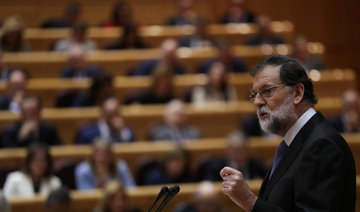
BARCELONA: Catalonia’s secessionist leader on Saturday defiantly called for “democratic opposition” to direct rule imposed by the central government on the semi-autonomous region after its parliament declared unilateral independence.
“The best way to defend what we have achieved to date is democratic opposition to the application of article 155,” Carles Puigdemont, who was officially deposed by Madrid on Friday, said in a carefully-worded televised statement that appeared to indicate he did not accept his dismissal.
Puigdemont was referring to the never-before-used constitutional article that gives Madrid the takeover powers, adding he and his team would keep working “to build a free country.”
In his first comments since being deposed as president of Catalonia, flanked by a Catalan and EU flag, he did not clarify whether he would carry on as leader of a new republic that is not recognized by Madrid or abroad.
In a copy of his speech sent to AFP, he signed off as “president of the Catalan government,” implying he considered himself to still officially be head of the semi-autonomous region.
He stopped short of signing off as president of the republic, though.
In a cryptic message, Puigdemont also asked Catalans to defend the republic proclaimed by the regional parliament.
“We need to keep defending the stage in which we have entered with a tireless sense of civic responsibility and peaceful commitment.”
He added that “in a democratic society, only parliaments can pick or dismiss presidents.”
The Catalan parliament, however, has been dissolved by Prime Minister Mariano Rajoy, who also called snap regional elections on December 21 in a bid to restore “normality.”
Spain’s central government has also been granted sweeping powers by the Senate to dismiss Puigdemont and his executive, and take control of all regional ministries.

Catalan separatist leader urges ‘democratic opposition’ to Madrid takeover

Fourth Palestine Action activist ends hunger strike in UK prison
- Amy Gardiner-Gibson began eating again after 49 days of protest
- Govt rejects claims it ignored prison safety protocols
LONDON: A fourth Palestine Action activist imprisoned in the UK has ended her hunger strike.
Amy Gardiner-Gibson, who also uses the name Amu Gib, began eating again after 49 days of fasting, the campaign group Prisoners for Palestine said.
Qesser Zuhrah, another activist, ended her hunger strike last week after 48 days but said she might resume it next year, Sky News reported.
Four Palestine Action activists have now ended their hunger strikes while in prison, while four others are continuing to fast.
All of them are in prison on remand, awaiting trial for a series of high-profile alleged break-ins and criminal damage.
Palestine Action was proscribed as a terrorist organization and banned earlier this year.
On Tuesday, Swedish climate activist Greta Thunberg was arrested in central London at a rally in support of the hunger strikers.
The protesters are demanding that weapons factories in Britain with ties to Israel be shut down, as well as the removal of Palestine Action’s proscription.
They are also calling for immediate bail to be given to imprisoned pro-Palestine activists and an end to the alleged mistreatment of prisoners in custody.
Seven imprisoned members of Palestine Action have been transferred to hospital over the course of the hunger strike campaign. Doctors have highlighted concerns about the long-term impact of fasting on the activists.
Lawyers representing the group on Monday initiated legal action against the government over its alleged failure to follow prison safety regulations.
The government, however, has rejected this accusation, Sky News reported.
A Ministry of Justice spokesperson said: “Ministers do not intervene in individual cases. Where individuals are on remand, doing so would risk prejudicing ongoing legal proceedings and undermine the independence of the justice system.
“Concerns about welfare and process can be raised through established legal and administrative channels, including prison governors and ultimately the prison and probation ombudsman.
“Healthcare decisions are taken independently by qualified NHS professionals and appropriate care and oversight frameworks remain in place.”
The activists still on hunger strike include Heba Muraisi and Teuta Hoxha. Hoxha has been on remand for 13 months and her family told Sky News they feared she would die in prison.
Another of the activists, Kamran Ahmad, is believed to have been on hunger strike for 45 days and hospitalized three times.
Lewie Chiaramello, who has Type 1 diabetes, is on day 31 of his strike and taking part by fasting every other day.