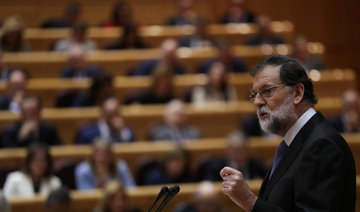
BARCELONA: Catalonia woke up Saturday under the direct control of Madrid as the Spanish prime minister took drastic measures to quash secession, deposing the region’s leaders and dissolving its parliament hours after lawmakers declared independence.
In a dramatic escalation of a political crisis that has stoked alarm in Europe and sent shockwaves through Spain, Mariano Rajoy also decided to call snap Catalan elections on December 21 to “restore normality” to a region in turmoil.
All eyes this weekend will be on whether Catalonia’s separatist executive willingly steps down and independence supporters carry out their threat of peaceful resistance to Madrid’s takeover.
In the Spanish capital, protesters were due to hit the streets Saturday against Catalonia’s declaration of independence, which while lacking any legal basis has caused strife in a region deeply divided on whether to split from Spain.
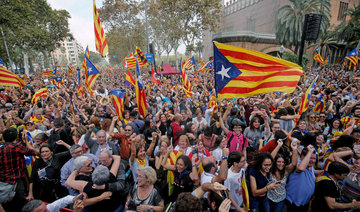
On Friday in Barcelona and other Catalan cities, thousands celebrated their regional parliament’s motion for independence, which passed with 70 votes for, 10 against and two absentions in a 135-seat chamber that anti-secession MPs had deserted in protest.
Demonstrators in Barcelona broke out in ecstatic shouts of: “Independence!” as the result was announced, while separatist MPs cheered, clapped and embraced before breaking out in the Catalan anthem.
But others glumly assessed the fallout to what they viewed as a hugely damaging and illegal vote.
“They’re forgetting part of the people, the majority,” said Josep Reina, a 34-year-old salesman.
The move to take over Catalan powers is likely to anger many in a region of some 7.5 million people that enjoyed considerable autonomy, with control over its education, health care and police.
It is the first time that the central government has curtailed regional autonomy since dictator Francisco Franco’s repressive 1939-75 rule.
Independence supporters have warned they will resist the temporary measure, implemented under Article 155 of the constitution, devised to rein in rebel regions.
“We won’t cave in to Rajoy’s authoritarianism nor to 155,” tweeted the far-left CUP party, an ally of Puigdemont.
The resistance could come in the form of street protests and strikes, all of which have already happened since October 1 when an outlawed independence referendum was marred by police violence as central authorities tried to stop people from voting.
Catalan leaders hold up the unregulated referendum that had been banned by the Constitutional Court as a mandate for independence, saying 90 percent voted “Yes” even if only 43 percent of voters turned out.
Federico Santi, Europe analyst at political risk consultancy Eurasia Group, warned there could be “more serious clashes between national police and pro-independence activists,” echoing widely-held fears.
Speaking after the parliament proclaimed an independent republic, Catalan leader Carles Puigdemont urged activists to “maintain the momentum” in a peaceful manner.
Other measures adopted by the government include the dismissal of the director of the Catalan regional police force, the Mossos d’Esquadra, as well as Catalan government representatives in Madrid and Brussels.
Deputy Prime Minister Soraya Saenz de Santamaria is due to meet Saturday with secretaries of states, who will likely take charge of Catalonia’s regional ministries.
The Spanish government has received unwavering support from his European allies and the US.
The EU in particular is wary of nationalistic and secessionist sentiment, particularly after Britain’s dramatic decision last year to leave the bloc.
EU President Donald Tusk insisted Madrid “remains our only interlocutor” in Spain.
But he also urged Madrid to exercise restraint, tweeting: “I hope the Spanish government favors force of argument, not argument of force.”

‘Independent’ Catalonia wakes up under Madrid’s control
Russia committed ‘crimes against humanity’ in deporting Ukrainian children: UN inquiry
- The inquiry said Russia had deported or transferred “thousands” of children from occupied areas of Ukraine, of which it had so far confirmed 1,205 cases
- “Four years on, 80 percent of the children deported or transferred in the cases investigated by the commission have not returned,” it said
GENEVA: Moscow’s deportation and forcible transfer of children from Ukraine to Russia amounts to a crime against humanity, a United Nations team of investigators said Tuesday.
The UN’s Independent International Commission of Inquiry on Ukraine said it had collected evidence leading it to conclude that “Russian authorities have committed the crimes against humanity of deportation and forcible transfer, as well as of enforced disappearance of children.”
The probe was established by the UN Human Rights Council shortly after Moscow launched its full-scale invasion of Ukraine in February 2022.
The inquiry said Russia had deported or transferred “thousands” of children from occupied areas of Ukraine, of which it had so far confirmed 1,205 cases.
“Four years on, 80 percent of the children deported or transferred in the cases investigated by the commission have not returned,” it said.
Moscow has failed to establish a system facilitating returns, and has instead focused on long-term placement of the children with families or institutions in Russia, while relatives were not informed of their fate.
The commission confirmed its previous finding that Russian authorities had unlawfully deported and transferred children — as a war crime — “and that they have unjustifiably delayed their repatriation, which is also a war crime.”
These measures “were not guided by the best interests of the child,” and have violated international law, the probe found.
- Putin cited -
It said the involvement of Russian President Vladimir Putin, “including through his direct authority over entities that have steered and executed this policy, has been visible from the outset.”
In 2023, the International Criminal Court issued a war crimes arrest warrant against Putin, accusing him of “unlawfully deporting” Ukrainian children.
The issue is highly sensitive in Ukraine and remains central to negotiations for a potential peace agreement between Kyiv and Moscow.
According to Kyiv, nearly 20,000 Ukrainian children have been forcibly removed since Russia’s full-scale invasion.
Russia insists it has moved some Ukrainian children from their homes or orphanages to protect them from hostilities.
As for Russian trials in the context of its invasion of Ukraine, the commission found that Russian authorities have “systematically fabricated evidence” and “systematically violated a range of fair trial guarantees,” while judges “have not acted with independence and impartiality.”
- ‘Extreme violence’ -
The commission also probed the situation of nationals from 17 countries who were recruited — either voluntarily or through deception — to fight with Russian troops in Ukraine.
They included men from Azerbaijan, Belarus, Brazil, Cuba, Egypt, Ghana, India, Iraq, Kazakhstan, Kenya, Nepal, Somalia, Sri Lanka, Tajikistan, Turkiye and Yemen.
“After training, usually lasting between one week and 30 days, they were forced to serve on frontlines in Ukraine, often assigned extremely dangerous duties,” the commission said in its report.
Commanders arbitrarily imposed “extreme violence” as punishment for refusing orders that meant almost certain death, with soldiers describing being treated like “cannon fodder,” sent on “meat assaults” without training or necessary equipment, and “forced to advance at all costs.”
“The evidence collected demonstrates abusive behavior, cruelty, humiliation, inhuman treatment, and a total disregard for human life and dignity, perpetrated with a sense of impunity,” the report said.
Regarding Ukraine, the report voiced concern about the overly broad definition and sometimes distorted interpretation of the crime of “collaboration.”
The commission also said reports regarding violent treatment of conscientious objectors during Ukrainian mobilization were “a source of concern.”
The report will be presented at the Human Rights Council in Geneva on Thursday.
Moscow does not recognize the commission and does not answer its requests for access, information and meetings.