OPEC official: Saudi Arabia, Russia statements “clear fog” before November 30 meeting

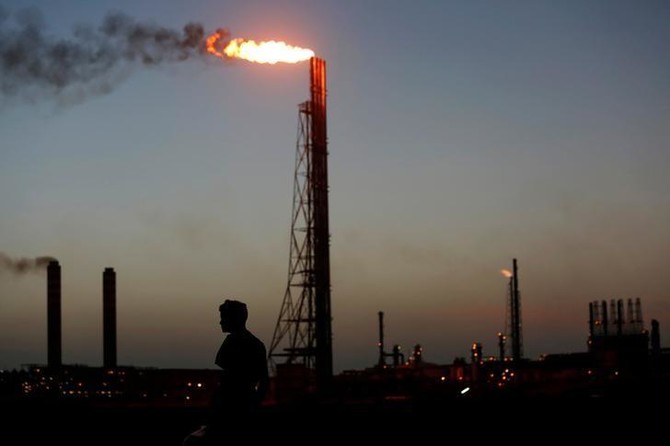
OPEC plus Russia and nine other producers have cut oil output by about 1.8 million barrels per day since January. (Reuters)
Updated 27 October 2017
Follow

OPEC official: Saudi Arabia, Russia statements “clear fog” before November 30 meeting

The fog has cleared ahead of OPEC’s next meeting, with Saudi Arabia and Russia clearly stating support to extend a global deal to cut oil supply for another nine months, OPEC’s secretary general told Reuters on Friday.
The Organization of the Petroleum Exporting Countries, plus Russia and nine other producers, have cut oil output by about 1.8 million barrels per day (bpd) since January. The pact runs to March 2018 and they are considering extending it.
Saudi Arabia’s Crown Prince Mohammad bin Salman said this week he supported keeping the deal in place for nine months, following on from similar remarks by Russian President Vladimir Putin.
“OPEC welcomes the clear guidance from the crown prince of Saudi Arabia on the need to achieve stable oil markets and sustain it beyond the first quarter of 2018,” OPEC’s Mohammad Barkindo told Reuters on the sidelines of a conference.
“Together with the statement expressed by President Putin this clears the fog on the way to Vienna on November 30.”


Saudi POS spending opens 2026 with a 31% surge: SAMA 

Updated 4 sec ago
Follow

Saudi POS spending opens 2026 with a 31% surge: SAMA 

RIYADH: Saudi Arabia’s total point-of-sale transactions reached SR17 billion ($4.5 billion) in the week ending Jan. 3, with all sectors recording positive weekly growth. 

According to the latest data from the Saudi Central Bank, the total POS value represented a 30.6 percent week-on-week increase, while the number of transactions rose 15.7 percent to 255.36 million. 

Spending on freight transport, postal and courier services recorded the sharpest increase, surging 110.9 percent to SR74.22 million, followed by education, which rose 66.4 percent to SR235.51 million. 

Expenditure on personal care increased by 31.7 percent, while spending on books and stationery rose 36 percent. Jewelry outlays climbed 48 percent to SR544.12 million. 

Further gains were recorded across other categories. Spending at pharmacies on medical supplies rose 42.1 percent to SR284.81 million, while expenditure on medical services increased 20.8 percent to SR556.27 million. 

The food and beverages sector saw outlays rise 41.4 percent to SR2.7 billion, accounting for the largest share of POS transactions.

Restaurants and cafes followed with a 20.9 percent increase to SR1.9 billion, while apparel and clothing spending rose 30 percent to SR1.6 billion, ranking third. 

Together, the top three categories accounted for approximately 36.53 percent of total POS spending, or SR6.22 billion. 

Saudi Arabia’s major urban centers mirrored the national surge.

Riyadh, which accounted for the largest share of POS spending, saw a 21 percent increase to SR5.61 billion, up from SR4.63 billion the previous week.

The number of transactions in the capital rose 12.2 percent to 79.6 million. 

In Jeddah, transaction values increased 25.6 percent to SR2.24 billion, while Dammam posted a 26.1 percent rise to SR831.93 million. 

POS data, tracked weekly by SAMA, provides an indicator of consumer spending trends and the ongoing growth of digital payments in Saudi Arabia. 

The data also highlights the expanding reach of POS infrastructure, extending beyond major retail hubs to smaller cities and service sectors, supporting broader digital inclusion initiatives. 

The growth of digital payment technologies aligns with Saudi Arabia’s Vision 2030 objectives, promoting electronic transactions and contributing to the Kingdom’s broader digital economy.