Surrender or die: Filipino troops battling final 30 Daesh-linked gunmen

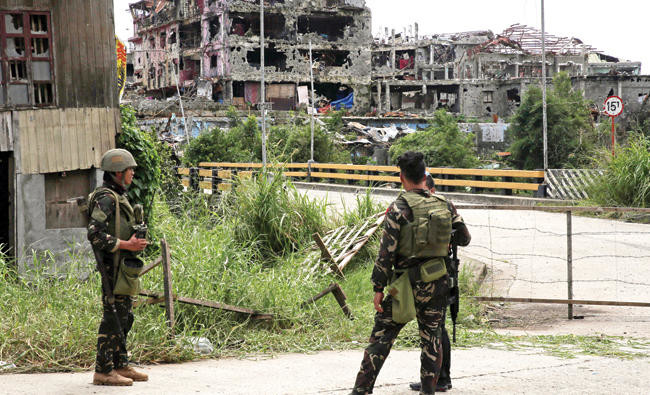
Soldiers stand on guard and look at damaged buildings and houses after government troops cleared the area from pro-Daesh militant groups inside the war-torn area in Saduc proper, Marawi city, southern Philippines Sunday. (Reuters)
Updated 22 October 2017
Follow

Surrender or die: Filipino troops battling final 30 Daesh-linked gunmen

MANILA: Philippine troops on Sunday were battling a final group of about 30 pro-Daesh group militants who were surrounded in one building with all their hostages gone as a nearly five-month siege neared its end in southern Marawi city, a military official said.
Army Col. Romeo Brawner said troops were aiming to end the crisis before midnight Sunday. He said the remaining gunmen, who include some Indonesian and Malaysian fighters, have the option of surrendering, or they can either be captured or killed.
“Our government forces will try to do everything to finish the firefight today,” Brawner said in a news conference in Marawi. He said the battle area centered in a two-story building near Lake Lanao where the firefight continued to rage at noon.
“It’s either they all get killed, because they’re determined to die inside, or we capture them or they surrender,” he said.
A gradual withdrawal of military forces was underway with the easing of the fighting, which has left at least 1,131 people dead, including 919 militants and 165 soldiers and policemen. Troops continued to ask the gunmen, who are leaderless and running low on ammunition, to surrender by using loudspeakers, Brawner said.
Military chief of staff Gen. Eduardo Año said some of the remaining militants were “suicidal.”
Hundreds of militants, many waving Daesh group-style black flags, launched the siege on May 23 in Marawi, a bastion of Islamic faith in the south of the largely Roman Catholic Philippines, by seizing the lakeside city’s central business district and outlying communities. They ransacked banks and shops, including gun stores, looted houses and smashed statues in a Roman Catholic cathedral, according to the military.
At least 1,780 of the hostages seized by the militants, including a Roman Catholic priest, were rescued, and a final group of 20 captives were freed overnight, Brawner said. That left the gunmen with none of the hostages they had used as human shields to slow the military advance for months.
The disastrous uprising, which has displaced hundreds of thousands of Marawi residents, erupted as the Philippines was hosting annual summit meetings of Southeast Asian nations and their Asian and Western counterparts, including the US and Australia. The two governments have deployed surveillance aircraft and drones to help Filipino troops rout the Marawi militants.
The siege has sparked fears that the Daesh group may gain a foothold in Southeast Asia by influencing and providing funds to local militants as it suffers battle defeats in Syria and Iraq.
Last Monday, troops killed the final two surviving leaders of the siege, including Isnilon Hapilon, who is listed among the FBI’s most-wanted terror suspects in the world, and Omarkhayam Maute. Following their deaths, President Rodrigo Duterte traveled near the main scene of battle and declared Marawi had been essentially liberated from terrorist influence, although skirmishes with a few dozen gunmen continued.
DNA tests done in the US requested by the Philippine military have confirmed the death of Hapilon, according to the US Embassy in Manila. Washington has offered a bounty of up to $5 million for Hapilon, who had been blamed for kidnappings for ransom of American nationals and other terrorist attacks.
Among the foreign militants believed to be with the remaining gunmen in Marawi were Malaysian militant Amin Baco and an Indonesian known only as Qayyim. Both have plotted attacks and provided combat training to local militants for years but have eluded capture in the south.


Le Pen: French far-right leader battling for political survival

Updated 13 sec ago
Follow

Le Pen: French far-right leader battling for political survival

  • Le Pen has said prosecutors wanted her “political death,” adding that she was being put on trial as a “political target“
  • Her life has been marked by the legacy of her outwardly racist father

PARIS: Far-right leader Marine Le Pen, who needs to have a graft conviction overturned to seize her best chance at the French presidency, risks seeing her life’s work upended if she loses her appeal.
Le Pen took over leadership of the National Front (FN) in 2011 from her father Jean-Marie, who co-founded France’s main postwar far-right movement.
In a move to distance it from the legacy of her father, who openly made antisemitic and racist statements, she renamed the party the National Rally (RN) and embarked on a policy she dubbed “de-demonization.”
The work bore fruit. In snap legislative polls in summer 2023, the RN emerged as the largest single party in the National Assembly — although without the outright majority it had targeted.
That gave Le Pen’s party power over French politics it had never before enjoyed, which she used by backing a no-confidence vote that toppled the government of prime minister Michel Barnier later in the year.
Critics accuse the party of still being inherently racist, taking too long to distance itself from Russia after its invasion of Ukraine and resorting to corrupt tactics to ease its strained finances, allegations Le Pen denies.
But by playing on people’s day-to-day concerns about immigration and the cost of living, Le Pen was seen as having her best chance to become France’s president in 2027 after three unsuccessful attempts.

- ‘Political target’ -
But her conviction last year, involving the use of fake jobs at the European Union parliament to channel funds to her party to employ people in France, has posed a potentially insurmountable hurdle to her long-sought end goal.
She was banned with immediate effect from standing for office for five years, which effectively disqualified her from running in next year’s presidential election.
Le Pen, 57, has said prosecutors wanted her “political death,” adding that she was being put on trial as a “political target.”
With her own ambitions hanging in the balance, she has backed her young lieutenant and protege, 30-year-old Jordan Bardella, to run in her place if needed.
“Bardella can win instead of me,” she told La Tribune Dimanche in December.
A poll in November predicted that Bardella — who is the RN party chief and not among those accused in the trial against Le Pen — would win the second round of the 2027 elections, no matter who stands against him.

- ‘Immense pain’ -
After coming third in the 2012 presidential polls, Marine Le Pen made the run-off in 2017 and 2022 but was beaten by Emmanuel Macron on both occasions.
Yet 2027 could be different, with Macron not allowed to stand again under France’s constitution.
Le Pen’s life has been marked by the legacy of her outwardly racist father, a veteran of the long war in Algeria that ultimately led to the former French colony’s independence.
She expelled her father, who once called the gas chambers of the Holocaust a “detail of history,” from the party in 2011, helping to temper its toxic image.
But his death last year aged 96 plunged his daughter into grief.
“I will never forgive myself” for expelling him, she said, describing him as a “warrior” in a tribute.
“I know it caused him immense pain,” she said of the man opponents nicknamed “the devil of the republic.”
“This decision was one of the most difficult of my life. And until the end of my life, I will always ask myself the question: ‘Could I have done this differently?’,” she said.