PARIS: The forces fighting the remnants of Daesh in Syria have tacit instructions on dealing with the foreigners who joined the extremist group by the thousands: Kill them on the battlefield.
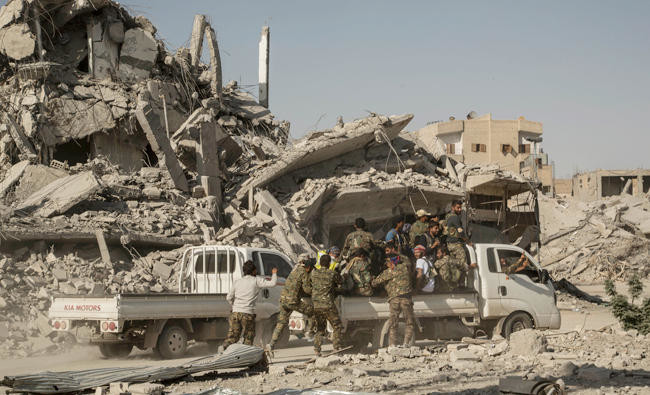
As they made their last stand in the northern Syrian city of Raqqa, an estimated 300 extremists holed up in and around a sports stadium and a hospital argued among themselves about whether to surrender, according to Kurdish commanders leading the forces that closed in. The final days were brutal — 75 coalition airstrikes in 48 hours and a flurry of desperate Daesh car bombs that were easily spotted in the sliver of devastated landscape still under militant control.
No government publicly expressed concern about the fate of its citizens who left and joined Daesh fighters plotting attacks at home and abroad. In France, which has suffered repeated violence claimed by Daesh — including the Nov. 13, 2015, attacks in Paris — Defense Minister Florence Parly was among the few to say it aloud.
“If the (Daesh) jihadis perish in this fight, I would say that’s for the best,” Parly told Europe 1 radio last week.
Those were the orders, according to the US.
“Our mission is to make sure that any foreign fighter who is here, who joined ISIS (Daesh) from a foreign country and came into Syria, they will die here in Syria,” said Brett McGurk, the top US envoy for the anti-Daesh coalition, in an interview with Dubai-based Al-Aan television.
“So if they’re in Raqqa, they’re going to die in Raqqa,” he said.
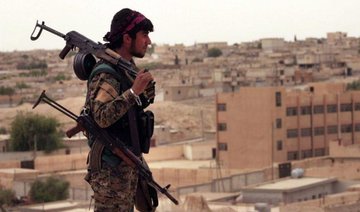
The coalition has given names and photos to the Kurdish fighters to identify the foreign terrorists, who are seen as a threat back home and a burden on their justice systems, according to a commander with the Kurdish-led Syrian Democratic Forces. The commander said his US-backed fighters are checking for wanted men among the dead or the few foreigners among the captured.
An official with the powerful People’s Protection Units (YPG), the backbone of the SDF that also runs the local security and intelligence branches, said foreigners who decided to fight until the end will be “eliminated.”
For the few prisoners, the Kurds try to reach out to the home countries, “and we try to hand them in.
But many would not want to take their (detainees),” he said.
No country will admit to refusing to take back citizens who joined Daesh, including women and their children. But few are making much of an effort to recover them.
In Iraq, hundreds of Daesh fighters have surrendered or have been taken into custody, and their families have been rounded up into detention camps. The men are put on trial and face the death penalty if convicted of terrorism charges — even if they are foreigners. One Russian fighter has already been hanged.
France, which routinely intervenes when citizens abroad face capital punishment, has said nothing about its terrorists in Iraq. More French joined Daesh, than any other European country.
Foreigners captured by Kurdish forces are in a more precarious position because the SDF does not answer to Syria’s regime and has no state of its own. A Syrian woman whose French husband surrendered to Kurdish authorities in June said she had no access to him and didn’t know where he was 50 days after they separated. She denied her husband was a Daesh fighter.
The camps for displaced civilians from Raqqa contain only foreign women and children. As for the fate of any French citizens there, France’s Foreign Ministry had a short response: “Our priority today is to achieve a complete victory over Daesh.”
German diplomats say all of the country’s citizens are entitled to consular assistance.
As the final battle in Raqqa drew to a close, Parly estimated a few hundred French fighters were still in the war zone. For Germany, about 600 men were unaccounted for.
At its height, between 27,000 and 31,000 may have traveled to Syria and Iraq to join Daesh, according to an analysis by the Soufan Group. Of those, about 6,000 were from Europe, with most from France, Germany and Britain. A majority had immigrant backgrounds and was heavily targeted by the group’s propaganda, which highlighted the injustices they faced at home. One study found that fewer than 10 percent of the Western fighters were converts to Islam.
As many as a third of the Europeans may have returned home. Many are jailed immediately and awaiting trial in backlogged courts, but others are freed and under surveillance.
Raqqa’s foreign holdouts are generally acknowledged to be midlevel Daesh recruits, and most are believed to have little information about the group’s inner workings. US Col. Ryan Dillon, a spokesman for the coalition, said he had no information about any “high-value targets” among around 350 fighters who surrendered in Raqqa in the last days, including a few foreigners.
But for their home countries, they pose a risk.
“The general sentiment in northern Europe is we don’t want these people back, but I don’t think anyone has thought about the alternatives,” said Pieter Van Ostaeyen, an expert on the Belgian terrorists.
Among the complications are how to prosecute any returnees and how to track them if and when they leave custody.
“You can see why almost the preferred resolution is that they don’t return,” said Bruce Hoffman, head of Georgetown University’s security studies program and author of “Inside Terrorism.”
“What worries me is I think it’s wishful thinking that they’re all going to be killed off,” he added.
Wishful thinking or not, Parly said it’s the best outcome.
“We cannot do anything to prevent their return besides neutralize the maximum number of terrorists in this combat,” she said.


![]()
Foreigners who joined Daesh face almost certain death in Raqqa
Foreigners who joined Daesh face almost certain death in Raqqa


Latest updates


Recommended


© 2026 SAUDI RESEARCH & PUBLISHING COMPANY, All Rights Reserved And subject to Terms of Use Agreement.