LONDON: As the centenary of the Balfour Declaration approaches, few people in the UK are aware of the implications of the 1917 document for Palestinians today, according to former BBC documentary maker Martin Buckley.
“There is a kind of unawareness in Britain,” said Buckley, at a London screening of the rough cut of a new documentary he directed.
He hopes it will help better inform the British public about the legacy of the 1917 declaration and how it paved the way for the creation of Israel in 1948.
The document — drawn up by the then-foreign secretary Arthur Balfour — declared the UK’s support for the Jewish people to be granted their own ‘national home’. It was welcome news to the growing Zionist movement in Europe.
“One of our inteviewees said that, didn’t she? That the average person on the street in England has no idea what Balfour is, but the average person in the street in the Middle East will have a strong opinion on Balfour,” he said.
He recounted a story about being sat on the tube in London chatting about this film with a colleague when the word ‘Balfour’ caught the attention of at least two Arabs sitting nearby who immediately joined in the debate. “It’s a powerful word for them,” he said.
One of those on the train — a student — was so interested in the event that he even turned up at the screening.
The inspiration for the documentary – which has the current working title of ‘From Balfour to Banksy’ — originally came from Miranda Pinch, a political activist and former social worker.
In the run up to the centenary of the Balfour Declaration on Nov. 2, Pinch saw an opportunity to tell the Palestinian side of the story on how the events that followed that 1917 declaration have affected their lives.
The film also demonstrates how the second part of the declaration, which said that that the rights of the existing non-Jewish communities in Palestine should be protected — has not been fulfilled.
Pinch met Buckley at an event earlier this year and within a couple of weeks the project was in motion.
The documentary was showcased to a small audience on Oct. 19 inevitably already well aware of the implications of Balfour.
Palestinian women; students; a filmmaker from Syria now living in France; a man in a free Gaza T-shirt and keen supporter of the London-based non-profit organization, the Palestine Solidarity Campaign, all made it through the rain to watch the film in North London held in an art gallery displaying pop art from North African artists.
Buckley however wants to get the film’s message out to far more people than this relatively small test audience, not only in the UK but across the world. The final version of the film is expected to be released in early November. He aims to put a version online as well as screened at film festivals.
The film traces the Palestinian story from the declaration of 1917: The UK’s mandate over Palestine; the creation of Israel to the recently installed art installation and hotel created by the UK artist Banksy called the ‘Walled Off Hotel’ – which opened this year in Bethlehem. The hotel rooms feature Banksy art and satirizes British foreign policy and its impact in the Middle East.
Buckley — who presents the documentary — interviews Palestinians in Hebron and the West Bank — all of whom express their frustration with the current Israeli government’s policies and the Jewish settlements in the West Bank as well as the daily restrictions on their movement within the occupied territories.
A young Palestinian student interviewed who studies in the shadow of the huge wall first erected by Israel in 2000 to divide the West Bank from Israel said “we feel like dreams don’t exist anymore.”
Yet, the film aims to be far more than just a historical documentary. “What I wanted from this film is to spend some time with Palestinians and see how they feel about the consequences of the Balfour declaration – not a pompous lecture about the declaration,” he said.
He added that it was important to include the Israeli perspective.
“I interviewed Jewish Israelis who were so keen to say why they thought the Balfour declaration had been a bad thing, and that they felt the Israeli state had become some kind of monster — and if it is going to survive as a state and physically – and those are interlinked — it is going to have to stop saying the British gave us a license to do whatever we wanted in 1917.”
The film currently ends — pending its final edit — with Palestinians calling for people from across the world to come and visit Palestine to meet the people and to learn more about the legacy of Balfour.
One of the woman interviewed in the closing sequence said it was no longer about being pro-Palestine or pro-Israel, but ‘pro-justice’.


![]()
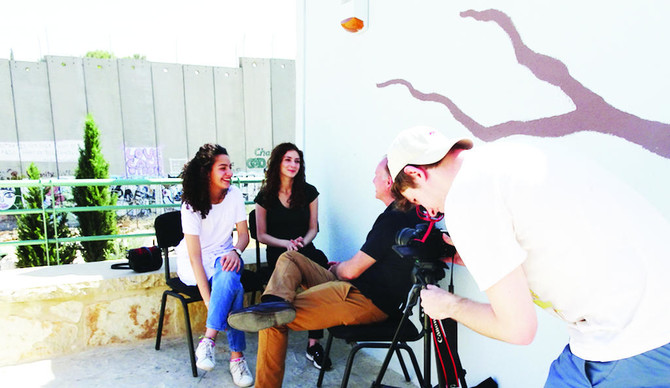
Filmmaker hopes to spread awareness of Balfour legacy in Britain
Filmmaker hopes to spread awareness of Balfour legacy in Britain

Latest updates



Recommended


© 2026 SAUDI RESEARCH & PUBLISHING COMPANY, All Rights Reserved And subject to Terms of Use Agreement.