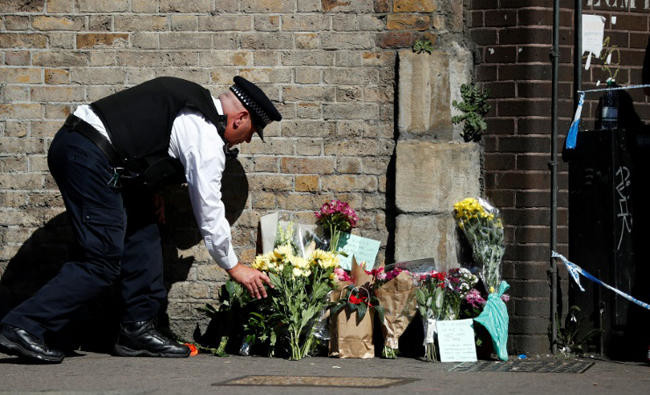
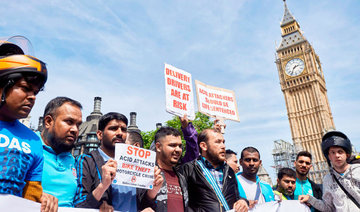
LONDON: Hate crimes in Britain surged by the highest amount on record last year, official figures showed on Tuesday, with the vote to leave the EU a significant factor. But despite the rise prosecutions fell.
There were 80,393 offenses in 2016/17, a rise of 29 percent from the year before. In the same period, hate crime prosecutions dropped to 14,480 from 15,442, a fall of 6.2 percent, according to Home Office data.
Assistant Chief Constable Mark Hamilton, National Police Chiefs’ Council Lead for Hate Crime, said in a statement to Arab News: “Police forces are making themselves more visible and accessible to local communities to ensure victims or anyone feeling vulnerable has the confidence to come forward.”
“We can do better at securing convictions,” Hamilton admitted.
“Nobody should have to face hatred because of who they are.”
Shaista Aziz, a British-Muslim journalist and founder of The EveryDay Bigotry Project, a digital anti-racism platform, said: “‘Today’s data showed a correlation between political events and terrorism attacks and peaks in reported hate crime.
“Many of the victims that I work with have not reported their hate crimes to the police because they may not have a witness to the crime or because they do not have confidence in the police or, even more worryingly, they say that these racialized incidents of hate are part of their daily lives.”
Fiyaz Mughal, founder of the hate crime reporting site Tell MAMA, told Arab News: “This is concerning. We know that the Crown Prosecution Service does a sterling job in sending out a message – where crimes have taken place and it is in the public interest to prosecute, they will do so with vigor and energy.
“The CPS will be reviewing their prosecution rates though there may be something in the hate crimes which relate to the online world which are much more difficult to get evidence on.”
Alison Saunders, the Director of Public Prosecutions, said: “The drop in referrals recorded last year has impacted on the number of completed prosecutions and we are working with the police at a local and national level to understand the reasons for the overall fall in referrals in the past two years.”
Saunders added that more than half of 2016-17 cases involving hostility on the grounds of race, religion, sexual orientation, disability or transgender identity saw sentences “uplifted.” This means that the courts passed increased sentences in more than 6,300 cases.

Hate crimes surge in Britain
India, Arab League target $500bn in trade by 2030
- It was the first such gathering of India–Arab FMs since the forum’s inauguration in 2016
- India and Arab states agree to link their startup ecosystems, cooperate in the space sector
NEW DELHI: India and the Arab League have committed to doubling bilateral trade to $500 billion by 2030, as their top diplomats met in New Delhi for the India–Arab Foreign Ministers’ Meeting.
The foreign ministers’ forum is the highest mechanism guiding India’s partnership with the Arab world. It was established in March 2002, with an agreement to institutionalize dialogue between India and the League of Arab States, a regional bloc of 22 Arab countries from the Middle East and North Africa.
The New Delhi meeting on Saturday was the first gathering in a decade, following the inaugural forum in Bahrain in 2016.
India’s Foreign Minister S. Jaishankar said in his opening remarks that the forum was taking place amid a transformation in the global order.
“Nowhere is this more apparent than in West Asia or the Middle East, where the landscape itself has undergone a dramatic change in the last year,” he said. “This obviously impacts all of us, and India as a proximate region. To a considerable degree, its implications are relevant for India’s relationship with Arab nations as well.”
Jaishankar and his UAE counterpart co-chaired the talks, which aimed at producing a cooperation agenda for 2026-28.
“It currently covers energy, environment, agriculture, tourism, human resource development, culture and education, amongst others,” Jaishankar said.
“India looks forward to more contemporary dimensions of cooperation being included, such as digital, space, start-ups, innovation, etc.”
According to the “executive program” released by India’s Ministry of External Affairs, the roadmap agreed by India and the League outlined their planned collaboration, which included the target “to double trade between India and LAS to US$500 billion by 2030, from the current trade of US$240 billion.”
Under the roadmap, they also agreed to link their startup ecosystems by facilitating market access, joint projects, and investment opportunities — especially health tech, fintech, agritech, and green technologies — and strengthen cooperation in space with the establishment of an India–Arab Space Cooperation Working Group, of which the first meeting is scheduled for next year.
Over the past few years, there has been a growing momentum in Indo-Arab relations focused on economic, business, trade and investment ties between the regions that have some of the world’s youngest demographics, resulting in a “commonality of circumstances, visions and goals,” according to Muddassir Quamar, associate professor at the School of International Studies, Jawaharlal Nehru University.
“The focus of the summit meeting was on capitalizing on the economic opportunities … including in the field of energy security, sustainability, renewables, food and water security, environmental security, trade, investments, entrepreneurship, start-ups, technological innovations, educational cooperation, cultural cooperation, youth engagement, etc.,” Quamar told Arab News.
“A number of critical decisions have been taken for furthering future cooperation in this regard. In terms of opportunities, there is immense potential.”