Britain, Germany ‘committed’ to Iran nuclear deal

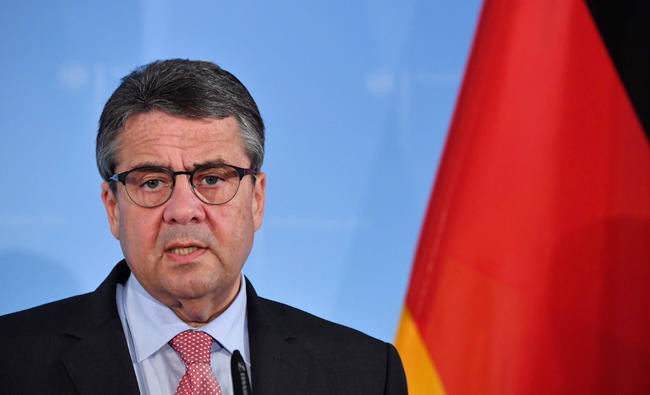
German Vice Chancellor and Foreign Minister Sigmar Gabriel gives a press conference on October 9, 2017 at the Foreign Ministry in Berlin to comment on Germany's position concerning the uphold of the landmark Iran nuclear deal. (AFP)
Updated 15 October 2017
Follow

Britain, Germany ‘committed’ to Iran nuclear deal

LONDON/PARIS: Britain and Germany agreed on Sunday they remained committed to the nuclear deal with Iran after a US decision to decertify the agreement, a spokeswoman said after a call between Prime Minister Theresa May and German Chancellor Angela Merkel.
“They agreed the UK and Germany both remained firmly committed to the deal,” the spokeswoman said in a statement.
“They also agreed the international community needed to continue to come together to push back against Iran’s destabilizing regional activity, and to explore ways of addressing concerns about Iran’s ballistic missile program.”
A day earlier, France also urged the US Congress not to rip up the Iran nuclear deal, after President Donald Trump decertified Iran’s compliance with the 2015 agreement.
“We strongly hope that Congress, which is now responsible for a possible rupture, does not jeopardize the deal,” French Foreign Minister Jean-Yves Le Drian said in an interview with AFP.
“If we denounce a deal that has been respected, it will set a dangerous precedent,” particularly in the context of negotiations with North Korea, Le Drian said, echoing other signatories of the Iran deal — Britain, France, Germany, China and Russia.
On Friday, Trump ignored the advice of worried allies and kicked the fate of the landmark 2015 deal to Congress, which he told to address its “many serious flaws.”
Under the deal a number of international sanctions against Tehran were lifted in return for Iranian curbs on its uranium enrichment.
The Republican-controlled Congress will now have to decide whether to reimpose sanctions on Iran — a step that if taken would almost certainly doom the agreement.
“For us, the Vienna accord is a good accord, it limits nuclear proliferation and prevents Iran from acquiring atomic weapons. It is robust and coherent,” said Le Drian.
However he left the door open to further talks on what happens after a deadline in 2025, when certain limits on Iran’s uranium enrichment are set to expire.
Washington would like to see the curbs extended in perpetuity.
“We can open a preliminary discussions with Tehran on what happens after 2025. If the treaty is respected, Iran can fully exercise its rights under the non-proliferation treaty. If safeguards or inspections are required on this date, we will start discussing them. It is also a way to avoid breaches today. We are ready to consider these issues with the Americans,” said Le Drian, who will visit Tehran in the coming weeks.
Asked if Europeans would be willing to impose sanctions against Iran’s powerful Revolutionary Guards Corps, as Trump has requested, Le Drian said “we can talk about it.”
More generally he said that recent decisions by the US — to withdraw from UNESCO and the Paris climate agreement, as well as jeopardizing the Iran deal — have called multilateralism into question.
“The American position today is a position of strength... of rivalry between powers and a denial of the interests of multilateralism,” he said.


India, Arab League target $500bn in trade by 2030

Updated 01 February 2026
Follow

India, Arab League target $500bn in trade by 2030

  • It was the first such gathering of India–Arab FMs since the forum’s inauguration in 2016
  • India and Arab states agree to link their startup ecosystems, cooperate in the space sector

NEW DELHI: India and the Arab League have committed to doubling bilateral trade to $500 billion by 2030, as their top diplomats met in New Delhi for the India–Arab Foreign Ministers’ Meeting. 

The foreign ministers’ forum is the highest mechanism guiding India’s partnership with the Arab world. It was established in March 2002, with an agreement to institutionalize dialogue between India and the League of Arab States, a regional bloc of 22 Arab countries from the Middle East and North Africa.

The New Delhi meeting on Saturday was the first gathering in a decade, following the inaugural forum in Bahrain in 2016.

India’s Foreign Minister S. Jaishankar said in his opening remarks that the forum was taking place amid a transformation in the global order.

“Nowhere is this more apparent than in West Asia or the Middle East, where the landscape itself has undergone a dramatic change in the last year,” he said. “This obviously impacts all of us, and India as a proximate region. To a considerable degree, its implications are relevant for India’s relationship with Arab nations as well.”

Jaishankar and his UAE counterpart co-chaired the talks, which aimed at producing a cooperation agenda for 2026-28.

“It currently covers energy, environment, agriculture, tourism, human resource development, culture and education, amongst others,” Jaishankar said.

“India looks forward to more contemporary dimensions of cooperation being included, such as digital, space, start-ups, innovation, etc.”

According to the “executive program” released by India’s Ministry of External Affairs, the roadmap agreed by India and the League outlined their planned collaboration, which included the target “to double trade between India and LAS to US$500 billion by 2030, from the current trade of US$240 billion.”

Under the roadmap, they also agreed to link their startup ecosystems by facilitating market access, joint projects, and investment opportunities — especially health tech, fintech, agritech, and green technologies — and strengthen cooperation in space with the establishment of an India–Arab Space Cooperation Working Group, of which the first meeting is scheduled for next year.

Over the past few years, there has been a growing momentum in Indo-Arab relations focused on economic, business, trade and investment ties between the regions that have some of the world’s youngest demographics, resulting in a “commonality of circumstances, visions and goals,” according to Muddassir Quamar, associate professor at the School of International Studies, Jawaharlal Nehru University.

“The focus of the summit meeting was on capitalizing on the economic opportunities … including in the field of energy security, sustainability, renewables, food and water security, environmental security, trade, investments, entrepreneurship, start-ups, technological innovations, educational cooperation, cultural cooperation, youth engagement, etc.,” Quamar told Arab News.

“A number of critical decisions have been taken for furthering future cooperation in this regard. In terms of opportunities, there is immense potential.”