Pollution is deadlier than war, disaster, hunger: Report

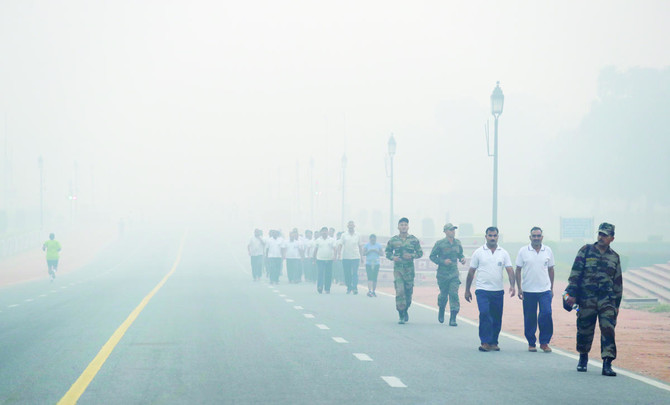
Indian soldiers walk amidst morning smog in New Delhi, on Friday. (AP)
Updated 21 October 2017
Follow

Pollution is deadlier than war, disaster, hunger: Report

NEW DELHI: Environmental pollution — from filthy air to contaminated water — is killing more people every year than all war and violence in the world. More than smoking, hunger or natural disasters. More than AIDS, tuberculosis and malaria combined.
One out of every six premature deaths in the world in 2015 — about 9 million — could be attributed to disease from toxic exposure, according to a major study released Thursday in the Lancet medical journal. The financial cost from pollution-related death, sickness and welfare is equally massive, the report says, costing some $4.6 trillion in annual losses — or about 6.2 percent of the global economy.
“There’s been a lot of study of pollution, but it’s never received the resources or level of attention as, say, AIDS or climate change,” said epidemiologist Philip Landrigan, dean of global health at the Icahn School of Medicine at Mount Sinai, New York, and the lead author on the report.
The report marks the first attempt to pull together data on disease and death caused by all forms of pollution combined.
“Pollution is a massive problem that people aren’t seeing because they’re looking at scattered bits of it,” Landrigan said.
Experts say the 9 million premature deaths the study found was just a partial estimate, and the number of people killed by pollution is undoubtedly higher and will be quantified once more research is done and new methods of assessing harmful impacts are developed.
Areas like Sub-Saharan Africa have yet to even set up air pollution monitoring systems. Soil pollution has received scant attention. And there are still plenty of potential toxins still being ignored, with less than half of the 5,000 new chemicals widely dispersed throughout the environment since 1950 having been tested for safety or toxicity.
“In the West, we got the lead out of the gasoline, so we thought lead was handled. We got rid of the burning rivers, cleaned up the worst of the toxic sites. And then all of those discussions went into the background” just as industry began booming in developing nations, said Richard Fuller, head of the global toxic watchdog Pure Earth and one of the 47 scientists, policy makers and public health experts who contributed to the 51-page report.
“To some extent these countries look to the West for examples and discussion, and we’d dropped it,” Fuller said.
Asia and Africa are the regions putting the most people at risk, the study found, while India tops the list of individual countries.
One out of every four premature deaths in India in 2015, or some 2.5 million, was attributed to pollution. China’s environment was the second deadliest, with more than 1.8 million premature deaths, or one in five, blamed on pollution-related illness, the study found.
Several other countries such Bangladesh, Pakistan, North Korea, South Sudan and Haiti also see nearly a fifth of their premature deaths caused by pollution.
Still, many poorer countries have yet to make pollution control a priority, experts say. India has taken some recent actions, such as tightening vehicle and factory emission standards and occasionally limiting the number of cars on New Delhi’s roads. But they have done little about crop burning, garbage fires, construction dust or rampant use of the dirtiest fossil fuels.
A court ban on firework sales before the Diwali festival did not stop New Delhi residents from firing rockets and lighting crackers throughout Thursday night. They awoke Friday morning to acrid, smoke-filled skies and levels of dangerous, lung-clogging particulate matter known as PM2.5 that went beyond 900 parts per million — 90 times the recommended limit by the World Health Organization (WHO) and 22 times higher than India’s own limits.
“Even though better pollution norms are coming in, still the pollution levels are continuously increasing,” said Shambhavi Shukla, a research associate with the Delhi-based Center for Science and Environment, which was not involved in the Lancet study.
To reach its figures on the overall global pollution burden, the study’s authors used methods outlined by the US Environmental Protection Agency for assessing field data from soil tests, as well as with air and water pollution data from the Global Burden of Disease, an ongoing study run by institutions including WHO and the Institute for Health Metrics and Evaluation at the University of Washington.


Swiss investigators believe sparklers on champagne bottles ignited bar fire

Updated 3 sec ago
Follow

Swiss investigators believe sparklers on champagne bottles ignited bar fire

  • Authorities are investigating whether the sparkling candles came too close to the ceiling of a bar crowded with New Year’s Eve revelers
  • At least 40 people were killed and another 119 injured as the blaze ripped through Le Constellation bar in Crans-Montana
CRANS-MONTANA, Switzerland: Investigators said Friday that they believe sparkling candles atop Champagne bottles ignited a fatal fire at a Swiss ski resort when they came too close to the ceiling of a bar crowded with New Year’s Eve revelers.
Authorities planned to look into whether sound-dampening material on the ceiling conformed with regulations and whether the candles, which give off a stream of upward-shooting sparks, were permitted for use in the bar.
Forty people were killed and another 119 injured in the blaze early Thursday as it ripped through the busy Le Constellation bar at the ski resort of Crans-Montana, authorities said. It was one of the deadliest tragedies in Switzerland’s history.
Officials said they would also look at other safety measures on the premises, including fire extinguishers and escape routes. The attorney general for the Valais region warned of possible prosecutions if any criminal liability is found.
Arthur Brodard, 16, from the Swiss city of Lausanne, was among the missing. His mother, Laetitia, was in Crans-Montana on Friday and frantic to find him. She held out “a glimmer of hope” that he might be one of the six injured people who had yet to be identified.
“I’m looking everywhere. The body of my son is somewhere,” she told reporters. “I want to know, where is my child, and be by his side, wherever that may be — be it in the intensive care unit or the morgue.”
The injured included 71 people from Switzerland, 14 from France and 11 from Italy, along with citizens of Serbia, Bosnia-Herzegovina, Luxembourg, Belgium, Portugal and Poland, according to Frédéric Gisler, police commander of the Valais region. The nationalities of 14 people were unclear.
An evening of celebration turns tragic
Among the crowd was Axel Clavier, a 16-year-old from Paris, who said he felt as if he was suffocating inside the Swiss Alpine bar where moments before he had been ringing in the new year.
The teenager escaped the inferno by forcing a window open with a table. The dead included one of Clavier’s friends, and he told The Associated Press that two or three other friends were still missing hours after the disaster.
An impromptu memorial took shape near the bar, where mourners left candles and flowers. Hundreds of others prayed for the victims at the nearby Church of Montana-Station.
A French teenager on Friday brought a bouquet of tulips to the regional hospital in Sion for her best friend, a fellow 17-year-old girl who was badly burned and in intensive care. The two attend school together in Lausanne, said the girl, who was in distress and did not give her full name to the AP.
But when she arrived at the hospital, her friend had been heavily sedated for a dressing change and could not see visitors. It was the latest in hours of heartbreak for the teen, who had intended to join a dozen schoolmates at the bar but ultimately decided against it.
She said she has since learned that two of the 12 are in a Zurich hospital. She did not know if the others survived.
On Instagram, an account filled up with photos of people who were unaccounted for, and friends and relatives begged for tips about their whereabouts.
Valais regional government head Mathias Reynard told RTS radio Friday that officials have “numerous accounts of heroic actions, one could say, of very strong solidarity in the moment.”
He lauded the work of emergency officials on the day after the fire but added “in the first minutes it was citizens — and in large part young people — who saved lives with their courage.”
Servers arrived with burning sparklers
Clavier, the Parisian teenager, said he did not see the fire start, but he saw servers arrive with Champagne bottles topped with the burning sparklers.
Two women told French broadcaster BFMTV they were inside when they saw a male bartender lifting a female bartender on his shoulders as she held a lit candle in a bottle. The flames spread, collapsing the wooden ceiling, they told the broadcaster.
One of the women described a crowd surge as people frantically tried to escape from the basement nightclub up a flight of stairs and through a narrow door.
Another witness speaking to BFMTV described people smashing windows to escape the blaze, some gravely injured, and panicked parents rushing to the scene in cars to see whether their children were trapped inside.
Gianni Campolo, a Swiss 19-year-old who was in Crans-Montana on vacation, raced to the bar to help first responders after receiving a call from a friend who escaped the inferno. He described people on the ground suffering from terrible burns.
“I have seen horror, and I don’t know what else would be worse than this,” Campolo told French television network TF1.
Marc-Antoine Chavanon, 14, joined the effort to get people out of the tavern.
“People were collapsing. We were doing everything we could to save them,” he said. “There was one of our friends: She was struggling to get out. She was all burnt. You can’t imagine the pain I saw.”
The severity of the burns made it difficult to identify bodies, requiring families to supply authorities with DNA samples. In some cases, wallets and any identification documents inside turned to ash in the flames.
Emanuele Galeppini, a promising teenage Italian golfer who competed internationally, was officially listed as missing. His uncle Sebastiano Galeppini told Italian news agency ANSA that their family is awaiting the results of DNA tests, though the Italian Golf Federation on its website announced that he had died.
With high-altitude ski runs rising around 3,000 meters (nearly 9,850 feet) in the heart of the Valais region’s snowy peaks and pine forests, Crans-Montana is a major destination for international alpine skiing competitions. It’s also home to the European Masters each August.