Building collapse in south India kills eight

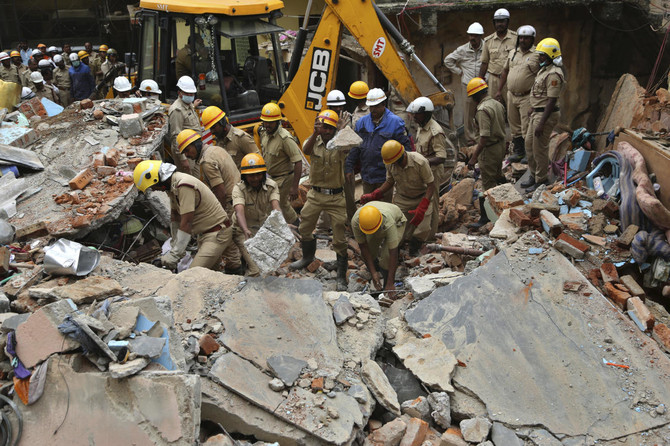
Rescue workers remove the debris to look for survivors at the site of a building that collapsed in Bangalore, India on Monday, October 16, 2017. (File photo by AP)
Updated 20 October 2017
Follow

Building collapse in south India kills eight

NEW DELHI: A building collapse in southern India left eight people dead on Friday, an official said, the latest such disaster in the country known for its dilapidated properties and poor quality construction.
The group were among 11 employees of a state-run transport company, including bus drivers and cleaners, who were sleeping in the 60-year-old, two story office block near a bus depo when a portion of it caved in.
“It was an old building that suddenly collapsed while the staff were asleep,” said C Suresh Kumar, the top government official for Nagapattinam district in Tamil Nadu state, where the incident occurred.
He said emergency workers had managed to rescue three of the workers from under tons of debris, who were being treated for their injuries at a government-run hospital.
The state government has also offered $2,300 in compensation to the victims’ families.
Building disasters are common in Indian cities where millions are forced to live in cramped, run-down properties due to spiraling real estate prices and a lack of housing, while activists say owners often cut corners on construction to save costs.
At least six people were killed on Monday when an apartment block collapsed in Bangalore city after a gas tank explosion, and more than 30 perished in September when a 117-year-old apartment building collapsed in Mumbai.


More than 100 dead in torrential rain and floods across southern Africa

Updated 5 sec ago
Follow

More than 100 dead in torrential rain and floods across southern Africa

  • South Africa has reported at least 19 deaths in two of its northern provinces following heavy rains
  • Tourists and staff members were evacuated this week by helicopter from flooded camps

JOHANNESBURG: Torrential rains and flooding have killed more than 100 people in South Africa, Mozambique and Zimbabwe, and authorities warned Friday that more severe weather was expected across several countries in southern Africa.
South Africa has reported at least 19 deaths in two of its northern provinces following heavy rains that began last month and led to severe flooding.
Tourists and staff members were evacuated this week by helicopter from flooded camps to other areas in the renowned Kruger National Park, which is closed to visitors while parts of it are inaccessible because of washed out roads and bridges, South Africa’s national parks agency said.
In neighboring Mozambique, the Institute for Disaster Management and Risk Reduction said 103 people had died in an unusually severe rainy season since late last year. Those deaths were from various causes including electrocution from lightning strikes, drowning in floods, infrastructure collapse caused by the severe weather and cholera, the institute said.
The worst flooding in Mozambique has been in the central and southern regions, where more than 200,000 people have been affected, thousands of homes have been damaged, while tens of thousands face evacuation, the World Food Program said.
Zimbabwe’s disaster management agency said that 70 people have died and more than 1,000 homes have been destroyed in heavy rains since the beginning of the year, while infrastructure including schools, roads and bridges collapsed.
Flooding has also hit the island nation of Madagascar off the coast of Africa as well as Malawi and Zambia. Authorities in Madagascar said 11 people died in floods since late November.
The United States’ Famine Early Warning System said flooding was reported or expected in at least seven southern African nations, possibly due to the presence of the La Nina weather phenomenon that can bring heavy rains to parts of southeastern Africa.
South African President Cyril Ramaphosa visited flood-stricken areas in the northern Limpopo province on Thursday and said that region had received around 400 millimeters (more than 15 inches) of rain in less than a week. He said that in one district he visited “there are 36 houses that have just been wiped away from the face of the Earth. Everything is gone ... the roofs, the walls, the fences, everything.”
The flooding occurred in the Limpopo and Mpumalanaga provinces in the north, and the South African Weather Service issued a red-level 10 alert for parts of the country for Friday, warning of more heavy rain and flooding that poses a threat to lives and could cause widespread infrastructure damage.
The huge Kruger wildlife park, which covers some 22,000 square kilometers (7,722 square miles) across the Limpopo and Mpumalanga provinces, has been impacted by severe flooding and around 600 tourists and staff members have been evacuated from camps to high-lying areas in the park, Kruger National Park spokesperson Reynold Thakhuli said.
He couldn’t immediately say how many people there were in the park, which has been closed to visitors after several rivers burst their banks and flooded camps, restaurants and other areas. The parks agency said precautions were being taken and no deaths or injuries had been reported at Kruger.
The South African army sent helicopters to rescue other people trapped on the roofs of their houses or in trees in northern parts of the country, it said. An army helicopter also rescued border post officers and police officers stranded at a flooded checkpoint on the South Africa-Zimbabwe border.
Southern Africa has experienced a series of extreme weather events in recent years, including devastating cyclones and a scorching drought that caused a food crisis in parts of a region that often suffers food shortages.
The World Food Program said more than 70,000 hectares (about 173,000 acres) of crops in Mozambique, including staples such as rice and corn, have been waterlogged in the current flooding, worsening food insecurity for thousands of small-scale farmers who rely on their harvests for food.