



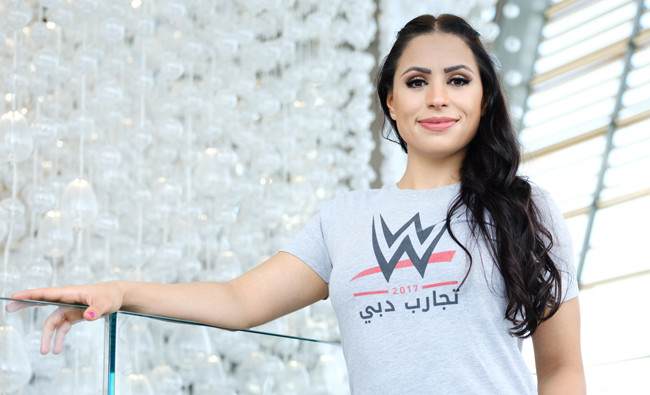


LONDON: Anyone wondering whether the relationship between Arab women and sport is changing need only look at the story of Shadia Bseiso for confirmation of this.
The Jordanian has just become the first female wrestler from the Middle East to sign up for WWE — the brash, in-your-face, athletic razzmatazz display that is pure Americana.
The story of her journey to the global sport-cum-entertainment show watched by millions across the world is pure Hollywood.
Bseiso, a former TV presenter, had one huge passion in her life, jiu-jitsu, so when the chance to combine her job with her love of exercise arose she jumped at the chance, auditioning as presenter for WWE’s first Arabic TV show.
She did not get the job, for the sole reason that no sooner had she finished the casting WWE officials, having found out about her jiu-jitsu background, asked her for a tryout to be an actual wrestler. Bseiso went to the trial, wowed those watching, and the rest is history.
“I never imagined an opportunity like this would materialize, it’s just incredible and a great opportunity,” Bseiso told Arab News.
“I trained seriously in jiu-jitsu and competed internationally so to be able to combine entertainment and sport is the dream.”
While that story is indeed the stuff of dreams and tells you a lot, her overall journey to that point tells you a whole lot more.
By her own admission Bseiso, like many Arab women, had a fairly ambivalent relationship with sport — she had tried her hand at various pursuits in the past without ever really committing to anything. Then one day in 2013 she tried jiu-jitsu and found her passion.
“I got into sport quite late but my perspective on life is that it’s either all or nothing,” she said.
“I started training just four years ago and I quickly fell in love with the sport. It’s a long journey in jiu-jitsu: It takes a minimum of eight years to get a black belt, so you really earn your stripes and that’s something that I really like. Nothing is given to you.”
Within three months of taking up jiu-jitsu she competed in a tournament in Dubai, where she is based, and ended up winning the bronze medal. Since then she has competed internationally, including bouts at the World Championships in Los Angeles two years in a row.
To help her jiu-jitsu she started to do CrossFit — a strength and conditioning program, which in language us couch potatoes understand is simply a very, very hard workout — and the combination of martial arts and tough exercise was a revelation to her.
“Sport has changed my life; jiu-jitsu has changed my life,” Bseiso said. “I feel like on a daily basis when I was presenting I would do a CrossFit session and it was literally the hardest thing I would do every day. Once I conquer that hour in the gym I feel like I can dominate the day.”
The sight of women taking part in sport is still relatively rare across the Arab world. Bseiso is only too aware that her journey to possible global superstardom, via the gyms and jiu-jitsu mats of the Middle East, can act as inspiration to women across a region she said is changing rapidly.
“I hope to be a role model one day, and be a good one; it’s an honor to be the first Arab women from the Middle East to sign with WWE, and a privilege,” she said.
“But it’s also a great responsibility. I hope this inspires girls, whether it is wanting to sign for WWE or pursue any other dream. The sky’s the limit now, the door is open.
“The world has changed; it doesn’t matter if you’re male or female, how old you are or where you’re from, if you put in the work everything follows and that is the message I want to put across.
“And I hope one day when I get the opportunity to step into the WWE ring that I represent the region very well.”
The timelines of increased women’s participation in sport and Bseiso’s own journey to the WWE are remarkably similar. It was only at the 2012 London Olympics that every country participating in the premier sporting showpiece was required to send female athletes, and the growing movement to increase female participation in sport is something Bseiso backs with as much force as one of her jiu-jitsu throws.
“As a young girl I didn’t get the chance to see Arab female athletes compete and now you get to see them compete at the highest level, imagine how different things would have been if growing up I had been able to watch women compete,” she remarked.
“The world is changing, you have to credit the London Olympics and there is a women’s revolution happening in WWE. I feel like it’s the perfect time to join. Women’s matches are as important as the men’s and they get to be the main event now, so this is a very exciting time for women in sports.”
It should come as no surprise to find out that having achieved so much, Bseiso sees her entry into WWE as only the start — but she is taking nothing for granted.
She moves to Orlando in January to train full time at the WWE Performance Center, the official professional wrestling school of WWE. There she will will be taught by the best coaches in the business and undergo sports-specific conditioning, in what she says will be like “going back to university.”
From there she hopes to get the call up to NXT, the developmental division of WWE, and if all goes to plan the next step up will be to the big ring, and being beamed to millions of TV screens around the world.
“With an opportunity like this there are no guarantees. It really depends on progress and remaining as injury free as possible. But I know it’s going to be a long journey,” Bseiso said.
“Hopefully one day I’ll get the call up to WWE and you know once I make it into the WWE ring I want it all — I want to be WWE women’s champion and I would absolutely love to perform at WrestleMania.”
One jibe regularly thrust in the face of WWE is that it is not a sport — that it is staged entertainment, with the result decided before any piledrivers and clotheslines are enacted in the ring.
That is something Bseiso — who is intending to maintain her charge for a jiu-jitsu black belt, no matter how long it takes — refuted.
“There’s nothing unreal about what happens in the ring,” she said.
“WWE superstars are trained super-athletes, you need to be athletic and trained to do these moves to entertain people but at the end of the day it’s about putting a smile on people’s faces.”
Given her journey so far, in the coming years do not be surprised if you see Bseiso become a superstar and role model for everyone across the region.


