MADRID: Spain said Thursday it will press ahead with suspending Catalonia’s autonomy after the region’s leader warned he may declare independence, heralding an unprecedented escalation of the country’s worst political crisis in decades.
The central government in Madrid had given separatist leader Carles Puigdemont until 10:00 am (0800 GMT) on Thursday to say whether or not he was declaring a breakaway state in the semi-autonomous region following a chaotic referendum on October 1.
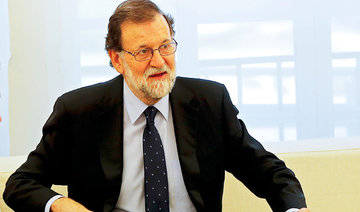
Prime Minister Mariano Rajoy had warned he would trigger Article 155 of Spain’s constitution — a never-before-used measure allowing it to impose direct rule over the wealthy northeastern region — unless Puigdemont backed down.
There are fears that such a move, allowing the government to potentially suspend Puigdemont’s government and take over its police force, could spark unrest in a region where even Catalans who oppose independence cherish their autonomy highly.
Puigdemont responded Thursday that Catalan lawmakers could vote to declare secession unilaterally if Madrid triggers Article 155.
“If the central government persists in preventing dialogue and continuing repression, Catalonia’s parliament could proceed... to vote for a formal declaration of independence,” he wrote in a letter to Rajoy, adding that a cryptic “suspended” independence declaration he issued last week did not amount to breaking away.
The government hit back by saying it intends to push on with triggering Article 155 — a process that would take several days — to “restore legality” in the region.
It called an emergency cabinet meeting for Saturday to specify how it will take control over the region.
The Catalonia crisis has worried investors and added to the woes of a European Union already grappling with Brexit.
Catalonia’s 7.5 million residents have their own language and culture but are divided on whether to break away from the rest of Spain.
Puigdemont says his regional administration has a mandate to declare independence from what he says was a 90-percent “Yes” vote on October 1, marred by a heavy-handed police crackdown on voters.
But turnout was given as only 43 percent. Many voters who oppose independence stayed away from a referendum that had been declared illegal by Spain’s Constitutional Court.
Madrid had on Wednesday offered the separatists a potential last-minute way out of the crisis by proposing fresh regional elections. A government source told AFP that would allow the region to “return to legality.”
Elections sanctioned by Madrid — unlike the referendum — would allow Catalan voters to have a say on how to move forward.
But while Puigdemont’s administration may still be weighing the proposal up, there was no mention of plans for such polls in his response Thursday.
Barcelona football club’s Camp Nou stadium displayed a massive banner emblazoned with the words “Dialogue, Respect and Sport” on Wednesday night.
It was reopening for its first match since playing to empty seats in protest at the violence against voters, some of whom were dragged by their hair and thrown down stairs by police.
Catalans have grown increasingly frustrated with politicians’ failure to find a way out of the deadlock. The prolonged uncertainty is taking a toll on one of Spain’s most important regional economies.
More than 800 companies have moved their headquarters out of Catalonia, citing the risk of instability. The national government has cut its growth forecast for next year to 2.3 percent, blaming the current crisis.
Separatists complain that Catalonia, which represents about a fifth of Spain’s economic output, pours more into the national coffers than it gets back, and say it would prosper if it went its own way.
But opponents say the region has more clout as part of Spain and that the instability could be disastrous for its economy.


![]()

Spain to push ahead with suspending Catalan autonomy
Spain to push ahead with suspending Catalan autonomy


Latest updates


Recommended


© 2026 SAUDI RESEARCH & PUBLISHING COMPANY, All Rights Reserved And subject to Terms of Use Agreement.