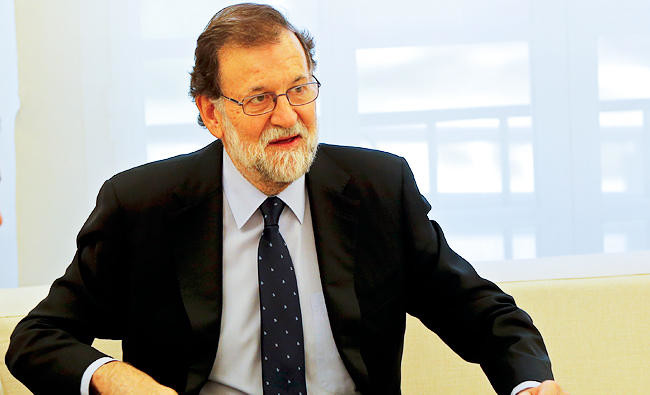
MADRID: Spanish Prime Minister Mariano Rajoy has refused to rule out suspending Catalonia’s regional autonomy unless its leaders withdraw a threatened declaration of independence as tens of thousands rallied for national unity.
“I don’t rule out anything,” Rajoy said in an interview with the daily newspaper El Pais published Sunday when asked about applying the constitutional provision that allows the suspension of autonomy and the imposition of direct rule from Madrid.
“But I must do things at the proper time... I would like the threat of an independence declaration to be withdrawn as quickly as possible.”
Seeking to reassure Spaniards, he added: “The government will ensure that any declaration of independence will lead to nothing.”
He also urged moderate Catalan nationalists to distance themselves from the “radicals” in the separatist camp who are pushing hardest for an independence move.
He spoke after tens of thousands of demonstrators rallied across Spain on Saturday calling for Spanish unity and demanding action to resolve the volatile political crisis.
Protesters dressed in white gathered in front of town halls in dozens of cities to demand dialogue to end the crisis in demonstrations organized by a group called “Let’s Talk.”
“I am sad to see the state in which we find our country and the mediocrity of our government,” said Marte Muro, 67, at the rally in Madrid, which drew several thousand people.
In Barcelona thousands packed Sant Jaume square in front of city hall as tension reigned with no solution in sight to Spain’s worst political crisis in a generation.
They held up signs with the word “parlem” — Catalan for “let’s talk” — and waved white handkerchiefs but not flags.
Similar rallies were held in Bilbao, Zaragoza, Valladolid and other cities under the slogan: “Spain is better than its leaders.”
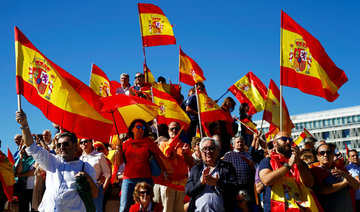
But in Madrid, parallel to the “Let’s Talk” march, some 50,000 people according to Spain’s central government gathered in Colon Square beneath an enormous Spanish flag for a “patriotic” march organized by activists to defend unity.
“Rajoy, you asshole, defend the nation!” chanted one group of demonstrators as they marched into Colon Square waving Spanish flags as well as one bearing the Franco-era black eagle.
Separate from that group, Octavi Puig, a retired Catalan who lives in Madrid, said he came to the protest because he did not want a “Berlin wall” to separate him from the graves of his loved ones and his family in Catalonia.
Opponents of secession for Catalonia have called for a mass demonstration on Sunday in Barcelona.
The rallies followed days of soaring tensions after police cracked down on voters during a banned October 1 Catalan independence referendum, prompting separatist leaders to warn they would unilaterally declare independence in days.
Tentative signs emerged Friday that the two sides may be seeking to defuse the crisis after Madrid offered a first apology to Catalans injured by police during the vote.
But uncertainty still haunts the country as Catalan leaders have not backed off from plans to declare the region independent.
And Catalan leader Carles Puigdemont said he has had “no contact” with the central government to try to resolve the crisis.
“There are millions of people who have voted, who want to decide. We have to talk about that,” he told Catalan public television TV3, which will broadcast its full interview with Puigdemont on Sunday.
Rajoy has rejected calls for mediation in a dispute that has drawn cries of concern all over Spain, and even from Barcelona and Real Madrid footballers.
The crisis has raised fears of unrest in the northeastern region, a tourist-friendly area of 7.5 million people that accounts for a fifth of Spain’s economy.
Businesses and the government have kept up economic pressure on Catalonia, with several big companies announcing moves to shift their headquarters to other parts of Spain.
Puigdemont had been due to appear at the regional parliament on Monday but postponed it by a day, a spokesman said.
It remains unclear what he plans to say, although some separatist leaders hope he will use the opportunity to make a declaration of independence.
The Catalan government on Friday published final results from the referendum indicating that 90 percent of voters backed the idea of breaking away from Spain.
Turnout was 43 percent. The vote was not held according to regular electoral standards, without regular voter lists or observers.
Recent polls had indicated that Catalans are fairly evenly split on independence, though leaders said the violence during the referendum turned many against the state authorities.