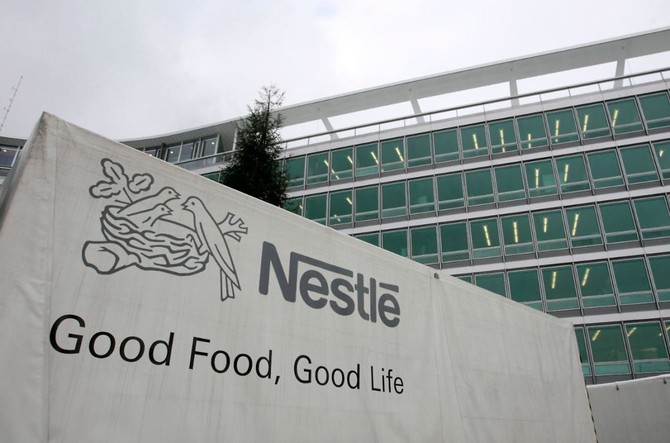
ZURICH: Swiss food giant Nestle expects organic sales growth to stay muted in the fourth quarter and is speeding up its restructuring program as it seeks to improve profit margins.
Makers of packaged foods are under pressure to review their business models and brand portfolios to satisfy consumers’ appetite for fresh, healthy, local foods, while at the same time improving returns to address increasingly vocal activist investors.
The maker of KitKat chocolate bars said on Thursday it expected its 2017 operating margin to slip by 0.4 to 0.6 percentage points as restructuring costs could reach 1 billion Swiss francs (SR3.82 billion), double the initial plan, while maintaining guidance for overall charges of up to 2.5 billion francs until 2020.
It said, however, that its underlying trading operating margin, which strips out restructuring costs, was set to improve by at least 0.2 percentage points in constant currency this year.
Under pressure from activist investor Third Point to improve near-term returns, Nestle last month set a target for this margin to reach 17.5-18.5 percent by 2020, up from 16.0 percent in 2016.
Organic sales growth accelerated to 3.1 percent in the third quarter from 2.3 percent in the first and 2.4 percent in the second, in line with expectations in a Reuters poll of analysts, helped by improved trading in Europe and Asia.
Nestle, also known for Nescafe instant coffee and Gerber baby food, said it expected organic growth for the full year to be in line with the 2.6 percent seen in the nine-month period, implying a slowdown in the fourth quarter from 2.9 percent in the year-ago period.
Chief Finance Officer Francois-Xavier Roger told reporters this was also due to seasonal factors such as the leap year last year and the timing of the Chinese New Year, with expected underlying growth in the final quarter “closer to 3 percent.”
He cautioned that the Europe, Middle East and North Africa zone and Asia might not be able to repeat the good performance over the final three months.
Roger confirmed Nestle’s goal of returning to mid-single-digit organic growth by 2020, citing a turnaround at its Chinese Yinlu business and a strategic review of its US candy business that would likely be completed by the end of the year.
Chief Executive Mark Schneider said last month about 10 percent of the group’s more than $90 billion in group sales could be under review.
Nestle shares, up almost 15 percent this year, were down 0.5 percent at 0752 GMT, broadly in line with the European sector .
“The stock has been strong year to date, but we see nothing in this reporting to push it further,” Bernstein analyst Andrew Wood wrote. He said the Americas lagged expectations and nutrition disappointed compared to Danone’s “fantastic performance.”
Danone reported a 4.7 percent rise in underlying third-quarter sales, helped by strong baby food sales in China. Peer Unilever reported a 2.6 percent rise in underlying quarterly sales, blaming poor weather in Europe and natural disasters in the Americas.

Nestle accelerates restructuring as sales growth stays tepid
Arab food and beverage sector draws $22bn in foreign investment over 2 decades: Dhaman
JEDDAH: Foreign investors committed about $22 billion to the Arab region’s food and beverage sector over the past two decades, backing 516 projects that generated roughly 93,000 jobs, according to a new sectoral report.
In its third food and beverage industry study for 2025, the Arab Investment and Export Credit Guarantee Corp., known as Dhaman, said the bulk of investment flowed to a handful of markets. Egypt, Saudi Arabia, the UAE, Morocco and Qatar attracted 421 projects — about 82 percent of the total — with capital expenditure exceeding $17 billion, or nearly four-fifths of overall investment.
Projects in those five countries accounted for around 71,000 jobs, representing 76 percent of total employment created by foreign direct investment in the sector over the 2003–2024 period, the report said, according to figures carried by the Kuwait News Agency.
“The US has been the region's top food and beverage investor over the past 22 years with 74 projects or 14 projects of the total, and Capex of approximately $4 billion or 18 percent of the total, creating more than 14,000 jobs,” KUNA reported.
Investment was also concentrated among a small group of multinational players. The sector’s top 10 foreign investors accounted for roughly 15 percent of projects, 32 percent of capital expenditure and 29 percent of newly created jobs.
Swiss food group Nestlé led in project count with 14 initiatives, while Ukrainian agribusiness firm NIBULON topped capital spending and job creation, investing $2 billion and generating around 6,000 jobs.
At the inter-Arab investment level, the report noted that 12 Arab countries invested in 108 projects, accounting for about 21 percent of total FDI projects in the sector over the past 22 years. These initiatives, carried out by 65 companies, involved $6.5 billion in capital expenditure, representing 30 percent of total FDI, and generated nearly 28,000 jobs.
The UAE led inter-Arab investments, accounting for 45 percent of total projects and 58 percent of total capital expenditure, the report added, according to KUNA.
The report also noted that the UAE, Saudi Arabia, Egypt, and Qatar topped the Arab ranking as the most attractive countries for investment in the sector in 2024, followed by Oman, Bahrain, Algeria, Morocco, and Kuwait.
Looking ahead, Dhaman expects consumer demand to continue rising. Food and non-alcoholic beverage sales across 16 Arab countries are projected to increase 8.6 percent to more than $430 billion by the end of 2025, equivalent to 4.2 percent of global sales, before exceeding $560 billion by 2029.
Sales are expected to remain highly concentrated geographically, with Egypt, Saudi Arabia, Algeria, the UAE and Iraq accounting for about 77 percent of the regional total. By product category, meat and poultry are forecast to lead with sales of about $106 billion, followed by cereals, pasta and baked goods at roughly $63 billion.
Average annual per capita spending on food and non-alcoholic beverages in the region is projected to rise 7.2 percent to more than $1,845 by the end of 2025, approaching the global average, and to reach about $2,255 by 2029. Household spending on these products is expected to represent 25.8 percent of total expenditure in 13 Arab countries, above the global average of 24.2 percent.
Arab external trade in food and beverages grew more than 15 percent in 2024 to $195 billion, with exports rising 18 percent to $56 billion and imports increasing 14 percent to $139 billion. Brazil was the largest foreign supplier to the region, exporting $16.5 billion worth of products, while Saudi Arabia ranked as the top Arab exporter at $6.6 billion.