BUSAN, South Korea: Virtual Reality will change the face of cinema in the next decade — but only if content keeps up with the advances in technology, industry experts at the Busan International Film Festival predict.
VR is already being heavily promoted by the tech giants, with Facebook and Microsoft launching new headsets they hope will ensure the format goes mainstream.
Studios and film-makers are also poised to capitalize, as cinema industry reports estimate VR could generate as much as $75 billion a year in revenues by 2021.
Earlier this year, the IMAX chain opened its first VR cinema in Los Angeles, while the leading film festivals — including Cannes, Venice, and Tribeca — now have sections dedicated to recognizing ground-breaking work in the medium.
“Facebook and Apple are pouring billions of dollars into this industry and these hardware developments are key but it will all come down to content and we are excited by the way that is developing,” explained Korean-American filmmaker Eugene Chung, whose production “Arden’s Wake” won the Best Virtual Reality award at Venice in September.
Chung insisted the format is going to shift public perception and expectations of cinema.
“We’re really building the future,” he said.
But revolutions in cinema do not always play out; despite their early hype, 3D movies have struggled to rival traditional film consumption.
IMAX has scaled back its 3D screenings, while box office figures in the US show declining audience interest, according to the Motion Picture Association of America.
But proponents of VR insist this time, it is different, and the format is likely to succeed because it fully immerses viewers in the imaginary environment.
BIFF programmer Park Jin, who organized the event’s VR section, which comprises more than 30 features, documentaries and animations, described VR as the “future of cinema.”
In Busan there has been a huge buzz around the VR program, with constant queues to experience what is on offer — both individual booths and a cinema are showcasing films.
“It feels a bit strange at first, a bit like a game, but once I got used to the equipment it was quite exciting,” said 60-year-old Kim Young-min, who had come to BIFF to take in a retrospective of legendary Korean actor Shin Seong-il but had been lured over to the VR show by her daughter.
Experts say therein lies the catch — the “computer game” feel to some shows can be a little off-putting.
“We need to find some emotion and how to engage the viewer in that,” said filmmaker Che Min-Hyuk, a producer at the VR Lab run by Korean media industry giants CJ.
“As filmmakers with VR we still don’t really know how far it will take us and the audience.”
Chung conceded the industry needs to tread carefully — going to the movies will not be the same social experience if everyone is in their own world wearing headsets.
“We think the impact of this medium is going to be incredibly powerful,” he said, admitting that it would be a voyage into the unknown in terms of social impact.
“There’s a first spaceship factor. When video games came out I think we as a society underestimated their impact so there are definitely things we need to look out for in VR in the coming years.”
But film giants are embracing the challenge.
At the Cannes festival this year Oscar-winner Alejandro G. Inarritu showcased his VR production “Meat and Sand,” while Warner Bros created a trailer in the format to promote Stephen King adaptation ‘It’.
Dreamscape Immersion, whose investors include Steven Spielberg, 21st Century Fox, and Metro-Goldwyn-Mayer, last month signed a deal with AMC Entertainment, the world’s largest theater chain, to rollout “Virtual Reality Multiplexes” where members explore storylines in virtual worlds and interact with other people’s avatars.
Director Jerome Blanquet, whose film “Alteration” won an award at the Tribeca Film Festival, said: “VR is like a dream. You can walk, you can fly, you can do anything.”


![]()
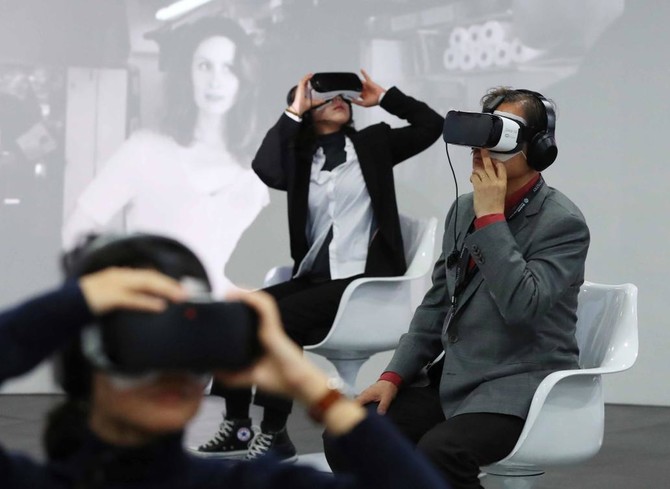
Gimmick or game-changer: Is Virtual Reality the future of film?
Gimmick or game-changer: Is Virtual Reality the future of film?


Latest updates




Recommended


© 2026 SAUDI RESEARCH & PUBLISHING COMPANY, All Rights Reserved And subject to Terms of Use Agreement.