US says Myanmar army responsible for Rohingya crisis

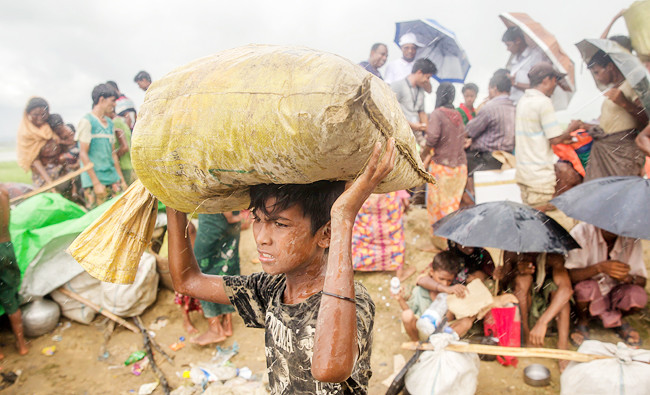
A newly arrived Rohingya Muslim boy, who crossed over from Myanmar into Bangladesh, carries his belonging in the rain in Palong Khali, Bangladesh, on Tuesday. (AP)
Updated 19 October 2017
Follow

US says Myanmar army responsible for Rohingya crisis

WASHINGTON: US Secretary of State Rex Tillerson said on Wednesday the United States held Myanmar’s military leadership responsible for its harsh crackdown on the Rohingya Muslim minority.
Tillerson, however, stopped short of saying whether the United States would take any action against Myanmar’s military leaders over an offensive that has driven more than 500,000 Rohingya Muslims out of the country.
Washington has worked hard to establish close ties with Myanmar’s civilian-led government led by Nobel laureate and former dissident Aung San Suu Kyi in the face of competition from strategic rival China.
“The world can’t just stand idly by and be witness to the atrocities that are being reported in the area,” Tillerson told Washington’s Center for Strategic and International Studies think tank.
“We really hold the military leadership accountable for what’s happening,” said Tillerson, who said the United States was “extraordinarily concerned” by the situation.
Forty-three US lawmakers urged the Trump administration to reimpose US travel bans on Myanmar’s military leaders and prepare targeted sanctions against those responsible for the crackdown.
The request, in a letter to Tillerson from Republican and Democratic members of the House of Representatives, said Myanmar authorities “appear to be in denial of what has happened” and called for Washington to take “meaningful steps” against those who have committed human rights abuses.
Rohingya Muslims have fled Myanmar in large numbers since late August when Rohingya insurgent attacks sparked a ferocious military response, with the fleeing people accusing security forces of arson, killings and rape.
Tillerson said Washington understood Myanmar had a militancy problem, but the military had to be disciplined and restrained in the way it dealt with this and to allow access to the region “so that we can get a full accounting of the circumstances.”
“Someone, if these reports are true, is going to be held to account for that,” Tillerson said. “And it’s up to the military leadership of Burma to decide, ‘What direction do they want to play in the future of Burma?’“
Tillerson said Washington saw Myanmar, which is also known as Burma, as “an important emerging democracy,” but the Rohingya crisis was a test for the power-sharing government.
He said the United States would remain engaged, including ultimately at the United Nations “with the direction this takes.”
The European Union and the United States have been considering targeted sanctions against Myanmar’s military leadership.
Punitive measures aimed specifically at top generals are among a range of options that have been discussed, but they are wary of action that could hurt the wider economy or destabilize already tense ties between Suu Kyi and the army.
Tillerson also said he would visit New Delhi next week as the Trump administration sought to dramatically deepen cooperation with India in response to China’s challenges to “international law and norms” in Asia.
Tillerson said the administration had began a “quiet conversation” with some emerging East Asian democracies about creating alternatives to Chinese infrastructure financing.


China’s top diplomat to visit Somalia on Africa tour

Updated 6 sec ago
Follow

China’s top diplomat to visit Somalia on Africa tour

  • Stop in Mogadishu provides diplomatic boost after Israel became the first country to formally recognize breakaway Somaliland
  • Tour focusses on Beijing's strategic trade ​access across eastern and southern Africa
BEIJING: China’s top diplomat began his annual New Year tour of Africa on Wednesday, focusing on strategic trade ​access across eastern and southern Africa as Beijing seeks to secure key shipping routes and resource supply lines.
Foreign Minister Wang Yi will travel to Ethiopia, Africa’s fastest-growing large economy; Somalia, a Horn of Africa state offering access to key global shipping lanes; Tanzania, a logistics hub linking minerals-rich central Africa to the Indian Ocean; and Lesotho, a small southern African economy squeezed by US trade measures. His trip this year runs until January 12.
Beijing aims to highlight countries it views as model partners of President Xi Jinping’s flagship “Belt and Road” infrastructure program and to expand export markets, particularly in young, increasingly ‌affluent economies such ‌as Ethiopia, where the IMF forecasts growth of 7.2 percent this year.
China, ‌the ⁠world’s ​largest bilateral ‌lender, faces growing competition from the European Union to finance African infrastructure, as countries hit by pandemic-era debt strains now seek investment over loans.
“The real litmus test for 2026 isn’t just the arrival of Chinese investment, but the ‘Africanization’ of that investment. As Wang Yi visits hubs like Ethiopia and Tanzania, the conversation must move beyond just building roads to building factories,” said Judith Mwai, policy analyst at Development Reimagined, an Africa-focussed consultancy.
“For African leaders, this tour is an opportunity to demand that China’s ‘small yet beautiful’ projects specifically target our industrial gaps, ⁠turning African raw materials into finished products on African soil, rather than just facilitating their exit,” she added.
On his start-of-year trip in 2025, ‌Wang visited Namibia, the Republic of Congo, Chad and Nigeria.
His visit ‍to Somalia will be the first by a Chinese foreign minister since the 1980s and is ‍expected to provide Mogadishu with a diplomatic boost after Israel became the first country to formally recognize the breakaway Republic of Somaliland, a northern region that declared itself independent in 1991.
Beijing, which reiterated its support for Somalia after the Israeli announcement in December, is keen to reinforce its influence around the Gulf of Aden, the entrance ​to the Red Sea and a vital corridor for Chinese trade transiting the Suez Canal to Europe.
Further south, Tanzania is central to Beijing’s plan to secure access to Africa’s ⁠vast copper deposits. Chinese firms are refurbishing the Tazara Railway that runs through the country into Zambia. Li Qiang made a landmark trip to Zambia in November, the first visit by a Chinese premier in 28 years.
The railway is widely seen as a counterweight to the US and European Union-backed Lobito Corridor, which connects Zambia to Atlantic ports via Angola and the Democratic Republic of the Congo.
By visiting the southern African kingdom of Lesotho, Wang aims to highlight Beijing’s push to position itself as a champion of free trade. Last year, China offered tariff-free market access to its $19 trillion economy for the world’s poorest nations, fulfilling a pledge by Chinese President Xi Jinping at the 2024 China-Africa Cooperation summit in Beijing.
Lesotho, one of the world’s poorest nations with a gross domestic product of just over $2 billion, ‌was among the countries hardest hit by US President Donald Trump’s sweeping tariffs last year, facing duties of up to 50 percent on its exports to the United States.