ANKARA: Turkey is accelerating its military buildup around Idlib with the deployment of more units and drones to determine surveillance points in the Syrian province.
The deployment is part of the de-escalation deal brokered in Astana last month between Ankara, Tehran and Moscow.
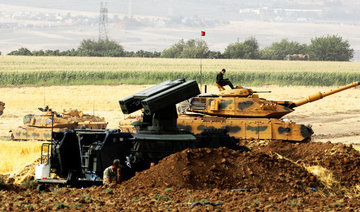
On Wednesday, armored personnel carriers and other military vehicles were transferred to border units to increase preparedness, while additional reconnaissance teams entered Syria.
Idlib is mainly controlled by Hayat Tahrir Al-Sham (HTS), which rejects the Astana process. Turkey’s operation is mainly aimed at clearing out HTS and implementing a de-escalation zone in the province.
Another Turkish priority is to contain territorial contiguity between the Syrian regions of Afrin and Kobane, which are controlled by the Kurdish People’s Protection Units (YPG).
Ankara considers the YPG a terrorist organization with links to the outlawed Kurdistan Workers’ Party (PKK), which has been waging an insurgency against the Turkish state for more than three decades.
Turkish media report that the army will determine 14 locations in Idlib to establish surveillance points to deploy Turkish soldiers.
Experts are conducting feasibility studies, with unmanned drones flying over the area. Spots where the Turkish military may be vulnerable to attack will also be determined.
Reconnaissance teams are working closely with local forces, and Turkish military units will be stationed on Syrian soil once the feasibility studies are complete, the Turkish daily Hurriyet reported.
Following Operation Euphrates Shield, this is the second time in a year that Turkey’s military has crossed into northern Syria.
“Idlib is important for several reasons,” Oytun Orhan, a researcher on Syria at the Ankara-based think tank Orsam, told Arab News.
“By solving or at least freezing the problem in Idlib, Turkey will avoid the risk of a refugee influx. By deploying the Turkish military on the borders of the de-escalation zone in Idlib, Turkey will prevent a possible YPG advance from Afrin. Also, Ankara will prepare suitable conditions for a future attack on Afrin.”
Given that Turkey’s Idlib operation is in coordination with Russia and Iran, Orhan said it has indirect consent from the Syrian regime.
“So there will be no negative reaction to Turkey’s move. The long-term plan is to divide the radicals from the moderates, then find a political solution to the Syrian conflict. Then Turkey will probably leave Idlib in the context of a political solution.”
Cengiz Tomar, professor of international relations at Marmara University, told Arab News: “The Turkish Army will bear a kind of peacekeeping mission in the region.”
But he does not expect an operation in Afrin anytime soon. “Afrin is under US protection, while Russia still maintains contact with the YPG in the region,” Tomar said.
“HTS has about 10,000 fighters in Idlib. There might be an understanding between it and Turkish forces to pull back to another region because HTS isn’t likely to prefer clashing with them.”


![]()

Turkey accelerates Idlib military deployment
Turkey accelerates Idlib military deployment


Latest updates


© 2026 SAUDI RESEARCH & PUBLISHING COMPANY, All Rights Reserved And subject to Terms of Use Agreement.