EU to cut ties with Myanmar military over Rohingya crisis

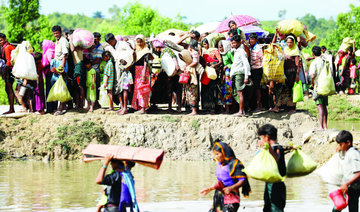
A Rohingya child uses his food bowl to shelter himself from the sun at the Palangkhali refugee camp in Ukhia district on Wednesday.(AFP)
Updated 11 October 2017
Follow

EU to cut ties with Myanmar military over Rohingya crisis

BRUSSELS/GENEVA: The EU is to halt ties with senior Myanmar military chiefs to protest the “disproportionate use of force” against the Rohingya minority, while the UN has revealed that attacks against the Muslims point to a strategy to prevent them from ever returning to their homes.
According to an agreement seen by AFP on Wednesday, the EU bloc has also warned it could consider sanctions if there is no improvement in the crisis, in which more than half-a-million Rohingya Muslims have fled a military crackdown into Bangladesh since August, a situation the UN says likely amounts to ethnic cleansing.
The agreement, approved by EU ambassadors and set to be signed off at a meeting of foreign ministers on Monday, said the rapid flight of so many people “strongly indicates a deliberate action to expel a minority.”
“In the light of the disproportionate use of force carried out by the security forces, the EU and its member states will suspend invitations to the commander-in-chief of the Myanmar/Burma armed forces and senior military officers and review all practical defense cooperation,” the agreement says, while calling on all sides to end violence immediately.
The EU currently bans the export of arms and equipment that can be used for “internal repression,” but said it “may consider additional measures” if the crisis does not improve.
The influx of refugees into poor and overpopulated Bangladesh slowed in recent weeks but appears to have picked up again, with an estimated 11,000 new arrivals on Monday.
A deliberate ploy
A report by the UN human rights office said attacks against Rohingya in Myanmar point to a strategy to instill “widespread fear and trauma” and prevent them from ever returning to their homes.
The report released Wednesday is based on 65 interviews conducted in mid-September with Rohingya, individually and in groups, as more the half a million people from the ethnic group fled into Bangladesh during a violent crackdown in Myanmar.
The attacks against Rohingya in Myanmar’s northern Rakhine state by security forces and Buddhist mobs were “coordinated and systematic,” with the intent of not only driving the population out of Myanmar but preventing them from returning, the report said.
Some of those interviewed said that before and during attacks, megaphones were used to announce: “You do not belong here — go to Bangladesh. If you do not leave, we will torch your houses and kill you.”
According to the UN researchers, measures against the minority group began almost a month before the Aug. 25 attacks on police posts by militants that served as a pretext for what Myanmar’s military called “clearance operations” in Rakhine.
“Information we have received indicates that days and up to a month before the 25th of August, that the Myanmar security forces imposed further restrictions on access to markets, medical clinics, schools and religious sites,” Karin Friedrich, who was part of the UN mission to Bangladesh, said at a news conference. “Rohingya men aged 15 to 40 were reportedly arrested by the Myanmar police” and detained without any charges, she said.
UN human rights chief Zeid Ra’ad Al-Hussein said the Myanmar government’s denial of rights, including citizenship, to the Rohingya appeared to be part of “a cynical ploy to forcibly transfer large numbers of people without possibility of return.” He has also described the systematic attacks and widespread burning of villages as “textbook ethnic cleansing.”
The report said efforts were made to “effectively erase signs of memorable landmarks” in Rohingya areas to make the landscape unrecognizable.
Myanmar’s Buddhist majority denies that Rohingya Muslims are a separate ethnic group and regards them as illegal immigrants.


UK pays Guantanamo detainee ‘substantial’ compensation over US torture questions

Updated 12 January 2026
Follow

UK pays Guantanamo detainee ‘substantial’ compensation over US torture questions

  • Abu Zubaydah has been held at Guantanamo Bay without charge for 20 years
  • British security services knew he was subjected to ‘enhanced interrogation’ but failed to raise concerns for 4 years

LONDON: A Saudi-born Palestinian being held without trial by the US has received a “substantial” compensation payment from the UK government, the BBC reported.

Abu Zubaydah has been imprisoned at Guantanamo Bay in Cuba for almost 20 years following his capture in Pakistan in 2002, and was subjected to “enhanced interrogation” techniques by the CIA.

He was accused of being a senior member of Al-Qaeda in the aftermath of the Sept. 11 terror attacks on the US. The allegations were later dropped but he remains in detention.

The compensation follows revelations that UK security services submitted questions to the US to be put to Abu Zubaydah by their US counterparts despite knowledge of his mistreatment.

He alleged that MI5 and MI6 had been “complicit” in torture, leading to a legal case and the subsequent compensation.

Dominic Grieve, the UK’s former attorney general, chaired a panel reviewing Abu Zubaydah’s case.

He described the compensation as “very unusual” but said the treatment of Abu Zubaydah had been “plainly” wrong, the BBC reported.

Grieve added that the security services had evidence that the “Americans were behaving in a way that should have given us cause for real concern,” and that “we (UK authorities) should have raised it with the US and, if necessary, closed down co-operation, but we failed to do that for a considerable period of time.”

Abu Zubaydah’s international legal counsel, Prof. Helen Duffy, said: “The compensation is important, it’s significant, but it’s insufficient.”

She added that more needs to be done to secure his release, stating: “These violations of his rights are not historic, they are ongoing.”

Duffy said Abu Zubaydah would continue to fight for his freedom, adding: “I am hopeful that the payment of the substantial sums will enable him to do that and to support himself when he’s in the outside world.”

He is one of 15 people still being held at Guantanamo, many without charge. Following his initial detention, he arrived at the prison camp having been the first person to be taken to a so-called CIA “black site.”

He spent time at six such locations, including in Lithuania and Poland, outside of US legal jurisdiction. 

Internal MI6 messages revealed that the “enhanced interrogation” techniques he was subjected to would have “broken” the resolve of an estimated 98 percent of US special forces members had they been subjected to them.

CIA officers later decided he would be permanently cut off from the outside world, with then-President George W. Bush publicly saying Abu Zubaydah had been “plotting and planning murder.”

However, the US has since withdrawn the allegations and no longer says he was a member of Al-Qaeda.

A report by the US Senate Select Committee on Intelligence said Abu Zubaydah had been waterboarded at least 83 times, was locked in a coffin-like box for extended periods, and had been regularly assaulted. Much of his treatment would be considered torture under UK law.

Despite knowledge of his treatment, it was four years before British security services raised concerns with their American counterparts, and their submission of questions within that period had “created a market” for the torture of detainees, Duffy said.

A 2018 report by the UK Parliament’s Intelligence and Security Committee was deeply critical of the behavior of MI5 and MI6 in relation to Abu Zubaydah. 

It also criticized conduct relating to Guantanamo detainee Khalid Sheikh Mohammed, widely regarded as a key architect of the Sept. 11 attacks, warning that the precedent set by Abu Zubaydah’s legal action could be used by Mohammed to bring a separate case against the UK.

MI5 and MI6 failed to comment on Abu Zubaydah’s case. Neither the UK government nor Mohammed’s legal team would comment on a possible case over his treatment.