Japan steel scandal grows as more carmakers hit

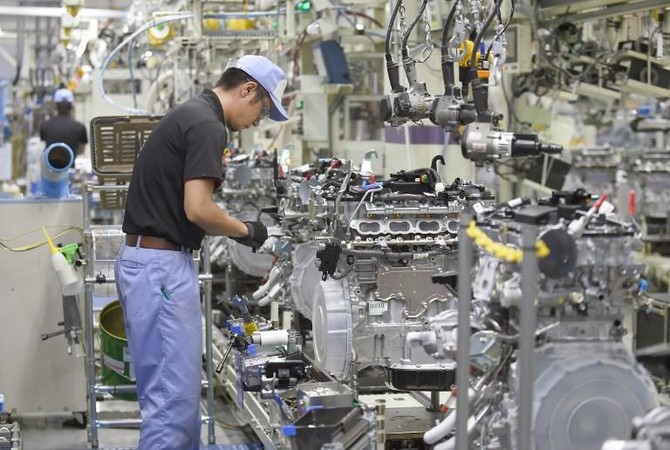
Auto giant Toyota has already said Kobe Steel supplied materials to one of its Japanese factories. Above, the company’s Kanda plant in Kanda, Fukuoka Prefecture. (AFP)
Updated 11 October 2017
Follow

Japan steel scandal grows as more carmakers hit

TOKYO: Top Japanese automakers said Wednesday they were scrambling to assess the safety of vehicles containing products from Kobe Steel, which has admitted falsifying quality data in a growing scandal.
Toyota, Nissan, Honda, Mitsubishi Motor, Subaru and Mazda joined aviation firms and defense contractors Mitsubishi Heavy Industries, Kawasaki Heavy Industries and IHI that have used the steelmaker’s products.
The brewing crisis is the latest in a string of quality control and governance scandals to hit major Japanese businesses in recent years, undermining the country’s reputation for quality.
Japan’s famous “Shinkansen” bullet trains also used Kobe Steel’s aluminum, as did high-speed trains in Britain, according to engineering firm Hitachi.
“Products used (for both Japanese and British trains) met safety standards. But they did not meet the specifications that were agreed between us and Kobe Steel,” a Hitachi spokesman told AFP.
Honda spokesman Tamon Kusakabe said: “As to safety, we are still studying (a possible) impact.”
“At this point, we don’t see a critical problem as we have our own safety inspection on materials we use. But we are still investigating and it’s premature to say” if recalls will be necessary.
Auto giant Toyota has already said Kobe Steel supplied materials to one of its Japanese factories, which used them in hoods, rear doors and surrounding areas of certain vehicles.
The industry ministry has pressed Kobe Steel to work with its clients, spread over a wide range of industries, to conduct urgent safety analysis.
Kobe Steel also admitted Wednesday that it was in talks with one client who received steel powder that did not match specifications.
However, it declined comment on a media report that materials used in semiconductors were also impacted by the scandal.
The Kobe Steel scandal broke on Sunday when the manufacturer first admitted falsifying data linked to the strength and quality of products.
An internal probe has revealed that data were fabricated for about 19,300 tons of aluminum products, 2,200 tons of copper products and 19,400 units of aluminum castings and forgings shipped to clients between September 2016 through August 2017.
The stock dived 22 percent on Tuesday to finish at ¥1,068 (SR35.5), its maximum daily loss limit — wiping almost one billion dollars off the firm’s market value.
On Wednesday it plunged a further 17.8 percent to close at ¥878.
The company said the fabrications, which might have started a decade ago, could affect products sent to as many as 200 companies but it remained unclear whether the scandal affected product safety.
The problems at Kobe Steel are an additional headache for Nissan, which has already announced a recall of more than a million vehicles in the domestic market over a certification issue.
And it is just the latest in a series of affairs to embarrass Japanese industry.
Airbag maker Takata went bankrupt after defective products were linked to 16 deaths and scores of injuries worldwide.
Mitsubishi Motors last year admitted that it had been falsifying mileage tests for years.
And electronics giant Toshiba has admitted that its executives had pressured underlings to cover up weak results for years after the 2008 global financial meltdown.


‘The future is renewables,’ Indian energy minister tells World Economic Forum

Updated 22 January 2026
Follow

‘The future is renewables,’ Indian energy minister tells World Economic Forum

  • ‘In India, I can very confidently say, affordability (of renewables) is better than fossil fuel energy,’ says Pralhad Venkatesh Joshi during panel discussion
  • Renewables are an increasingly important part of the energy mix and the technology is evolving rapidly, another expert says at session titled ‘Unstoppable March of Renewables?’

BEIRUT: “The future is renewables,” India’s minister of new and renewable energy told the World Economic Forum in Davos on Wednesday.
“In India, I can very confidently say, affordability (of renewables) is better than fossil fuel energy,” Pralhad Venkatesh Joshi said during a panel discussion titled “Unstoppable March of Renewables?”
The cost of solar power has has fallen steeply in recent years compared with fossil fuels, Joshi said, adding: “The unstoppable march of renewables is perfectly right, and the future is renewables.”
Indian authorities have launched a major initiative to install rooftop solar panels on 10 million homes, he said. As a result, people are not only saving money on their electricity bills, “they are also selling (electricity) and earning money.”
He said that this represents a “success story” in India in terms of affordability and “that is what we planned.”
He acknowledged that more work needs to be done to improve reliability and consistency of supplies, and plans were being made to address this, including improved storage.
The other panelists in the discussion, which was moderated by Godfrey Mutizwa, the chief editor of CNBC Africa, included Marco Arcelli, CEO of ACWA Power; Catherine MacGregor, CEO of electricity company ENGIE Group; and Pan Jian, co-chair of lithium-ion battery manufacturer Contemporary Amperex Technology.
Asked by the moderator whether she believes “renewables are unstoppable,” MacGregor said: “Yes. I think some of the numbers that we are now facing are just proof points in terms of their magnitude.
“In 2024, I think it was 600 gigawatts that were installed across the globe … in Europe, close to 50 percent of the energy was produced from renewables in 2024. That has tripled since 2004.”
Renewables are an increasingly important and prominent part of the energy mix, she added, and the technology is evolving rapidly.
“It’s not small projects; it’s the magnitude of projects that strikes me the most, the scale-up that we are able to deliver,” MacGregor said.
“We are just starting construction in the UAE, for example. In terms of solar size it’s 1.5 gigawatts, just pure solar technology. So when I see in the Middle East a round-the-clock project with just solar and battery, it’s coming within reach.
“The technology advance, the cost, the competitiveness, the size, the R&D, the technology behind it and the pace is very impressive, which makes me, indeed, really say (renewables) is real. It plays a key role in, obviously, the energy demand that we see growing in most of the countries.
“You know, we talk a lot about energy transition, but for a lot of regions now it is more about energy additions. And renewables are indeed the fastest to come to market, and also in terms of scale are really impressive.”
Mutizwa asked Pan: “Are we there yet, in terms of beginning to declare mission accomplished? Are renewables here to stay?”
“I think we are on the road but (its is) very promising,” Pan replied. There is “great potential for future growth,” he added, and “the technology is ready, despite the fact that there are still a lot of challenges to overcome … it is all engineering questions. And from our perspective, we have been putting in a lot of resources and we are confident all these engineering challenges will be tackled along the way.”
Responding to the same question, Arcelli said: “Yes, I think we are beyond there on power, but on other sectors we are way behind … I would argue today that the technology you install by default is renewables.
“Is it a universal truth nowadays that renewables are the cheapest?” asked Mutizwa.
“It’s the cheapest everywhere,” Arcelli said.