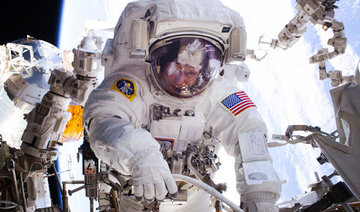
MIAMI: Two US astronauts installed a high-definition video camera at the International Space Station Tuesday and made more progress on repairs to the lab’s robotic arm, NASA said.
NASA spokesman Rob Navias described the camera equipment as offering “new eyes” to the orbiting outpost, as live video showed astronaut Randy Bresnik in sharp detail, floating in his white spacesuit.
The previous camera had aged, and was tinting images pink. Another camera outside the ISS, nicknamed “Old Yeller” because of its yellow hues, is set to be replaced on the next spacewalk October 18.
The spacewalk was the second in five days for Bresnik and his NASA colleague Mark Vande Hei.
The spacewalk formally began when the duo switched their spacesuits to battery power at 1156 GMT, then floated out into the vacuum of space, NASA said. It ended six hours and 26 minutes later.
On their spacewalk Thursday, the pair replaced the latching end of the 57-foot-long (17-meter) Canadian-made arm, called Canadarm2.
On Tuesday, they lubricated its latching end effector.
The robotic arm was installed at the orbiting outpost 16 years ago, and recently stopped gripping effectively.
Astronauts need it in working order so it can capture incoming cargo ships that ferry supplies to the crew living in orbit. The next US shipment arrives in November.

US spacewalkers install ‘new eyes’ at space station
Scores killed in militant attacks in northwest Nigeria
- The attacks came days after the state hosted the UNESCO-listed Argungu fishing festival
- The Lakurawa group has been blamed for many of the attacks on communities
LAGOS: Militant fighters have killed scores of people and destroyed seven villages in raids in northwestern Nigeria’s Kebbi state, the police said Thursday.
Members of the Lakurawa group attacked villages in the Bui district of Arewa northern region at around 1:15 p.m. (1215 GMT) Wednesday, said Kebbi state police spokesman Bashir Usman.
A security report seen by AFP said the militants had killed “more than 30 villagers.”
Usman said: “Scores of people were killed as residents from Mamunu, Awasaka, Tungan Tsoho, Makangara, Kanzo, Gorun Naidal, and Dan Mai Ago mobilized to resist the attackers.”
The attackers had also rustled “some cattle” in the raids, he added. Police, soldiers and local militia were immediately sent to the area.
The attacks came days after the state hosted the UNESCO-listed Argungu fishing festival, about 60 kilometers (38 miles) from the Arewa region, where the attacks took place.
The Lakurawa group has been blamed for many of the attacks on communities in the northern part of the state and in neighboring Sokoto state.
Its members stage deadly attacks from their forest base, rustling livestock and imposing “taxes” on locals.
The Nigerian government said the Christmas day air strikes by the US military in Sokoto had targeted members of the group and “bandit” gangs.
Some researchers have linked the group to the Islamic State Sahel Province, which is active mainly in neighboring Niger and Mali, though others remain doubtful.
The activities of the group have compounded Nigeria’s insecurity.
The West African nation is grappling with a more than 16-year militant insurgency in the northeast, as well as a farmer-herder conflict in the north central region.
They also have to contend with a violent secessionist agitation in the southeast, and kidnappings for ransom plague the northwest.
Nigeria is now looking to the United States for technical and training support for its troops fighting the militants after a resurgence of violence strained relationships between the two countries.
The US Africa Command said 200 troops were expected to join the deployment overall.
US President Donald Trump has said the violence there amounts to the “persecution” of Christians — a framing long used by the US religious and political right wing.
Nigeria’s government and many independent experts say Christians and Muslims alike are the victims of the country’s security crises.