YANGON: Muslim Rohingya insurgents said on Saturday they are ready to respond to any peace move by the Myanmar government but a one-month cease-fire they declared to enable the delivery of aid in violence-racked Rakhine State is about to end.
The Arakan Rohingya Salvation Army (ARSA) did not say what action it would take after the cease-fire ends at midnight on Monday but it was “determined to stop the tyranny and oppression” waged against the Rohingya people.
“If at any stage, the Burmese government is inclined to peace, then ARSA will welcome that inclination and reciprocate,” the group said in a statement.
Government spokesmen were not immediately available for comment.
When the ARSA announced its one-month cease-fire from Sept. 10, a government spokesman said: “We have no policy to negotiate with terrorists.”
The rebels launched coordinated attacks on about 30 security posts and an army camp on Aug. 25 with the help of hundreds of disaffected Rohingya villagers, many wielding sticks or machetes, killing about a dozen people.
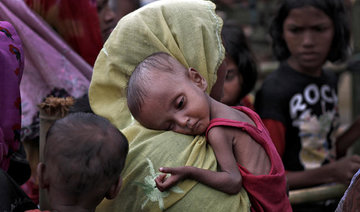
In response, the military unleashed a sweeping offensive across the north of Rakhine State, driving more than half a million Rohingya villagers into Bangladesh in what the United Nations branded a textbook example of “ethnic cleansing.”
Myanmar rejects that. It says more than 500 people have been killed in the fighting, most of them “terrorists” who have been attacking civilians and torching villages.
The ability of the ARSA, which only surfaced in October last year, to mount any sort of challenge to the Myanmar army is not known but it does not appear to have been able to put up resistance to the military offensive unleashed in August.
Inevitably, there are doubts about how the insurgents can operate in areas where the military has driven out the civilian population, cutting the insurgents off from recruits, food, funds and information.
The ARSA accused the government of using murder, arson and rape as “tools of depopulation.”
The ARSA denies links to foreign Islamists.
In an interview with Reuters in March, ARSA leader Ata Ullah linked the creation of the group to communal violence between Buddhists and Muslims in Rakhine in 2012, when nearly 200 people were killed and 140,000, mostly Rohingya, displaced.
The group says it is fighting for the rights of the Rohingya, who have never been regarded as an indigenous minority in Myanmar and so have been denied citizenship under a law that links nationality to ethnicity.
The group repeated their demand that Rohingya be recognized as a “native indigenous” ethnic group, adding that all Rohingya people should be allowed “to return home safely with dignity ... to freely determine their political status and pursue their economic, social and cultural development.”
The Rohingya have long faced discrimination and repression in Rakhine State where bad blood between them and ethnic Rakhine Buddhists, stemming from violence by both sides, goes back generations.
The ARSA condemned the government for blocking humanitarian assistance in Rakhine and said it was willing to discuss cease-fires with international organizations so aid could be delivered.
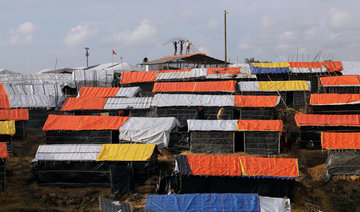
Some 515,000 Rohingya have fled to Bangladesh but thousands remain in Rakhine.
Myanmar leader Aung San Suu Kyi has faced scathing criticism for not doing more to stop the violence, although a military-drafted constitution gives her no power over the security forces.
Suu Kyi has condemned rights abuses and said Myanmar was ready to start a process agreed with Bangladesh in 1993 by which anyone verified as a refugee would be accepted back.
Many refugees fear they will not have the paperwork they believe Myanmar will demand to allow them back.

Rohingya insurgents open to peace but Myanmar cease-fire ending
US allies, foes alarmed by capture of Venezuela’s Maduro
- Countries such as Russia and China, which had ties with Maduro’s government, were quick to condemn the operation but alarm also shared by France and EU
- UN Secretary-General Antonio Guterres was “deeply alarmed” by the US strikes
PARIS: The US military operation that led to the seizure of Venezuelan President Nicolas Maduro on Saturday sparked alarm across the international community, with allies and foes of Washington and Caracas expressing disquiet.
US President Donald Trump said Maduro and his wife would be taken to New York to face federal charges after military strikes and an operation which he described as looking like a “television show.”
The Venezuelan government decried what it termed a “extremely serious military aggression” by Washington and declared a state of emergency.
Countries such as Russia and Iran, which had longstanding ties with Maduro’s government, were quick to condemn the operation but their alarm was also shared by Washington’s allies including France and the EU.
Here is a rundown of the main reaction.
Russia
Russia demanded the US leadership “reconsider its position and release the legally elected president of the sovereign country and his wife.”
China
Beijing said “China is deeply shocked and strongly condemns the US’s blatant use of force against a sovereign state and its action against its president.”
Iran
Iran, which Trump bombed last year, said it “strongly condemns the US military attack on Venezuela and a flagrant violation of the country’s national sovereignty and territorial integrity.”
Mexico
Mexico, which Trump has also threatened with military force over drug trafficking, strongly condemned the US military action in Venezuela, saying it “seriously jeopardizes regional stability.”
Colombia
Colombian President Gustavo Petro — whose country neighbors Venezuela — called the US action an “assault on the sovereignty” of Latin America which would lead to a humanitarian crisis.
Brazil
Brazilian President Luiz Inacio Lula da Silva slammed the US attacks as a “serious affront” to Venezuela’s sovereignty.
Cuba
Cuba, a strong ally of Venezuela, denounced “state terrorism against the brave Venezuelan people.”
Spain
Spain offered to mediate in the crisis to find a way to a peaceful solution, while calling for “de-escalation and restraint.”
France
France condemned the US operation, saying it undermined international law and no solution to Venezuela’s crisis can be imposed from the outside.
EU
The EU more generally expressed concern at the developments and urged respect for international law, even as it noted that Maduro “lacks legitimacy.”
EU candidate country North Macedonia, along with fellow Balkan nations Albania and Kosovo, backed Washington, however.
“We stand with the United States and the Venezuelan people for freedom and democracy,” North Macedonia FM Timco Mucunski said on X.
Britain
British Prime Minister Keir Starmer said all countries should “uphold international law” and added that “the UK was not involved in any way in this operation” as he urged patience in order to “establish the facts.”
Italy
In a rare expression of support for the US operation by a major European country, far-right Italian Prime Minister Giorgia Meloni — a Trump ally — argued the US military action in Venezuela was “legitimate” and “defensive.”
Israel
Israel also hailed the operation, saying Washington acted as the “leader of the free world.”
Ukraine
Ukraine — dependent on US support in its war against invading Russia — did not address the legality of a big country like America using military force against a much smaller one like Venezuela.
Foreign minister Andriy Sybiga instead focused on Maduro’s lack of legitimacy and the Venezuelan government’s repression, while backing “democracy, human rights, and the interests of Venezuelans.”
South Africa
South Africa, which Trump accuses of alleged discrimination — and even “genocide” — of minority white Afrikaners, said: “Unlawful, unilateral force of this nature undermines the stability of the international order and the principle of equality among nations.”
UN
UN Secretary-General Antonio Guterres was “deeply alarmed” by the US strikes, with his spokesman quoting him as saying it could “constitute a dangerous precedent.”