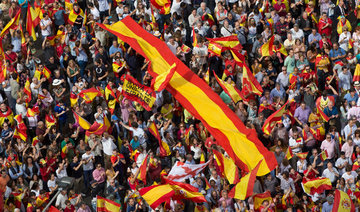
BARCELONA: Spanish Prime Minister Mariano Rajoy warned anew Monday that Spain will not be divided by a declaration of independence from Catalonia and said the government is ready to respond to any such attempt.
Catalan regional President Carles Puigdemont plans to address the Catalan Parliament on Tuesday evening to debate the current political situation. Separatist politicians say there will be a declaration of independence for the northeastern region of 7.5 million during that session, although some ruling coalition lawmakers say the move could be simply “symbolic.”
Still, Rajoy was being as explicit as possible in warning that the national government in Madrid would not stand for such a declaration.
“Spain will not be divided and the national unity will be preserved. We will do everything that legislation allows us to ensure this,” Rajoy told the German newspaper Die Welt. “We will prevent this independence from taking place.”
Secession-minded authorities in Catalonia have vowed to break away from Spain after claiming a pro-independence victory in a disputed referendum earlier this month. The Oct. 1 vote has been followed by mass protests of Catalans angered by police violence as authorities tried to stop the vote and, more recently, by others in Catalonia and Madrid urging the unity of Spain.
Yet politicians supporting Puigdemont’s minority government and civil society groups backing independence say they will not accept anything less than a full declaration of independence.
“Credibility and dignity suggest making the declaration of independence tomorrow,” said Jordi Sanchez, the head of the civil group National Catalonia Assembly said Monday.
Puigdemont has not clarified what his intentions are.
Rajoy’s deputy, Soraya Saenz de Santamaria, also warned that Spain would act decisively if there was any independence declaration.
“If they declare independence, there will be decisions to restore the law and democracy,” said on Monday during a radio interview.
She called for members of the Catalan government “who still respect democracy and freedom to refrain from jumping into the void.”
Catalonia’s top judicial official, meanwhile, ordered additional Spanish police protection for the headquarters of the regional judiciary.
The regional Mossos d’Esquadra police force, whose hierarchy reports to the Catalan government, had been in charge until now of guarding the palace in central Barcelona that hosts the judiciary.
But the High Judiciary in Catalonia says its president, Jesus Barrientos, has asked the chief of the National Police force in the region to join in the protection of the building. The statement says a declaration of independence, even if illegal under Spanish laws, could trigger the suspension of the judiciary and the ouster of its president.
Separatist leaders in Catalonia have declared valid a pro-independence victory in a disputed Oct. 1 referendum that Spain calls illegal. The vote took place amid police violence that injured hundreds.
Rajoy has said the central government could take control of the governance of the Catalan region.
“The ideal situation would be that I don’t have to find drastic solutions, but for that to happen there will have to be some rectifications (by Catalan leaders),” Rajoy said this weekend.

Spain warns it will act if Catalonia declares independence
Tug of war: how US presidents battle Congress for military powers
- The last official declaration of war by Congress was as far back as World War II
WASHINGTON, United States: Donald Trump’s unleashing of operation “Epic Fury” against Iran has once more underscored the long and bitter struggle between US presidents and Congress over who has the power to decide on foreign military action.
In his video address announcing “major combat” with the Islamic republic, Trump didn’t once mention any authorization or consultation with the US House of Representatives or Senate.
In doing so he sidelined not only Democrats, who called for an urgent war powers vote, but also his own Republican party as he asserts his dominance over a largely cowed legislature.
A US official said Secretary of State Marco Rubio had called top congressional leaders known as the “Gang of Eight” to give them a heads up on the Iran attack — adding that one was unreachable.
Rubio also “laid out the situation” and consulted with the same leaders on Tuesday in an hour-long briefing, the US official said.
According to the US Constitution, only Congress can declare war.
But at the same time the founding document of the United States first signed in 1787 says that the president is the “commander in chief” of the military, a definition that US leaders have in recent years taken very broadly.
The last official declaration of war by Congress was as far back as World War II.
There was no such proclamation during the unpopular Vietnam War, and it was then that Congress sought to reassert its powers.
In 1973 it adopted the War Powers Resolution, passed over Richard Nixon’s veto, to become the only lasting limit on unilateral presidential military action abroad.
The act allows the president to carry out a limited military intervention to respond to an urgent situation created by an attack against the United States.
In his video address on Saturday, Trump evoked an “imminent” threat to justify strikes against Iran.
- Sixty days -
Yet under this law, the president must still inform Congress within 48 hours.
It also says that if the president deploys US troops for a military action for more than 60 days, the head of state must then obtain the authorization of Congress for continued action.
That falls short of an official declaration of war.
The US Congress notably authorized the use of force in such a way after the September 11, 2011 attacks on the United States by Al-Qaeda. Presidents have used it over the past two decades for not only the 2001 invasion of Afghanistan but a series of operations in several countries linked to the “War on Terror.”
Trump is far from the first US president to launch military operations without going through Congress.
Democrat Bill Clinton launched US air strikes against Kosovo in 1999 as part of a NATO campaign, despite the lack of a green light from skeptical lawmakers.
Barack Obama did the same for airstrikes in Libya in 2011.
Trump followed their example in his first term in 2018 when he launched airstrikes in Syria along with Britain and France.
But since his return to power the 79-year-old has sought to push presidential power to its limits, and that includes in the military sphere.
Trump has ordered strikes on alleged drug trafficking boats in Latin America without consulting Congress, and in June 2025 struck Iran’s nuclear facilities.
Perhaps the most controversial act was when he ordered the capture of Venezuelan president Nicolas Maduro in a lightning military raid on January 3.
Republicans however managed to knock down moves by Democrats for a rare war powers resolution that would have curbed his authority over Venezuela operations.
Trump has meanwhile sought to extend his powers over the home front. Democrats have slammed the Republican for deploying the National Guard in several US cities in what he calls a crackdown on crime and immigration.