MADRID/BARCELONA: Thousands of people gathered in Madrid and Barcelona on Saturday as Catalonia prepared to declare independence, many dressed in white and calling for talks to defuse Spain’s worst political crisis for decades.
The wealthy northeastern region of Catalonia, with its own language and culture, has long claimed to be distinct from the rest of the country and on Sunday held a referendum on leaving Spain, a vote the constitutional court had banned.
The Catalan authorities say that a majority of those who voted supported a split from Spain, something Madrid says is illegal under the country’s 1978 constitution.
The political stand-off has divided the country, pushed banks and companies to move their headquarters outside Catalonia and shaken market confidence in the Spanish economy, prompting calls from the European Commission for Catalan and Spanish leaders to find a political solution.
“I’ve come because I feel very Spanish and makes me very sad what’s happened,” Rosa Borras, 47, an unemployed secretary who had joined a noisy gathering in central Madrid, said.
Borras, wearing a “Catalonia, we love you” sticker and surrounded by thousands waving Spanish flags, added: “I wanted to be here for unity, because I also feel very Catalan. My family lives in Catalonia.”
While Catalan leader Carles Puigdemont has said he is open to mediation, Prime Minister Mariano Rajoy insists the region gives up the independence push, which grew in strength during a near-six year economic crisis, before he will sit down to talk.
Rajoy’s government mobilized thousands of national police to stop Sunday’s vote, leading to clashes with would-be voters as they tried to close polling stations in schools and remove ballot boxes.
The police violence drew widespread condemnation and forced the government to issue an apology on Friday, although tensions continued to rise after reports that plans for a unilateral declaration of independence will be handed to the Catalan parliament on Tuesday.
The crisis has also caused disquiet among Spain’s EU partners and German Chancellor Angela Merkel has discussed it with European Commission President Jean-Claude Juncker, an EU official told Reuters.
Concern is growing in EU capitals about the negative impact of the crisis on the Spanish economy, the fourth largest in the euro zone, and on possible spillovers to other economies.
European finance ministers, gathering in Brussels on Monday and Tuesday for a regular meeting, could discuss the issue, although it is not formally on the agenda, EU officials said.
The support given in public statements by EU leaders to Rajoy is combined with concern expressed in private about how the Spanish government’s use of police to prevent Catalans from voting last week in an independence referendum could backfire.
Some EU states are worried that talk of Catalan independence could fuel secessionist feelings in other parts of Europe.


![]()
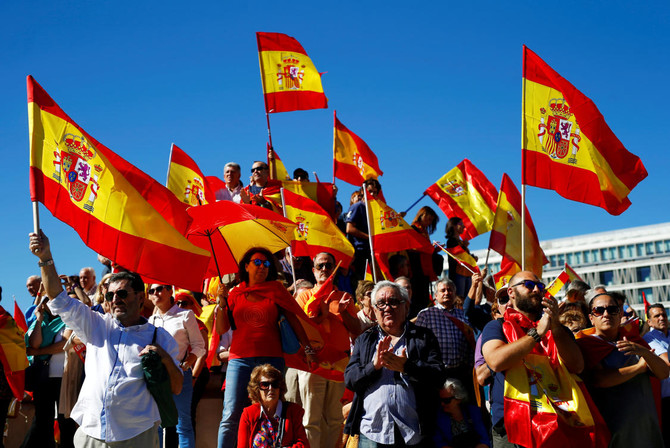
Spaniards take to streets as Catalonia independence tensions rise
Spaniards take to streets as Catalonia independence tensions rise


Latest updates


© 2026 SAUDI RESEARCH & PUBLISHING COMPANY, All Rights Reserved And subject to Terms of Use Agreement.