BRUSSELS: Catalonia’s independence stand-off with Spain risks deepening the EU’s woes just as it was beginning to contemplate the end of the Brexit and migrant crises and a bright new future for the bloc.
Only days ago EU leaders held a summit to declare they were plotting a new course together, while European Commission chief Jean-Claude Juncker proclaimed recently “the wind is back in Europe’s sails” after being buffeted by the euroskeptism that drove Britain’s shock vote to leave.
But the escalating crisis over Catalonia’s hotly contested independence referendum on Sunday – banned by Spain and marred by violence – has left the EU floundering in the shoals again.
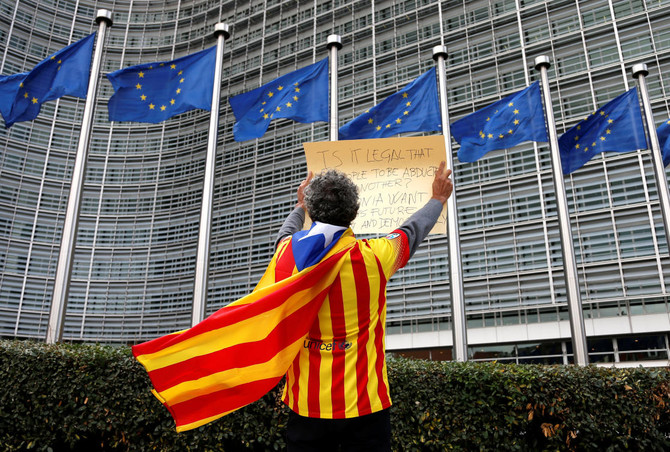
The Catalonia crisis has trapped the EU between the rock of its principle of non-interference in member states’ internal affairs, and the hard place of its role as a champion of democracy and freedom of expression.
The European Commission, the bloc’s executive arm, on Monday broke weeks of virtual silence on the subject, after scores were hurt in clashes at Sunday’s vote in Catalonia, to say the referendum was “not legal” under Spanish law and was an “internal matter” for Madrid.
While the EU has called for dialogue, it has ruled out taking any mediation role itself.
The response from Brussels after the dramatic scenes of violence in Barcelona, including riot police dragging voters from polling stations, has prompted accusations of hypocrisy.
Euroskeptic British MEP Nigel Farage – normally the first to criticize the EU for interfering in the affairs of its member states – said it was “extraordinary to realize that this union is prepared to turn a blind eye”, and criticized Juncker for saying “not a dicky bird” about the violence.
The head of the Greens in the parliament also voiced astonishment at the commission’s response, saying it undermined the EU’s credibility in the eyes of its citizens.
Heightening the claims of double standards, the EU’s muted response to the Catalan crisis has come as it is taking legal action against both Poland and Hungary over democratic issues.
Stefani Weiss of the Bertelsmann Foundation think tank said the Catalan crisis had been brewing for some time “without gaining the attention it needed” in Brussels.
“The EU in a way is a good weather institution – as long everything goes well, it works well. As soon as problems arise the EU has huge difficulties in positioning itself and taking action,” she said.
With separatist movements affecting states across the continent – from Scotland, to Flanders in Belgium, and the Basque country of Spain – EU members were reluctant to get involved in the Catalan issue, she said.
Aside from Belgium, where Flemish nationalists are an important player in the ruling coalition, and Slovenia, born of secession from the former Yugoslavia, EU capitals have lined up to support Spanish Prime Minister Mariano Rajoy, fearful of a chain reaction of secessionism.
“If today you let Spain break up with Catalonia, a domino effect will follow across the continent. Instead of a Europe of 27 we will have a non-Europe of mini-states,” warned Esteban Gonzalez Pons, an MEP from Rajoy’s Popular Party.
While the Catalan standoff has not yet threatened to reach the gravity of the eurozone debt crisis, the migrant influx or Brexit, it is “clearly a drag” on the EU, Frederic Allemand, a European affairs expert at the University of Luxembourg, told AFP.
Allemand said the EU’s focus for now was to keep the crisis confined to Spain, and despite appeals from independence supporters, it would have no interest in mediating, as doing so would amount to “legitimizing the separatists”.
A further risk to the EU is that the more time and energy it expends on issues like the Catalan crisis, the less it has for bigger challenges such as terrorism, the North Korean nuclear crisis and remaining economically competitive, Weiss of the Bertelsmann Foundation said.


![]()
Catalan crisis poses fresh challenge to battered EU
Catalan crisis poses fresh challenge to battered EU


Latest updates


© 2026 SAUDI RESEARCH & PUBLISHING COMPANY, All Rights Reserved And subject to Terms of Use Agreement.