Immigrants in US seeking safe haven worry Trump may send them back

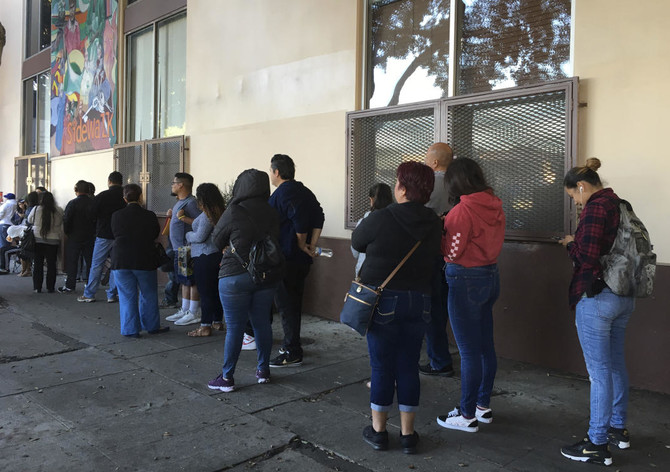
Above, people wait in line at CHIRLA (Coalition for Humane Immigrant Rights Los Angeles) for help with immigration paperwork, including renewing work permits. (AP)
Updated 07 October 2017
Follow

Immigrants in US seeking safe haven worry Trump may send them back

WASHINGTON: Thousands of Salvadorans, Haitians and others now sheltered in the US from danger in their home countries might have to leave under a crackdown the Trump administration is weighing on a program that critics slam as “back-door” immigration.
People close to the administration said the White House is considering anti-immigration activists’ appeals for pull-back on the 27-year old US Temporary Protected Status (TPS) program, which protects more than 300,000 people in the country.
“There’s no question people inside the administration want to reform the excesses,” said Roy Beck, president of NumbersUSA, a group that seeks to reduce immigration into the United States.
“We have definitely expressed our opinions to the administration. This time there actually are people willing to listen,” Beck said in a telephone interview.
Officials at the State Department and Department of Homeland Security would not comment on administration plans for TPS.
The White House did not respond immediately to a request for comment.
President Donald Trump campaigned last year on a promise to deport large numbers of immigrants, a racially-tinged political theme that won him passionate support among some US voters.
Since he took office in January, Trump has moved to ban US entry by people from select Muslim countries. He also announced the end next March of an Obama-era program giving temporary legal status to “Dreamers” brought illegally into the United States as children, unless Congress revives it.
Now immigration advocacy groups fear Trump will curtail TPS by refusing to renew the protected status of some of the nine countries covered: El Salvador, Haiti, Honduras, Nepal, Nicaragua, Somalia, South Sudan, Syria and Yemen.
Last month, Sudan was slated for TPS termination, effective November 2018. Immigration groups were heartened somewhat that South Sudan’s status was renewed in September through mid-2019.
Advocacy groups said they are also concerned Trump might seek legislative changes making it harder to designate TPS countries.
Ira Mehlman, a spokesman for the Federation for American Immigration Reform (FAIR), which also seeks to reduce overall immigration, said the administration is assessing each country’s status. “In the past it was routine renewal,” he said.
FAIR would be “open” to TPS continuing, Mehlman said, but only with assurances that participation is temporary and “not a 20-year stay.”
Several immigration advocacy groups said officials within the administration have told them significant changes to TPS were being debated among agencies and the White House.
In July, Trump’s Department of Homeland Security fired a warning shot when it renewed Haiti’s designation for only six months instead of the typical 18 months. “During this six-month extension, beneficiaries are encouraged to prepare for their return to Haiti in the event Haiti’s designation is not extended again,” the department warned.

TEMPORARY OR PERMANENT?
Critics have complained the program allows participants to repeatedly extend their stays in 6-18 month increments in case of a natural disaster, civil strife or other emergencies in their homelands.
Haiti, for example, has had TPS designation for seven years; El Salvador for 16 years. “It’s not TPS, it is PPS, Permanent Protected Status,” Beck said. “The chance of someone having to leave is closer to the chance of being struck by lightning.”
Michelle Brane, director of migrant rights at the Women’s Refugee Commission in New York, acknowledged TPS needs repair, but warned that if Trump forced thousands of Salvadorans to go home, they would be easy targets of gang violence after years of living in the United States and raising families.
Many of them “have kids who are US citizens, but it could push the families underground” if parents lose their work permits and face deportation, she said.
Paul Altidor, Haiti’s ambassador to the US, said in a telephone interview that his government is asking the Trump administration for an 18-month extension, citing an ongoing cholera outbreak and destruction from recent hurricanes.
“These people have been strung along,” said Matt Adams, legal director for the Seattle-based Northwest Immigrant Rights Project, disputing the critics who say TPS was not meant to provide protection for a decade or more.
He said TPS participants have had their hopes raised and then dashed as repeated attempts in Congress to update the TPS program have sputtered, while past administrations have carved out programs for some groups of immigrants by granting them permanent legal status.
Adams said that in the event of a crackdown, some people, such as those married to US citizens, will have other legal ways to stay.
But he said many of his clients, including entire families, will have their lives “thrown into chaos.”


Afghan returnees in Bamiyan struggle despite new homes

Updated 01 February 2026
Follow

Afghan returnees in Bamiyan struggle despite new homes

  • More than five million Afghans have returned home since September 2023, according to the International Organization for Migration

BAMIYAN, Afghanistan: Sitting in his modest home beneath snow-dusted hills in Afghanistan’s Bamiyan province, Nimatullah Rahesh expressed relief to have found somewhere to “live peacefully” after months of uncertainty.
Rahesh is one of millions of Afghans pushed out of Iran and Pakistan, but despite being given a brand new home in his native country, he and many of his recently returned compatriots are lacking even basic services.
“We no longer have the end-of-month stress about the rent,” he said after getting his house, which was financed by the UN refugee agency on land provided by the Taliban authorities.
Originally from a poor and mountainous district of Bamiyan, Rahesh worked for five years in construction in Iran, where his wife Marzia was a seamstress.
“The Iranians forced us to leave” in 2024 by “refusing to admit our son to school and asking us to pay an impossible sum to extend our documents,” he said.
More than five million Afghans have returned home since September 2023, according to the International Organization for Migration (IOM), as neighboring Iran and Pakistan stepped up deportations.
The Rahesh family is among 30 to be given a 50-square-meter (540-square-foot) home in Bamiyan, with each household in the nascent community participating in the construction and being paid by UNHCR for their work.
The families, most of whom had lived in Iran, own the building and the land.
“That was crucial for us, because property rights give these people security,” said the UNHCR’s Amaia Lezertua.
Waiting for water
Despite the homes lacking running water and being far from shops, schools or hospitals, new resident Arefa Ibrahimi said she was happy “because this house is mine, even if all the basic facilities aren’t there.”
Ibrahimi, whose four children huddled around the stove in her spartan living room, is one of 10 single mothers living in the new community.
The 45-year-old said she feared ending up on the street after her husband left her.
She showed AFP journalists her two just-finished rooms and an empty hallway with a counter intended to serve as a kitchen.
“But there’s no bathroom,” she said. These new houses have only basic outdoor toilets, too small to add even a simple shower.
Ajay Singh, the UNHCR project manager, said the home design came from the local authorities, and families could build a bathroom themselves.
There is currently no piped water nor wells in the area, which is dubbed “the dry slope” (Jar-e-Khushk).
Ten liters of drinking water bought when a tanker truck passes every three days costs more than in the capital Kabul, residents said.
Fazil Omar Rahmani, the provincial head of the Ministry of Refugees and Repatriation Affairs, said there were plans to expand the water supply network.
“But for now these families must secure their own supply,” he said.
Two hours on foot
The plots allocated by the government for the new neighborhood lie far from Bamiyan city, which is home to more than 70,000 people.
The city grabbed international attention in 2001, when the Sunni Pashtun Taliban authorities destroyed two large Buddha statues cherished by the predominantly Shia Hazara community in the region.
Since the Taliban government came back to power in 2021, around 7,000 Afghans have returned to Bamiyan according to Rahmani.
The new project provides housing for 174 of them. At its inauguration, resident Rahesh stood before his new neighbors and addressed their supporters.
“Thank you for the homes, we are grateful, but please don’t forget us for water, a school, clinics, the mobile network,” which is currently nonexistent, he said.
Rahmani, the ministry official, insisted there were plans to build schools and clinics.
“There is a direct order from our supreme leader,” Hibatullah Akhundzada, he said, without specifying when these projects will start.
In the meantime, to get to work at the market, Rahesh must walk for two hours along a rutted dirt road between barren mountains before he can catch a ride.
Only 11 percent of adults found full-time work after returning to Afghanistan, according to an IOM survey.
Ibrahimi, meanwhile, is contending with a four-kilometer (2.5-mile) walk to the nearest school when the winter break ends.
“I will have to wake my children very early, in the cold. I am worried,” she said.