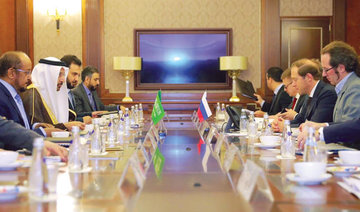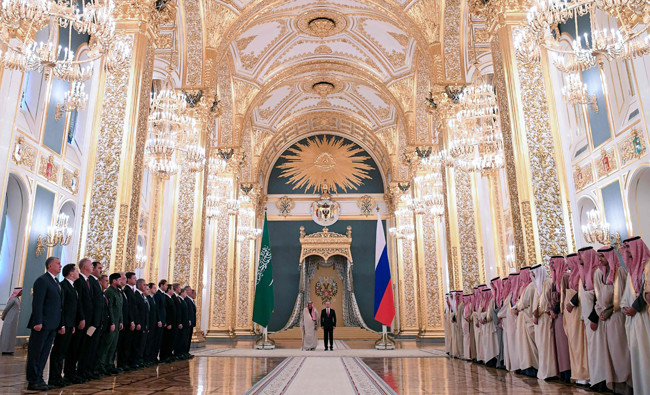
LONDON: King Salman and Russian President Vladimir Putin on Thursday agreed deals worth billions of dollars to strengthen energy, defense and business ties.
The meeting was described as a “landmark event” by President Putin as it was the first visit to Russia by a reigning Saudi Arabian monarch and was held despite differences between Riyadh and Moscow over the Syrian civil war.
But relations have been improving between the two nations with an energy pact forged last year when 24-oil exporting countries, including Saudi Arabia and Russia – the two largest oil exporting nations – agreed to cut output to halt the downward drift of the oil price. That agreement, to March 2018, could be extended, President Putin told reporters yesterday.
Following the meeting in the Russian capital, the two countries launched a joint energy investment fund worth $1 billion, while Saudi state oil firm Aramco penned preliminary agreements on oil refining with the Russian Direct Investment Fund (RDIF) and Russian resources group Sibur.
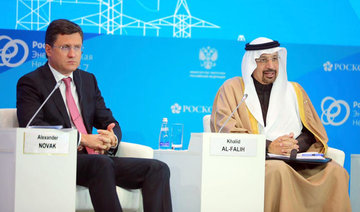
Additionally, Russia’s state atomic corporation Rosatom and the Saudi Energy Ministry signed a nuclear energy cooperation accord. Russian Energy Minister Aleksandr Novak said: “We have a vast potential for developing cooperation in nuclear power. Nuclear power may become one of the basic sources and an extra catalyst for the development of various industries and innovation technologies in Saudi Arabia,” he added.
Novak said the two countries’ business circles maintain intensive dialogue, and he pointed out that the Saudi delegation to Moscow included 85 chief executives of major Saudi companies.
Saudi Arabia and Russia have a joint interest in diversifying their economies away from oil as the price is still trading well below historic highs. Kirill Dmitriev, chief executive of RDIF said in an interview with CNBC the two countries “could join forces” and “solve some of the issues in Syria …we can solve lots of geopolitical issues by working together”.
Dmitriev also told CNBC the evolving relationship was about more than supporting the oil price. It was about cementing a wider business relationship. He said the two states would shortly unveil a Saudi investment in Russian toll roads, illustrating their joint interest in infrastructure projects. He also referred to a 2015 deal when the Public Investment Fund (PIF) agreed to invest $10 billion in Russia. “Around 95 percent” of planned projects [linked to that deal] related to “non-oil assets,” he said.
Putin said the agreement to cut oil production last year between OPEC and non-OPEC countries could be extended beyond March 2018 but an announcement was unlikely before the next OPEC meeting in Vienna at the end of November.
On defense, Saudi Arabia said it had signed a memorandum of understanding on the purchase of S-400 air defense systems from Russia’s state arms exporter.
Nabi Abullaev, associate director at Control Risks in London, said: “With trade between Russia and Iran being below $2 billion (compared to $40 billion with Turkey), Russia is interested in balancing Tehran politically and in exploring economic opportunities with Saudi Arabia, the largest global military spender (around 10 percent of the Saudi GDP goes to military expenditure),” he said.
Saudi Arabia’s Energy Minister Khalid Al-Falih said Russia had helped breathe new life into OPEC and that shale can be a major contributor to the market in years to come.
“We welcome the contributions of shale as demand approaches 100 million barrels (per day) next year and continues rising,” he said.
Speaking at a CNBC-moderated plenary session at Russia Energy week 2017, Al-Falih said predictions shale producers would bounce back at certain price points had proven incorrect.
He said: “We believe unreasonable expectations that shale will somehow spring up at certain prices and grow exponentially have been proven to be way unrealistic.”
The price of oil collapsed from near $120 a barrel in June 2014 due to weak demand, a strong dollar and booming US shale production.