Zimbabwe arrests journalist over report Grace Mugabe gave used underwear to supporters

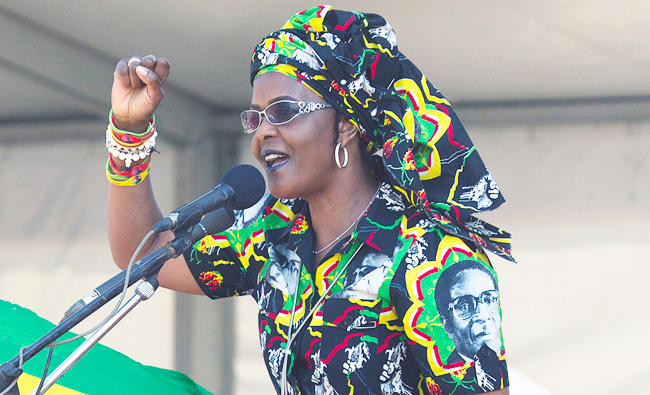
In this Sept. 1, file photo Zimbabwean first lady Grace Mugabe addresses party supporters at a rally in Gweru, Zimbabwe. (AP)
Updated 04 October 2017
Follow

Zimbabwe arrests journalist over report Grace Mugabe gave used underwear to supporters

HARARE: Zimbabwe police have arrested a journalist at a privately-owned daily over a story claiming that President Robert Mugabe’s wife, Grace had donated second-hand underwear to supporters, lawyers said Tuesday.
Zimbabwe Lawyers for Human Rights (ZLHR) said that Kenneth Nyangani, a NewsDay journalist, was arrested on Monday night “for allegedly writing and publishing a story over the donation of some used undergarments by First Lady Grace Mugabe.”
Nyangani was being detained in the eastern city of Mutare and is likely to face “criminal defamation” charges, the organization said in a statement. He is yet to appear in court.
The NewsDay on Monday reported that a ruling Zanu-PF lawmaker, Esau Mupfumi had over the weekend handed out clothes saying they were donated by Grace Mugabe.
“I met the First Lady Grace Mugabe and I was given these clothes so that I can give you. I have briefs for you and I am told that most of your briefs are not in good shape, please come and collect your allocations today,” the NewsDay quoted Mupfumi as saying.
“We have night dresses, sandals and clothes, come and take, this is from your First Lady Grace Mugabe.”
Zimbabwe’s worsening economic crisis has forced many people to resort to buying second-hand clothes which are more affordable.
The used clothes that include undergarments are mostly imported from Mozambique after being shipped from Western nations.
Zimbabwe once banned the sale of second-hand clothes in 2015 but later lifted the ban.
The southern African country is facing money shortages and high unemployment blamed on long ruling President Robert Mugabe economic policies.
Amnesty International has called for Nyangani’s unconditional release, saying his arrest aimed at harassing and intimidating journalists.
“The intention is to send a chilling message to journalists and media workers that they must self-censor rather than expose truths,” it said in a statement.


Foreign media group slams Israel for refusing to lift Gaza press ban

Updated 07 January 2026
Follow

Foreign media group slams Israel for refusing to lift Gaza press ban

  • Foreign Press Association expresses 'profound disappointment' with Israeli government’s response to a Supreme Court appeal
  • Israel has barred foreign journalists from independently entering the devastated territory since the war started

JERUSALEM: An international media association on Tuesday criticized the Israeli government for maintaining its ban on unrestricted media access to Gaza, calling the move disappointing.
The government had told the Supreme Court in a submission late Sunday that the ban should remain in place, citing security risks in the Gaza Strip.
The submission was in response to a petition filed by the Foreign Press Association (FPA) — which represents hundreds of journalists in Israel and Palestinian territories — seeking immediate and unrestricted access for foreign journalists to the Gaza Strip.
“The Foreign Press Association expresses its profound disappointment with the Israeli government’s latest response to our appeal for full and free access to the Gaza Strip,” the association said on Tuesday.
“Instead of presenting a plan for allowing journalists into Gaza independently and letting us work alongside our brave Palestinian colleagues, the government has decided once again to lock us out” despite the ceasefire in the territory, it added.
Since the outbreak of the Gaza war in October 2023, triggered by an attack on Israel by the Palestinian militant group Hamas, the government has barred foreign journalists from independently entering the devastated territory.
Instead, Israel has allowed only a limited number of reporters to enter Gaza on a case-by-case basis, embedded with its military inside the blockaded Palestinian territory.
The FPA filed its petition in 2024, after which the court granted the government several extensions to submit its response.
Last month, however, the court set January 4 as a final deadline for the government to present a plan for allowing media access to Gaza.
In its submission, the government maintained that the ban should remain in place.
“This is for security reasons, based on the position of the defense establishment, which maintains that a security risk associated with such entry still exists,” the government submission said.
The government also said that the search for the remains of the last hostage held in Gaza was ongoing, suggesting that allowing journalists in at this stage could hinder the operation.
The remains of Ran Gvili, whose body was taken to Gaza after he was killed during Hamas’s 2023 attack, have still not been recovered despite the ceasefire.
The FPA said it planned to submit a “robust response” to the court, and expressed hope the “judges will put an end to this charade.”
“The FPA is confident that the court will provide justice in light of the continuous infringement of the fundamental principles of freedom of speech, the public’s right to know and free press,” the association added.
The Supreme Court is expected to issue a ruling on the matter, though it is unclear when a decision will be handed down.
An AFP journalist sits on the board of the FPA.