RIYADH: As part of their pledge to ensure peace and security in the Middle East and the world at large, Saudi Arabia and Russia have set a course to build strong and pragmatic relations. King Salman’s visit to Russia, which begins on Thursday, will foster relations and establish a road map for collaboration, signaling yet another sea change in the ever-evolving global order.
In fact, Saudi-Russian relations are already at a high and cordial level, both in terms of shared interests and mutual understanding, despite differences over a few issues such as the Syrian conflict and the Iranian nuclear deal. But Riyadh and Moscow have renewed their commitment to narrow differences on such issues, as Riyadh moves ahead by adopting a more assertive line in its global and regional policy.
“The first ever official visit by a Saudi king to Moscow since the foundation of the Kingdom demonstrates that Riyadh is eager to keep a balance in its foreign policy and diversify its ties,” said Dr. Mona A. Almushait, a Shoura Council member.
“The Kingdom acknowledges the importance of Russia as a major global player, and its potential role in the region; and for Russia’s part, it is giving due importance to Riyadh’s political and strategic status in Russia-Arab relations.
“The Saudis see Russia in the role of a negotiator on all political issues including Syria and Yemen.”
While Saudi Arabia launched a military operation against Houthi rebels in Yemen, intensified support for Syrian rebels and cut diplomatic ties with Tehran, at the same time a visible trend in Saudi foreign policy was seen in its approach to Moscow. This was evident from the visit of Crown Prince Mohammed bin Salman to Russia in May, and the visit of Sergey Lavrov, the Russian foreign minister, to Riyadh last month.
Russia’s policy in the Middle East is multidimensional, and calls for building strategic relations with influential regional actors. Pursuing a partnership with Saudi Arabia is now a priority for the Russian Federation and its leadership, because the Kingdom is a leading country in the region, as well as in the international community.
Like Russia, the Kingdom is also a major player in the global oil market. Changes in the region and around the world, as well as the launch in April 2016 of the Saudi Vision 2030, open up new opportunities for the two countries. Both realize that the current status of political dialogue needs to be strengthened.
While the positions of Moscow and Riyadh on Egypt and Tunisia coincide, they differ over Syria, because they disagree on Iran’s policy. The June 2015 meeting between Russian President Vladimir Putin and Crown Prince Mohammed in St. Petersburg, and Putin’s meeting with King Salman in Antalya five months later, paved the way for more contacts and dialogue.
The two countries have similar positions on the resolution of the Middle East conflict based on the two-state solution. The convergence of Russian and Saudi positions was further promoted by Moscow’s decision to abstain from voting on Resolution 2216 on Yemen at the UN Security Council. Despite differences, Moscow and Riyadh are unanimous in their approach to stabilizing the situation in Lebanon and Iraq.
Russia is also well placed to talk to, or even mediate between, the Kingdom, Iran and Syria. For Saudi Arabia or even for the GCC and Arab League, Russia’s influence in Iran, Syria, Yemen, Turkey, and even Qatar, is a strategic asset. So Arabs, including Saudis, see Russia in the role of negotiator on all political issues.
As far as Egypt is concerned, the Kingdom and Russia welcomed the change of power in Egypt in 2013 and continue to support President Abdel Fattah El-Sisi. Egypt’s procurement of Russian weapons was possible thanks to Saudi financial assistance to Cairo. The Kingdom also seems to have appreciated Russia’s restrained position on the Yemen issue.
No doubt all these issues, including the Qatar crisis, will be on the agenda of the Russia-Saudi summit this week. Until now, Russia has not taken sides in the dispute between Qatar and other Arab states, and it has a recent history of cooperation with all sides of this conflict. As a result, Moscow can be an honest broker when it comes to intensifying efforts to resolve key regional conflicts, including Qatar.
Two years ago the two countries had virtually no dialogue on commercial issues, even energy. But now they have made a joint effort to push for further cutting oil production to help bring up global oil prices. Russia and Saudi Arabia are considering an OPEC deal extension and joint projects in the oil and petrochemical sector.
The Russia-Saudi summit is a milestone event to demonstrate that both countries are set for a much closer relationship. Russia and Saudi Arabia are showing the political will to foster bilateral economic ties, and their potential has yet to be fulfilled, Kremlin spokesman Dmitry Peskov said on Tuesday.
He said Russia had long-standing ties with Saudi Arabia, which Moscow valued. “There are very broad prospects, and the potential is far from being fulfilled. Now both sides are showing the political will to contribute to developing business contacts,” he said.
The issue of Iran was irrelevant, Peskov said. “Relations between Moscow and Riyadh are absolutely self-sufficient and in this case there is no need to draw any parallels, this is a separate vector of our foreign policy, given the important role of Saudi Arabia in the region and in the Arab world in general.
“Saudi Arabia is a country that plays a key role in Arab affairs. We in Russia seek to boost dialogue with Riyadh on various issues of common concern, including the current situation in the Middle East and in Syria in particular.”
The visit of King Salman at this critical time indicates that Russia has proved its presence in the Middle East and Moscow is giving due importance to Riyadh’s political and strategic status in Russia-Arab relations.


![]()
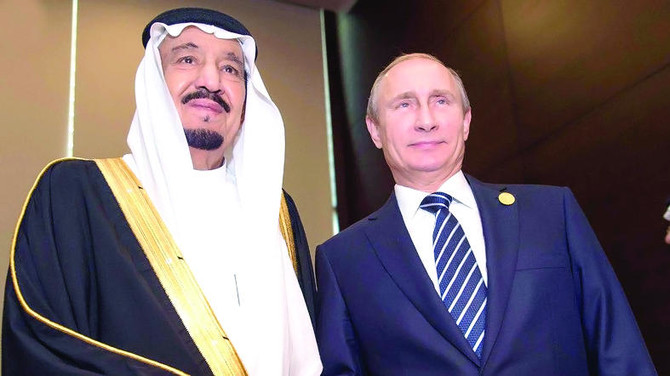
King Salman’s summit with Putin will set road map for new order
King Salman’s summit with Putin will set road map for new order


Latest updates


© 2026 SAUDI RESEARCH & PUBLISHING COMPANY, All Rights Reserved And subject to Terms of Use Agreement.