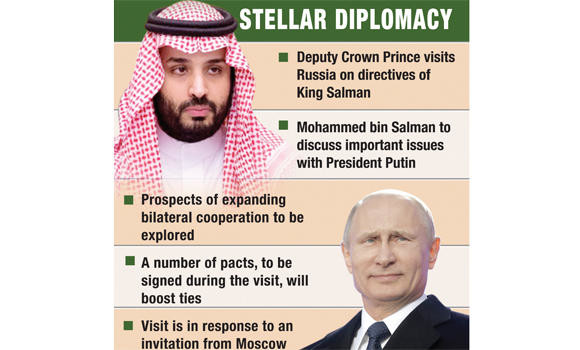
JEDDAH: Deputy Crown Prince Mohammed bin Salman, second deputy premier and minister of defense, will begin an official visit to Russia on Wednesday and hold talks with President Vladimir Putin, a Royal Court statement said.
Prince Mohammed’s landmark visit to Moscow comes on the directives of Custodian of the Two Holy Mosques King Salman, the statement said, adding that the minister would meet with a number of Russian officials to explore prospects of expanding cooperation between the two countries.
The royal visit will witness the signing of a number of agreements in various fields and will contribute to further bolstering relations between the two countries, an official statement said. The visit is in response to an invitation from the Russian government.
Prince Mohammed had held talks with Russian Ambassador to the Kingdom Oleg Ozerov on regional developments during the past two months.
Saudi-Russian relations began in 1926 when the Soviet Union recognized Saudi Arabia, thus becoming the first foreign country to recognize the Kingdom. In 1930 the Soviet Consulate was upgraded to an embassy.
High-level exchanges of visits played a big role in strengthening relations. King Faisal, the a prince representing the king, visited Soviet Union in 1932. King Abdullah’s visit to Russia in 2003 — when he was crown prince — took the Saudi-Russian ties to new heights as he met with President Putin.
During that visit the two countries signed agreements for expanding cooperation in energy, science and technology. King Abdullah also opened an exhibition of Saudi products in Moscow, organized by the Council of Saudi Chambers.
King Salman visited Russia in 2006 — when he was the governor of Riyadh — and the visit contributed to further strengthening ties. Prince Sultan visited the country in 2007 when he was the crown prince and defense minister. Prince Sultan received an honorary doctorate degree from the University of International Relations in Moscow. That visit also expanded trade and economic ties.

Saudi-Russia ties to touch new heights
Saudi Arabia’s Sharaan and Wadi Nakhlah nature reserves win Dark Sky recognition
- The two reserves in AlUla join more than 250 locations worldwide that are protected from light pollution
- AlUla Manara and AlGharameel Nature Reserve, also both in AlUla, received Dark Sky Park designations last year
ALULA: Two more nature reserves in Saudi Arabia’s AlUla have won recognition as Dark Sky Places, joining more than 250 locations worldwide that are protected from light pollution.
The official accreditation of Sharaan National Park and Wadi Nakhlah reserves from the DarkSky International builds on AlUla’s 2024 achievement, when AlUla Manara and AlGharameel Nature Reserve became the first sites in the Kingdom and the Gulf region to receive Dark Sky Park designations.
The latest recognition further strengthens AlUla’s position as a leading global destination for night sky protection and astronomical tourism, said the Royal Commission for AlUla (RCU) in a statement carried by the Saudi Press Agency (SPA).
Dark Sky International also announced the recognition in an earlier report, noting that the Sharaan and Wadi Nakhlah’s combined area of 6,146 square kilometers reflects the “expanded scope of environmental protection efforts aimed at preserving AlUla’s pristine night skies and reducing light pollution across a vast geographical area.”
DarkSky International works to reduce light pollution in both urban and rural areas and to raise global awareness of the importance of protecting the night sky.
AlUla’s protected areas are located in the heart of northwest Arabia, near the ancient oasis city of AlUla in Madinah Province.
“Towering sandstone cliffs, labyrinthine canyons, tranquil basins, and volcanic formations create a dramatic setting where geological diversity, cultural heritage, and thriving biodiversity converge beneath exceptionally dark, open skies,” Dark Sky said.
Scientists have noted that AlUla’s natural isolation from urban light sources, combined with ideal atmospheric conditions, makes it a world-class destination for stargazing, astronomy education, and immersive dark-sky experiences.
With the phased development of its reserves, AlUla is now ranked 3rd globally in the Dark Sky Park category, solidifying its status as one of the world’s premier destinations for astronomical discovery.
The RCU reaffirmed its commitment to protecting the natural environment, preserving the night sky, and promoting sustainable tourism, further positioning AlUla as a leading global destination for astronomy, scientific research, and advanced environmental experiences, in line with AlUla Vision and the Kingdom’s Vision 2030.