Iraqi sanctions will not punish Kurdish people, says Al-Abadi

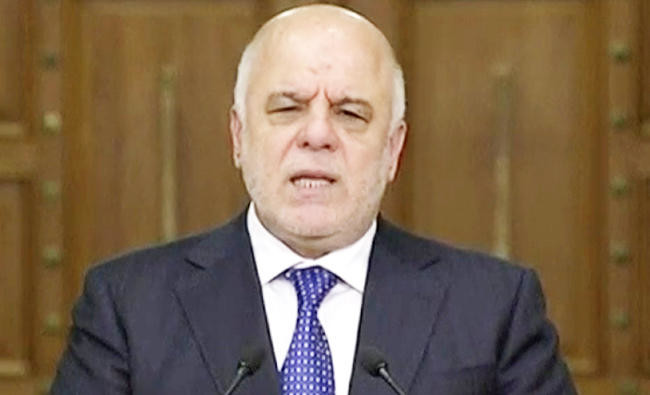
Iraqi Prime Minister Haider Al-Abadi. (REUTERS)
Updated 03 October 2017
Follow

Iraqi sanctions will not punish Kurdish people, says Al-Abadi

BAGHDAD: Amid fears in Iraqi Kurdistan that economic and financial sanctions imposed by Baghdad will hurt them soon, Iraqi Prime Minister Haider Al-Abadi said on Monday his government would not target or punish the Kurdish people.
Al-Abadi demanded that Kurdish leaders annul their independence referendum, commit fully to Iraq’s constitutional unity and cease provocations in areas they have “illegally seized.”
These are the conditions for talks with Irbil after last month’s controversial referendum in which more than 90 percent of voters in the Kurdistan Region of Iraq supported independent statehood, the prime minister’s spokesman said.
“They must deal with Baghdad as the federal authority that has federal power inside the region,” Ehssan Al-Shimiri, an adviser to the prime minister, told Arab News.
“Imposing the international flight ban was a message that federal authority applies in the region, and that the government has a right to take further measures against the Kurdish leaders.”
Baghdad says the referendum was illegal and unconstitutional, and imposed a ban on international flights to and from Irbil and Sulaymaniyah airports. Kurdish leaders insist the result of the referendum must be the basis for talks with the government.
Kurdish Regional Government (KRG) President Masoud Barazani and other Kurdish leaders arrived in Kirkuk on Monday to meet commanders of their peshmerga militia. The commanders included Kamal Kirkuki, Mustafa Chao Rish, Sierwan Barazani and Jaafar Shiekh Mustafa.
Kirkuk is an oil hub with a majority Kurdish population, but is not officially part of the Kurdistan Region, but Barzani said: “The identity of Kirkuk is Kurdish and the referendum was a tool to legitimize the decision of the people.”


Syrian government and SDF agree to de-escalate after Aleppo violence

Updated 37 min 40 sec ago
Follow

Syrian government and SDF agree to de-escalate after Aleppo violence

  • Turkiye views the US-backed SDF, which controls swathes of northeastern Syria, as a ⁠terrorist organization and has warned of military action if the group does not honor the agreement

DAMASCUS: Syrian government forces and the Kurdish-led Syrian Democratic Forces agreed to de-escalate on Monday evening in the northern city of Aleppo, after a wave of attacks that both sides blamed on each other left at least two civilians dead and several wounded.
Syria’s state news agency SANA, citing the defense ministry, said the army’s general command issued an order to stop targeting the SDF’s fire sources. The SDF said in a statement later that it had issued instructions to stop responding ‌to attacks ‌by Syrian government forces following de-escalation contacts.

HIGHLIGHTS

• SDF and Syrian government forces blame each other for Aleppo violence

• Turkiye threatens military action if SDF fails integration deadline

• Aleppo schools and offices closed on Tuesday following the violence

The Syrian health ministry ‌said ⁠two ​people ‌were killed and several were wounded in shelling by the SDF on residential neighborhoods in the city. The injuries included two children and two civil defense workers. The violence erupted hours after Turkish Foreign Minister Hakan Fidan said during a visit to Damascus that the SDF appeared to have no intention of honoring a commitment to integrate into the state’s armed forces by an agreed year-end deadline.
Turkiye views the US-backed SDF, which controls swathes of northeastern Syria, as a ⁠terrorist organization and has warned of military action if the group does not honor the agreement.
Integrating the SDF would ‌mend Syria’s deepest remaining fracture, but failing to do ‍so risks an armed clash that ‍could derail the country’s emergence from 14 years of war and potentially draw in Turkiye, ‍which has threatened an incursion against Kurdish fighters it views as terrorists.
Both sides have accused the other of stalling and acting in bad faith. The SDF is reluctant to give up autonomy it won as the main US ally during the war, which left it with control of Islamic ​State prisons and rich oil resources.
SANA, citing the defense ministry, reported earlier that the SDF had launched a sudden attack on security forces ⁠and the army in the Sheikh Maqsoud and Ashrafiyah neighborhoods of Aleppo, resulting in injuries.
The SDF denied this and said the attack was carried out by factions affiliated with the Syrian government. It said those factions were using tanks and artillery against residential neighborhoods in the city.
The defense ministry denied the SDF’s statements, saying the army was responding to sources of fire from Kurdish forces. “We’re hearing the sounds of artillery and mortar shells, and there is a heavy army presence in most areas of Aleppo,” an eyewitness in Aleppo told Reuters earlier on Monday. Another eyewitness said the sound of strikes had been very strong and described the situation as “terrifying.”
Aleppo’s governor announced a temporary suspension of attendance in all public and private schools ‌and universities on Tuesday, as well as government offices within the city center.