BAGHDAD: Iraqi Prime Minister Haider Al-Abadi demanded on Monday that Kurdish leaders annul their independence referendum, commit fully to Iraq’s constitutional unity and cease provocations in areas they have “illegally seized.”
These are the conditions for talks with Irbil after last month’s controversial referendum in which more than 90 percent of voters in Iraq Kurdistan supported independent statehood, the prime minister’s spokesman said.
“They must deal with Baghdad as the federal authority that has federal power inside the region,” Ehssan Al-Shimiri, an adviser to the prime minister, told Arab News.
“Imposing the international flight ban was a message that federal authority applies in the region, and that the government has a right to take further measures against the Kurdish leaders,” he said.
“These measures are aimed at isolating the secessionists and to take firm steps against any faction working to destabilize the situation,” Al-Shimiri said.
Baghdad says the referendum was illegal and unconstitutional, and imposed a ban on international flights to and from Irbil and Sulaymaniyah airports. Kurdish leaders insist the result of the referendum must be the basis for talks with the government.
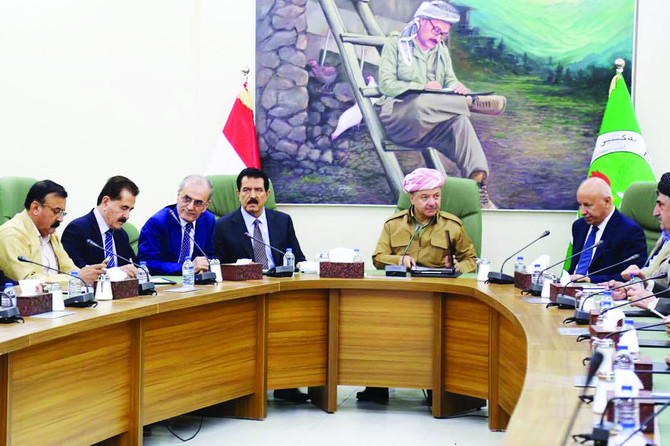
Kurdish Regional Government (KRG) President Masoud Barzani and other Kurdish leaders arrived in Kirkuk on Monday to meet commanders of their peshmerga militia. The commanders included Kamal Kirkuki, Mustafa Chao Rish, Sierwan Barzani and Jaafar Shiekh Mustafa.
Kirkuk is an oil hub with a majority Kurdish population, but is not officially part of the Kurdistan region, but Barzani said: “The identity of Kirkuk is Kurdish and the referendum was a tool to legitimize the decision of the people.”
Kurdistan has controlled the airports at Sulaymaniyah and Irbil since the US-led invasion toppled Saddam Hussein in 2003. It took over the Kirkuk oil wells in 2014, when the Iraqi Army fled in the face of an onslaught by Daesh militants. Since then, Iraqi Kurdistan has exported oil via a 970km-pipeline from Kirkuk to Ceyhan in Turkey. The KRG also controls border crossings into Turkey, Syria and Iran.
Despite the income from oil, from the two airports, and from the hundreds of trucks of food and construction materials that cross into the region from neighboring countries, the KRG has complained of a serious shortage of money, and government employees have been paid only 25 percent of their salaries for the past two years.
Federal officials told Arab News that Baghdad intends to take control of the income from oil, the airports and the border crossings to pay employees their full salaries.
“Baghdad has made deals with Iran and Turkey to create isolation zones in front of our border crossing points if Kurdistan refuses to hand over control to Baghdad,” said Fadi Al-Shimiri, a senior Iraqi political leader.
In response to the referendum result, there have also been joint military exercises involving Iran, Iraq and Turkey on their borders with Iraqi Kurdistan. Senior officials told Arab News that the three countries had set up a joint operations room to organize retaking control of the border crossings.
“The first batch of customs staff, and military units to protect them, have arrived at the border posts and will entirely control them,” Fadi Al-Shimiri said.
There are fears in Kurdistan that economic and financial sanctions imposed by Baghdad will hurt them soon, but Al-Abadi said his government would not target or punish the Kurdish people.
“All these measures aim to isolate the secessionists and take firm steps against any faction working to destabilize the situation,” his spokesman Al-Shimiri said.
“So far no decision has been taken to shut down the border crossing points. At the end of the day, neither the government nor the political parties in Baghdad are looking to besiege our people in Kurdistan.”


![]()
Iraq ramps up pressure on Kurds
Iraq ramps up pressure on Kurds

Latest updates





© 2026 SAUDI RESEARCH & PUBLISHING COMPANY, All Rights Reserved And subject to Terms of Use Agreement.