ISTANBUL: Turkey’s President Tayyip Erdogan said on Saturday Iraqi Kurdish authorities would pay the price for an independence referendum, which was widely opposed by foreign powers.
Iraq’s Kurds overwhelmingly backed independence in Monday’s referendum, defying neighboring countries which fear the vote could fuel Kurdish separatism within their own borders and lead to fresh conflict.
“They are not forming an independent state, they are opening a wound in the region to twist the knife in,” Erdogan told members of his ruling AK Party in the eastern Turkish city of Erzurum.
“To ignore this reality benefits neither us, nor our Kurdish brothers in Iraq,” he said, calling on Iraqi Kurds to “wake up from this dream” of independence.
Erdogan has built strong commercial ties with Kurdish authorities in northern Iraq, which pump hundreds of thousands of barrels of oil daily through Turkey for export to world markets.
“We don’t regret what we did in the past. But since the conditions are changed and the Kurdish Regional Government (KRG), to which we provided all support, took steps against us, it would pay the price,” he said.
Separately, Erdogan said that Israel’s Mossad intelligence agency played a role in the vote, proved by the waving of Israeli flags during celebrations of the overwhelming “yes’ vote.
During a televised speech, Erdogan claimed that Turkey had been saddened to see some Iraqi Kurds acclaiming the independence referendum with Israeli flags.
“This shows one thing, that this administration (in northern Iraq) has a history with Mossad, they are hand-in-hand together,” Erdogan said in Erzurum, in eastern Turkey.
Israel has been the only country to openly support an independent Kurdish state, with Prime Minister Benjamin Netanyahu backing “the legitimate efforts of the Kurdish people to attain a state of its own.”
Erdogan has derided the Israeli support.
“Are you aware of what you are doing?” Erdogan said in an appeal to Iraqi Kurdish leaders. “Only Israel supports you.”
Ankara has threatened a series of measures to punish Iraqi Kurds, including shutting the land border between Turkey and the region and halting the transit of oil from Iraqi Kurdistan to the southern Turkish port of Ceyhan, an economic lifeline.
On Friday, the Turkish carriers Turkish Airlines, Atlas and Pegasus suspended their flights to Iraqi Kurdistan for an unspecified period of time.
Ankara had previously refused to engage in official contacts with Iraqi Kurds, fearing that any actions that could encourage the creation of an independent Kurdish state could embolden its own Kurds.
But as Turkey’s economy has boomed, Erdogan has moved to forge trade ties with Iraq’s Kurdistan region, helping make Iraq the second-largest market for Turkish exports last year, after Germany.
The Iraqi Kurdish leader Masoud Barzani has also become a frequent visitor to Turkey.
Business sources quoted in Turkish media have warned that the closure of the Habur border gate could harm $7 billion of trade between Ankara and Irbil.
Turkey has repeatedly threatened to impose economic sanction, effectively cutting their main access to international markets, and has held joint military exercises with Iraqi troops on the border.
However, after Erdogan said that Iraqi Kurds would go hungry if Ankara halted the cross-border flow of trucks and oil, it has said that any measures it took would not target civilians and instead focus on those who organized the referendum.
Iraq’s Defense Ministry said on Friday it plans to take control of the borders of the autonomous Kurdistan region in coordination with Iran and Turkey.
Turkish Prime Minister Bin Yildirim, speaking on Saturday, did not refer specifically to those plans, but said Ankara would no longer deal with Kurdish authorities in Irbil.
“From now on, our relationships with the region will be conducted with the central government, Baghdad,” he said. “As Iran, Iraq and Turkey, we work to ensure the games being played in the region will fail.”


![]()
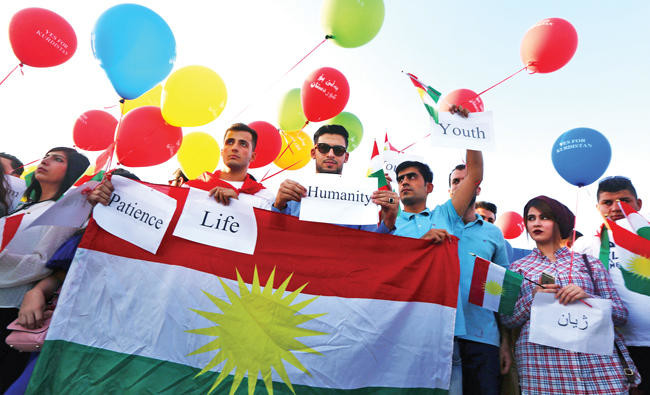
Erdogan sees Israel’s hand in Iraqi Kurdistan vote
Erdogan sees Israel’s hand in Iraqi Kurdistan vote
Latest updates


Recommended


© 2026 SAUDI RESEARCH & PUBLISHING COMPANY, All Rights Reserved And subject to Terms of Use Agreement.