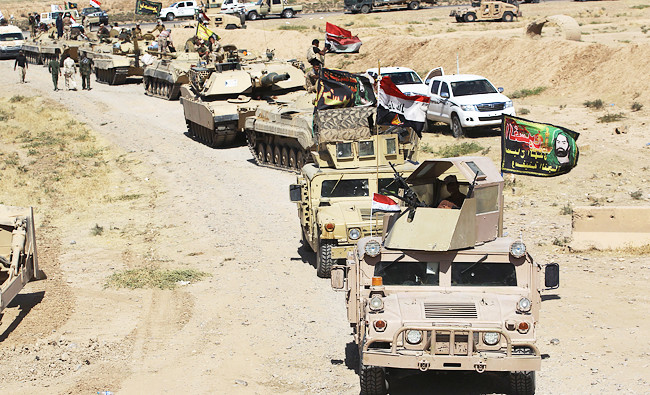
SULAIMANIYAH: Iranian and Iraqi forces staged joint military exercises on Monday near the border with Iraq’s autonomous Kurdistan region, a Kurdish official said, following tensions over the Kurds’ independence vote.
Iraqi Kurds voted 92.7 percent in favor of independence on Sept. 25 in a non-binding referendum held in defiance of the central government, which quickly retaliated.
Following the vote, Iraq, Iran and Turkey — which all have sizeable Kurdish minorities — took measures to isolate Iraqi Kurdistan, including suspending international flights to and from its two main airports.
The measures included Iran announcing an indefinite ban on the transport of oil and energy products to and from Iraqi Kurdistan.
An Iranian official said Monday that some 600 full fuel tankers were now blocked by Iranian customs from crossing the border.
“Iraqi and Iranian units began exercises at 11:00 a.m. (08:00 GMT) with tanks and infantry only 250 meters from the border,” said Shwan Abu Bakr, the Kurdish customs chief at the Bashmakh border post.
“Iraqi forces are dressed in black and there is a large number of Iranian forces,” he said, the black uniforms indicating that the Iraqi forces were from the country’s elite Counter Terrorism Service.
The Iranian military on its website announced joint military exercises with units of the Iraqi army involving armor and artillery units as well as drones and other air units.
An Iranian military official had announced on Saturday that the joint exercise would be staged in response to the referendum.
Baghdad declared the ballot illegal and suspended flights in retaliation.
Turkey and Iran, which fear the vote will embolden their own sizeable Kurdish minorities, also threatened action against the Iraqi Kurds.
On Saturday, Iranian armed forces spokesman Masoud Jazayeri said the exercises would be held “in the coming days along the shared border.”
The decision to carry out the exercises followed a high-level meeting of Iranian commanders where “the territorial integrity and unity of Iraq and the illegitimacy of the independence referendum in northern Iraq were stressed again,” he said.
Iraqi soldiers last week also took part in a Turkish military drill close to the Iraqi frontier.
The referendum was held in the three provinces of Iraqi Kurdistan and in several disputed areas under Kurdish control.
Iraqi authorities have demanded that Kurdish forces withdraw from disputed areas and that Kurdish authorities hand over control of the region’s airports and border posts.
The Iraqi government on Monday demanded that the Kurdish authorities stop “provocations” in disputed territories.
Prime Minister Haider Al-Abadi’s office insisted that the Kurdistan region halt movements of its peshmerga security forces and return Baghdad’s control over areas Irbil claimed after a 2014 advance by Daesh.
“The region must stop the escalation and provocation in areas seized by it,” spokesman Saad Al-Hadithi said in a statement.
Al-Hadithi said that Kurdish forces had declared they would remain in several disputed areas and were continuing movements in Nineveh province that were meant to be “temporary.”
“These movements have to cease,” he said.
Officially comprising Irbil, Dohuk and Sulaimaniyah provinces, Iraqi Kurdistan also claims other territory including oil-rich Kirkuk province — a dispute that is a major source of contention with Baghdad.
Hadithi demanded that Irbil “cancel the results of the referendum” and “engage in serious dialogue to strengthen the unity of Iraq.”


![]()
Iran, Iraq hold exercises near border with Kurdistan
Iran, Iraq hold exercises near border with Kurdistan

Latest updates


© 2026 SAUDI RESEARCH & PUBLISHING COMPANY, All Rights Reserved And subject to Terms of Use Agreement.