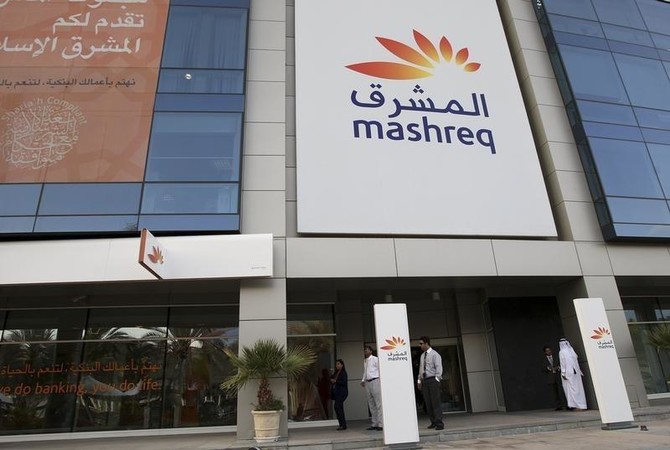
Mashreq to cut branches as it shifts toward digital banking

Mashreq has 44 branches in the UAE.
Updated 03 October 2017
Follow

Mashreq to cut branches as it shifts toward digital banking

DUBAI: Dubai’s Mashreq Bank, the emirate’s third largest lender by assets, plans to halve the number of its branches over the next three years as it shifts its focus toward digital banking services, its CEO told Reuters on Sunday.
The downsizing will translate into a reduction of 15 to 20 percent of the bank’s staff in retail services, including employees working at branches and also back office personnel, said Abdul Aziz Al Ghurair, without giving precise numbers.
Mashreq has 44 branches in the UAE, and a retail presence in other countries in the region including Egypt, Qatar, Kuwait and Bahrain, according to its website.
It has more than 4,000 employees.
Banks in the UAE have faced headwinds as lower oil prices over the past three years have reduced loan growth and led to an increase in debt defaults.
Al Ghurair predicted earlier this year net profit growth for the bank of around 5 percent in 2017, with the corporate sector leading the growth but retail sector growth sluggish.
The bank’s transition to digital services means “branches will take a different shape, and they may reduce in size,” said Al Ghurair.
The executive was speaking to Reuters at a Mashreq event promoting the launch of a new digital banking platform.
“There will be a shift toward digital marketing and digital selling. How do you access your customers, that’s going to be interesting and dramatically different than what we have seen in the past,” said Al Ghurair.
The bank will have to reduce staff across retail in general, but it will have to hire more people for its digital marketing and banking team. The number of new hires for digital services, however, will not be as big as the losses from the bank’s retail business, said the CEO.


India and US release a framework for an interim trade agreement to reduce Trump tariffs

Updated 58 min 25 sec ago
Follow

India and US release a framework for an interim trade agreement to reduce Trump tariffs

  • Under the deal, tariffs on goods from India would be lowered to 18 percent, from 25 percent, after Indian Prime Minister Narendra Modi agreed to stop buying Russian oil, Trump had said.

NEW DELHI: India and the United States released a framework for an interim trade agreement to lower tariffs on Indian goods, which Indian opposition accused of favoring Washington.
The joint statement, released Friday, came after US President Donald Trump announced his plan last week to reduce import tariffs on the South Asian country, six months after imposing steep taxes to press New Delhi to cut its reliance on cheap Russian crude.
Under the deal, tariffs on goods from India would be lowered to 18 percent, from 25 percent, after Indian Prime Minister Narendra Modi agreed to stop buying Russian oil, Trump had said.
The two countries called the agreement “reciprocal and mutually beneficial” and expressed commitment to work toward a broader trade deal that “will include additional market access commitments and support more resilient supply chains.” The framework said that more negotiations will be needed to formalize the agreement.
India would also “eliminate or reduce tariffs” on all US industrial goods and a wide range of food and agricultural products, Friday’s statement said.
The US president had said that India would start to reduce its import taxes on US goods to zero and buy $500 billion worth of American products over five years, part of the Trump administration’s bid to seek greater market access and zero tariffs on almost all American exports.
Trump also signed an executive order on Friday to revoke a separate 25 percent tariff on Indian goods he imposed last year.
Indian Prime Minister Narendra Modi thanked Trump “for his personal commitment to robust ties.”
“This framework reflects the growing depth, trust and dynamism of our partnership,” Modi said on social media, adding it will “further deepen investment and technology partnerships between us.”
India’s opposition political parties have largely criticized the deal, saying it heavily favors the US and negatively impacts sensitive sectors such as agriculture. In the past, New Delhi had opposed tariffs on sectors such as agriculture and dairy, which employ the bulk of the country’s population.
Meanwhile, Piyush Goyal, Indian Trade Minister, said the deal protects “sensitive agricultural and dairy products” including maize, wheat, rice, ethanol, tobacco, and some vegetables.
“This (agreement) will open a $30 trillion market for Indian exporters,” Goyal said in a social media post, referring to the US annual GDP. He said the increase in exports was likely to create hundreds of thousands of new job opportunities.
Goyal also said tariffs will go down to zero on a wide range of Indian goods exported to the US, including generic pharmaceuticals, gems and diamonds, and aircraft parts, further enhancing the country’s export competitiveness.
India and the European Union recently reached a free trade agreement that could affect as many as 2 billion people after nearly two decades of negotiations. That deal would enable free trade on almost all goods between the EU’s 27 members and India, covering everything from textiles to medicines, and bringing down high import taxes for European wine and cars.
India also signed a comprehensive economic partnership agreement with Oman in December and concluded talks for a free trade deal with New Zealand.