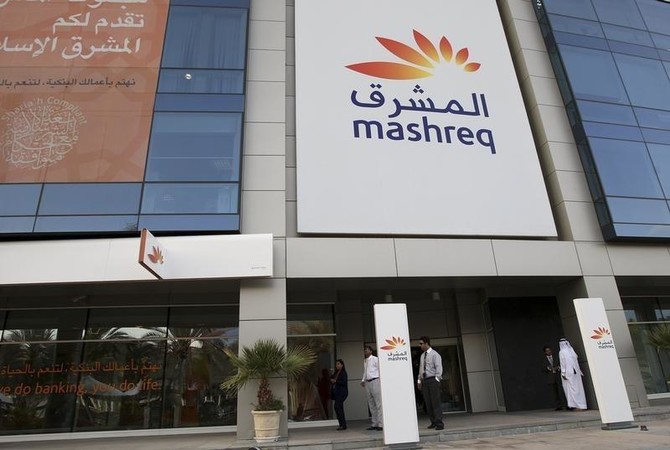
DUBAI: Dubai’s Mashreq Bank, the emirate’s third largest lender by assets, plans to halve the number of its branches over the next three years as it shifts its focus toward digital banking services, its CEO told Reuters on Sunday.
The downsizing will translate into a reduction of 15 to 20 percent of the bank’s staff in retail services, including employees working at branches and also back office personnel, said Abdul Aziz Al Ghurair, without giving precise numbers.
Mashreq has 44 branches in the UAE, and a retail presence in other countries in the region including Egypt, Qatar, Kuwait and Bahrain, according to its website.
It has more than 4,000 employees.
Banks in the UAE have faced headwinds as lower oil prices over the past three years have reduced loan growth and led to an increase in debt defaults.
Al Ghurair predicted earlier this year net profit growth for the bank of around 5 percent in 2017, with the corporate sector leading the growth but retail sector growth sluggish.
The bank’s transition to digital services means “branches will take a different shape, and they may reduce in size,” said Al Ghurair.
The executive was speaking to Reuters at a Mashreq event promoting the launch of a new digital banking platform.
“There will be a shift toward digital marketing and digital selling. How do you access your customers, that’s going to be interesting and dramatically different than what we have seen in the past,” said Al Ghurair.
The bank will have to reduce staff across retail in general, but it will have to hire more people for its digital marketing and banking team. The number of new hires for digital services, however, will not be as big as the losses from the bank’s retail business, said the CEO.

Mashreq to cut branches as it shifts toward digital banking
Saudi Aramco raises $4bn in bond sale as investor demand holds strong
RIYADH: Saudi Aramco raised $4 billion through a multi-tranche bond sale, extending its run of international debt offerings as the world’s largest oil exporter taps strong investor appetite for Gulf investment-grade debt.
The notes were issued under the company’s Global Medium Term Note Program and priced on Jan. 26, Aramco said in a statement. The bonds are listed on the London Stock Exchange and span maturities from 2029 to 2056.
This comes as Aramco remains an active borrower in global markets, having raised $5 billion through a bond sale in June and a further $3 billion via an international sukuk in September, after completing a $6 billion bond deal and a $3 billion sukuk offering in 2024.
The latest transaction underscores the company’s ability to secure long-dated financing at competitive rates as it balances expansion spending with shareholder returns.
Ziad Al-Murshed, Aramco’s executive vice president and chief financial officer, said: “This issuance is part of Aramco’s focused strategy to further optimize its capital structure and enhance shareholder value creation.”
He added: “The attractive pricing achieved on the transaction reflects global investors’ continued confidence in Aramco’s financial strength and resilient balance sheet. We remain firmly committed to maintaining disciplined capital management and delivering long-term value to our shareholders.”
The notes include a $500 million tranche due in 2029 with a 4 percent coupon and a $1.5 billion tranche due in 2031 at 4.37 percent.
They also comprise a $1.25 billion tranche due in 2036 at 5 percent, alongside a $750 million 30-year tranche maturing in 2056 with a 6 percent coupon.
A key indicator of the transaction’s success and Aramco’s robust credit standing was the achievement of negative new issue premiums on three of the four tranches, the statement said.
The proceeds are expected to support the company’s ongoing capital expenditure programs, which include investments in both upstream oil and gas capacity and downstream chemical projects, as well as its strategic initiatives in new energy sectors.
The transaction highlights Aramco’s ability to leverage its superior credit profile to secure cost-effective financing, aligning its capital structure optimization with its broader ambition of sustainable value creation for its shareholders.